Sunday, April 30, 2006
Bush Reserves Right To Disobey More Than 750 Laws
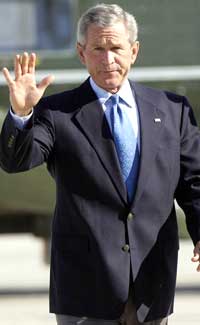
It is no secret that President Bush holds an expansive view of the powers of the presidency.
But the extent of his flagrant disregard for the nation's laws has never been cataloged to the extent that today's Boston Globe has managed to do.
President Bush has quietly claimed the authority to disobey more than 750 laws enacted since he took office, asserting that he has the power to set aside any statute passed by Congress when it conflicts with his interpretation of the Constitution.
Among the laws Bush said he can ignore are military rules and regulations, affirmative-action provisions, requirements that Congress be told about immigration services problems, "whistle-blower" protections for nuclear regulatory officials, and safeguards against political interference in federally funded research.
Legal scholars say the scope and aggression of Bush's assertions that he can bypass laws represent a concerted effort to expand his power at the expense of Congress, upsetting the balance between the branches of government. The Constitution is clear in assigning to Congress the power to write the laws and to the president a duty "to take care that the laws be faithfully executed." Bush, however, has repeatedly declared that he does not need to "execute" a law he believes is unconstitutional.
The genesis of Bush's power-grab lies in the post-Watergate experiences of Cheney and Rumsfeld in the Ford administration. These two chafed at the scrutiny of the White House by Congress and the Court, and vowed to push back against these institutions if they ever got the chance.
Far more than any predecessor, Bush has been aggressive about declaring his right to ignore vast swaths of laws -- many of which he says infringe on power he believes the Constitution assigns to him alone as the head of the executive branch or the commander in chief of the military.
Many legal scholars say they believe that Bush's theory about his own powers goes too far and that he is seizing for himself some of the law-making role of Congress and the Constitution-interpreting role of the courts...Bush is the first president in modern history who has never vetoed a bill, giving Congress no chance to override his judgments. Instead, he has signed every bill that reached his desk, often inviting the legislation's sponsors to signing ceremonies at which he lavishes praise upon their work.
Then, after the media and the lawmakers have left the White House, Bush quietly files "signing statements" -- official documents in which a president lays out his legal interpretation of a bill for the federal bureaucracy to follow when implementing the new law. The statements are recorded in the federal register.
In his signing statements, Bush has repeatedly asserted that the Constitution gives him the right to ignore numerous sections of the bills -- sometimes including provisions that were the subject of negotiations with Congress in order to get lawmakers to pass the bill. He has appended such statements to more than one of every 10 bills he has signed...
But it was not until the mid-1980s, midway through the tenure of President Reagan, that it became common for the president to issue signing statements. The change came about after then-Attorney General Edwin Meese decided that signing statements could be used to increase the power of the president.
Under Meese's direction in 1986, a young Justice Department lawyer named Samuel A. Alito Jr. wrote a strategy memo about signing statements. It came to light in late 2005, after Bush named Alito to the Supreme Court.
On at least four occasions while Bush has been president, Congress has passed laws forbidding US troops from engaging in combat in Colombia, where the US military is advising the government in its struggle against narcotics-funded Marxist rebels.
After signing each bill, Bush declared in his signing statement that he did not have to obey any of the Colombia restrictions because he is commander in chief...
"This is an attempt by the president to have the final word on his own constitutional powers, which eliminates the checks and balances that keep the country a democracy," Bruce Fein, a deputy attorney general in the Reagan administration said. "There is no way for an independent judiciary to check his assertions of power, and Congress isn't doing it, either. So this is moving us toward an unlimited executive power."
Bush has engineered a situation in which we get the worst combination possible.
A tilting of the balance of powers dramatically to the benefit of the most sociopathic Chief Executive we have had since Andrew Jackson.


Saturday, April 29, 2006
Report: Rove Close To Indictment
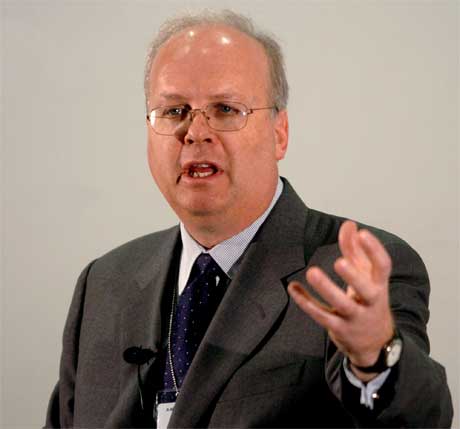
A new report by Jason Leopold in Truthout says that Plamegate Special Prosecutor Patrick J. Fitzgerald is preparing to ask the grand jury to vote on a list of charges against Karl Rove.
Despite vehement denials by his attorney who said this week that Karl Rove is neither a "target" nor in danger of being indicted in the CIA leak case, the special counsel leading the investigation has already written up charges against Rove, and a grand jury is expected to vote on whether to indict the Deputy White House Chief of Staff sometime next week, sources knowledgeable about the probe said Friday afternoon...
Luskin was informed via a target letter that Fitzgerald is prepared to charge Rove for perjury and lying to investigators during Rove's appearances before the grand jury in 2004 and in interviews with investigators in 2003 when he was asked how and when he discovered that Valerie Plame Wilson worked for the CIA, and whether he shared that information with the media...
In the event that an indictment is handed up by the grand jury it would be filed under seal. A press release would then be issued by Fitzgerald's press office indicating that the special prosecutor will hold a news conference, likely on a Friday afternoon, sources close to the case said. The media would be given more than 24 hours notice of a press conference, sources added...
In recent weeks, sources close to the case said, Fitzgerald's staff has met with Rove's legal team several times to discuss a change in Rove's status in the case--from subject to target--based on numerous inconsistencies in Rove's testimony, whether he discussed Plame Wilson with reporters before her name and CIA status were published in newspaper reports, and whether he participated in a smear campaign against her husband...
As of Friday afternoon, sources close to the case said, it appeared likely that charges of obstruction of justice would be added to the prepared list of charges...
Rove has been questioned by FBI investigators and grand jurors on ten different occasions since October 2003. The time he has spent under oath exceeds 20 hours, sources said, adding that he answered a wide-range of questions about intelligence the White House used to win support for the Iraq war.
Rove made a horrendous mistake by agreeing to talk to the FBI in the first place.
In over 20 hours of questioning, he is certain to have tried to lie or otherwise mislead the investigators.
That's the reason guilty people are advised never to speak with law enforcement. The crook may think that he can talk his way out of trouble, but 99% of the time, the suspect ends up incriminating himself.
Criminal Probe Of Ex-FDA Head Crawford
A federal criminal investigation in underway against a briefly serving head of the FDA under the Bush administration, according to the New York Times.
Dr. Lester M. Crawford, the former commissioner of food and drugs, is under criminal investigation by a federal grand jury over accusations of financial improprieties and false statements to Congress, his lawyer said Friday.
The lawyer, Barbara Van Gelder, would not discuss the accusations further. In a court hearing held by telephone on Thursday, she told a federal magistrate that she would instruct Dr. Crawford to invoke his Fifth Amendment right against compelled self-incrimination if ordered to answer questions this week about his actions as head of the Food and Drug Administration, according to a transcript of the hearing...
Dr. Crawford resigned in September, fewer than three months after the Senate confirmed him. He said then that it was time for someone else to lead the agency.
The next month, financial disclosure forms released by the Department of Health and Human Services showed that in 2004 either Dr. Crawford or his wife, Catherine, had sold shares in companies regulated by the agency when he was its deputy commissioner and acting commissioner...
The criminal investigation was disclosed at a court hearing in a lawsuit over the F.D.A.'s actions on the emergency contraceptive Plan B, a subject of bitter contention during Dr. Crawford's tenure as acting commissioner and commissioner. After the pill's maker, Barr Laboratories, applied three years ago to sell the pill over the counter, the agency repeatedly delayed making a decision on the application.
While many lawmakers, abortion rights advocates and former F.D.A. officials said the delays had resulted from politics, Dr. Crawford and other agency officials said their concerns were scientific and legal...
Before Dr. Crawford's confirmation, the secretary of health and human services, Michael O. Leavitt, promised that the F.D.A. would act on the Plan B application by September 2005, a promise that led two Democratic senators, Hillary Rodham Clinton of New York and Patty Murray of Washington, to relent in their efforts to delay the nomination. But after he was confirmed, Dr. Crawford announced an indefinite delay that has remained in effect.
The speculation in Washington has been that President Bush nominated Dr. Crawford in order to obstruct the approval of Plan B.
Things Looking Bad For Rep. Ney
The Jack Abramoff lobbying scandal is readying to claim another scalp.
The Washington Post reports that federal prosecutors are expanding the range of charges being contemplated against a congressman who has previously been linked to the scandal.
Federal prosecutors signaled this week that they have decided to pursue a wide range of allegations about dealings between Rep. Robert W. Ney (R-Ohio) and lobbyist Jack Abramoff, rather than bringing a narrowly focused bribery case against the congressman...
Court papers filed in recent months show that prosecutors have lined up at least four cooperating witnesses against the Ohio congressman: Abramoff, former congressional aides Michael Scanlon and Tony C. Rudy, and businessman Adam Kidan. All have pleaded guilty to various conspiracy, fraud or public corruption charges.
The court filings that accompanied the plea agreements of Abramoff, Scanlon and Rudy accused Ney of accepting "a stream of things of value" in exchange for official actions.
Ney had first been fingered as providing political cover for Abramoff and an associate in a dodgy cruise ship purchase, which later featured a gangland-style hit on the seller.
Ney was also involved with Abramoff and his lobbying team on other issues under federal investigation. In 2002, Ney sponsored legislation at the team's request to reopen a casino for a Texas Indian tribe that Abramoff represented, and approved a 2002 license for an Abramoff client to wire the House of Representatives for mobile phone service.
At the same time, Ney accepted many favors from Abramoff, among them campaign contributions, dinners at the lobbyist's downtown restaurant, skybox fundraisers -- including one at his then-MCI Center box the month after Boulis's murder -- and a lavish golf junket to Scotland in August 2002.
Ney was directly implicated by three of the four who pleaded guilty to conspiracy and bribery charges: Abramoff, Scanlon and Rudy. Kidan's attorney said his client also would testify against Ney if asked.
There is all sorts of debate about what effect a possible indictment of Ney will have upon his chances for re-election in the Fall midterms:
Democrats acknowledge privately that the only way they can win in this Republican-leaning district, which President Bush carried with 57 percent in 2004, is for the election to be a referendum on Ney. He has vowed to remain in the race even if he is indicted.
Unless Ney does something rash--like withdraw from the race--he is almost assured of victory.
One must not forget that we are dealing with Ohio here, the posterboy for electronic voting technology.
Friday, April 28, 2006
What's Eating Donald Rumsfeld?
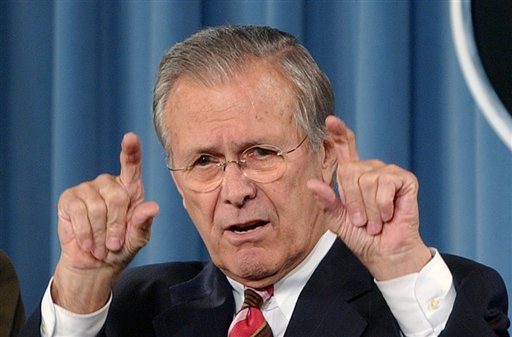
Secretary of Defense Donald Rumsfeld has been acting like more of a pissant than usual, as shown by his performance on his most recent trip to Iraq this week.
Contrasted by the willed insincerity of Secretary of State Condoleezza Rice--who met Rumsfeld in Baghdad--the Defense Secretary didn't even try to force himself to appear dignified.
Even though her arrival here followed an exhausting sprint through Greece and Turkey, Rice appeared energized by the task at hand. Rumsfeld arrived directly from Washington -- after a recent Asian tour -- but he seemed disengaged and bored, both to reporters traveling with him and to some U.S. officials. Some said he seemed irritated by the whole exercise. He did not speak a word to reporters with him on the flight to Baghdad.
During a joint meeting with reporters traveling with the secretaries, Rumsfeld frequently doodled with a black felt-tip pen or stared absent-mindedly at the ceiling when Rice spoke. Rice would occasionally cast a nervous glance at Rumsfeld as he prepared to respond to a question. His answers were terse; hers were expansive...
Rice courted the news media, racing through five television interviews in 17 minutes. Rumsfeld gave no separate interviews. At one point, he arrived early for a meeting and saw an array of television cameras inside the room. He shook his head at the reporters and turned on his heel.
There will be speculation in the parlors of the nation's capital about what may be the matter with Rumsfeld.
Some will say it is the strain of being the architect of the disasterous Iraq folly.
Others will proffer the opinion that he may be concerned about our upcoming war with Iran.
And the remainder of observers may venture to guess that Rumsfeld could be finding himself ensnared in a heretofore unknown scandal or illegal program of this boundary-stretching administration.
Gas Price Posturing

The lawmakers in Washington are doing their best to convince the public that they are concerned about high gasoline prices.
Their best, however, is sometimes somewhat lacking:
The Republican House leadership, hopping aboard the new anti-oil-addiction campaign, staged a fine media event yesterday at a BP gas station at Ninth Street and Pennsylvania Avenue SE that featured a hydrogen-powered car.
House Speaker J. Dennis Hastert (Ill.), along with other top House Republicans, was photographed in and around the snappy blue General Motors HydroGen 3 van.
The event followed one by Senate Democrats on Wednesday, who rode in their gas guzzlers to an Exxon station a block from their offices to blame Republicans for high fuel prices.
Hastert, who appeared to have walked to the station, left in the very fuel-efficient vehicle, apparently headed for his office. But he went only a block or so before he got out and stepped into his pre-positioned gas-guzzling armored SUV to take him back to his office. Alert photographers, suspecting a ploy, had followed the speaker and captured the bait-and-switch.
Hastert's security detail is getting the official blame for his vehicle-hopping, but sources are saying that there were fears that Hastert's super-sized frame might have been too much for the energy efficient vehicle, even on the nine-block ride back to the Capitol.
IAEA Report To Be Released Today

Iranian President Mahmoud Ahmadinejad--often criticized for his inflammatory statements--proved today to have a better handle than most on the facts of the manufactured crisis over Iran's nuclear program.
"Enemies think they can make the Iranians give up their honorable path through propaganda, false publicity, political threats and imposition of sanctions," he said, according to the IRNA news agency. "Iran is a nuclear country. This slogan that nuclear energy is our inalienable right is the outcry of the people and a national demand."
Iran's U.N. ambassador pointed to the fact that nations have the right under international law to pursue nuclear energy programs, and then referred to the Security Council effort to crack down on the Islamic republic:
Javad Zarif, the Iranian ambassador to the United Nations, told reporters in New York that Iran would consider illegitimate any Council resolution calling on Iran to stop uranium enrichment that invoked the so-called Chapter 7 clause, which could open the door to penalties and possibly to military action...
"If the Security Council decides to take decisions that are not within its competence, Iran is not obliged to obey them," Mr. Zarif said, speaking to reporters at the residence of the Iranian Mission to the United Nations in Manhattan...
He also sought to portray Iran's defiant stance as nothing more than a logical response to American threats against Iran"We're not upping the ante," he said. "We're simply responding to others upping the ante."
"We hope the relevant parties can keep calm and exercise restraint to avoid moves that would further escalate the situation," Chinese Foreign Ministry spokesman Qin Gang said.
Russian President Vladimir Putin reiterated Russia's position in support of the nonproliferation of weapons of mass destruction and Iran's right to develop nuclear energy for power generation.
"Iran must have an opportunity to develop modern technologies and peaceful nuclear energy," Putin said Thursday.
As the U.S. Secretary of Defense would quaintly put it, China and Russia are being "unhelpful."
Despite a formal request from the U.N. Security Council, Iran has not provided international inspectors with new information about the country's nuclear program and has accelerated, rather than curbed, uranium-enrichment activities, according to sources familiar with a report the inspectors plan to issue today.
The Iranian program, in any case, appears from the report not to be progressing as successfully as they would probably hope:
Iran announced two weeks ago that it had used a "cascade" -- or array -- of 164 centrifuges to enrich uranium for nuclear fuel. Inspectors from the International Atomic Energy Agency are expected to confirm in the report that Iran ran the cascade successfully, but several officials with knowledge of the nuclear program said yesterday that the cascade was no longer operating and that a number of the networked centrifuges had crashed during a fairly rushed process.
The evidence--much like the proof of the Iraqi WMD program--is not as clear cut as the U.S. is warning the world about:
Inspectors, on their third year of an investigation, have not found proof of a weapons program, but Iran is not fully cooperating and questions remain.
Questions remained about the Iraqi weapons of mass destruction until months after the U.S. invasion.
In other words, no proof is going to be necessary this time either.
Thursday, April 27, 2006
Lobbying Reform Watered Down

The lobbying reform issue--as of now-- looks close to dead. The voters across the nation seem not to care.
The scandal surrounding disgraced lobbyist Jack Abramoff has been a Washington obsession for months, but Republican lawmakers who returned from a two-week recess this week said they felt free to pass a relatively tepid ethics bill because their constituents rarely mention the issue.
The House is scheduled to vote today on ethics legislation to increase lobbyists' disclosures and require lawmakers to own up to the earmarks, or narrow projects, that they insert into appropriations bills. But the measure would not restrict the gifts or meals provided by lobbyists as House Speaker J. Dennis Hastert (R-Ill.) had proposed in January, nor would it expand the number of enforcers of lobbying rules and laws.
Lawmakers acknowledge that the bill is more limited in its scope and impact than the provisions promised by congressional leaders immediately after Abramoff's guilty plea to federal charges of bribery, conspiracy, tax evasion and mail fraud nearly four months ago. But they say they do not feel compelled to push more stringent measures partly because voters do not appear to be demanding them...
Today, the House plans to vote on a bill that would require lobbyists to file quarterly instead of semiannual disclosures and to include in those reports the donations they give to federal candidates and political action committees. Lobbyists would also have to make public the amount of any gift that they give to lawmakers or congressional aides. In addition, appropriations bills would have to list any earmarks that they contain, as well as the sponsors of those projects. Ethics training would become mandatory in the House under the legislation.
Government watchdog groups have complained that the legislation would not change much about how lawmakers and lobbyists interact. "It's a reform bill in name only, and they're hoping no one will notice," said Melanie Sloan, executive director of Citizens for Responsibility and Ethics in Washington...
The issue of the "culture of corruption" surrounding lawmakers' dealings with lobbyists, may however, come back to life if the right conditions present themselves:
Some lawmakers and political analysts believe that voters could punish incumbents during the November elections if Congress passes a minimalist ethics bill. The chances of such a backlash could rise, these critics say, if there are more indictments or guilty pleas later this year. Abramoff and two former aides to Rep. Tom DeLay (R-Tex.) are cooperating with federal authorities in a wide-ranging investigation of political favors done in return for gifts, trips, payments and campaign contributions. DeLay, a once-powerful House majority leader, is fighting a criminal indictment in Texas on charges of political money laundering.
Some congressional historians assert that GOP leaders would be taking a risk in assuming that the lobbying bill is of such low voter priority that they could push through a modest plan without paying a political cost. "When you combine [the ethics issue] with the general dissatisfaction with the way in which we are governed," said L. Sandy Maisel, a professor of government at Colby College, "I think the breaking point might be near."
There are always predictions about "breaking points" or "tipping points" being close at hand on various issues. The predictions are usually wrong.
Real "breaking points" emerge out of the blue, having only been predicted by the most marginalized and ignored voices.
Iran Supreme Leader Warns Of Reprisals If Attacked

The Iranian leadership is certainly doing their part in keeping to the timetable of the drama we are watching by enabling--with carefully chosen words--circumstances favorable to a precipitating event dramatic enough to keep the audience enthralled at the end of the first act.
Iran's supreme religious leader vowed Wednesday that Iran would retaliate "twofold" if it were attacked by the United States over its refusal to comply with demands regarding its nuclear activities. He made his comments as other senior Iranians traveled to Vienna just days ahead of the deadline for international monitors to report on Iran's nuclear program.
"Iranian people and the Islamic regime will not invade any country, but the Americans should know that if they invade Iran, their interests around the world would be harmed," the supreme leader, Ayatollah Ali Khamenei, told workers gathered ahead of May Day, the international workers' holiday, the ISNA news agency reported.
"Iran will respond twofold to any attack," Ayatollah Khamenei said.
In escalating rhetoric, a number of Iranian officials have made similar threats in recent days, but the Bush administration has insisted it is pursuing a diplomatic path, even while vaguely holding open the distant option of imposing sanctions or taking military action if diplomacy fails.
For military action being a "distant option", today's Washington Post provides details of a specific nature:
Two main options are under consideration, say people familiar with Air Force thinking. The first would be a quick series of strikes against several dozen nuclear-related facilities, lasting only a few days and followed by a U.S. statement that the bombing would resume if Iran retaliated.
The second option envisions a lengthier, more ambitious campaign of waves of strikes by bombers and cruise missiles aimed at hundreds of targets, hitting not just nuclear-related facilities but also the headquarters of intelligence agencies, the Revolutionary Guard and other key government offices.
Many experts worry that Iran, dominated by Shiite Muslims, would retaliate against U.S. and British forces in neighboring Iraq by mobilizing Iraqi Shiites. It might also attack U.S. and British installations in Saudi Arabia and Bahrain through the help of Shiites in those countries. In other scenarios, Iranian agents would stage terrorist strikes against civilians in the United States, Europe and elsewhere.
During Cold War-era war gaming exercises, nations were officially considered to be "rational actors". This made predicting military moves and counter-moves possible.
The "experts" of the type quoted above are making their forecasts of likely Iranian reprisals based on Iran being a "rational actor." And, all evidence of recent Iranian statements aside, they actually fit the description.
It is the United States that, in the face of worldwide condemnation of the Iraq fiasco--by contemplating starting another war in a larger and more populated Muslim country--does not fit the definition of a "rational actor."
Reclassification Update

We have been following the story of the reclassification of declassified government documents that had been publicly available at the National Archives.
It turns out, as some suspected, that many of these documents should have been left declassified.
An audit by the National Archives of more than 25,000 historical documents withdrawn from public access since 1999 found that more than a third did not contain sensitive information justifying classification, archives officials announced Wednesday.
They said the removal of the remaining two-thirds was technically justified, though many had already been published or contained old secrets with little practical import.
Even withdrawing those documents that included truly significant secrets may have done more harm than good by calling new attention to the sensitivity of records that researchers had read and photocopied for years, the officials said.
And there have been many more documents recalled than previously announced.
The audit found that 25,315 documents were withdrawn from public access, far more than the 9,000 they estimated in February, and that 64 percent met the minimal criteria for classification. The Air Force was responsible for the largest share--17,702--followed by the C.I.A., the Department of Energy, the Federal Emergency Management Agency and the presidential libraries, which are part of the National Archives system.
As for the perplexing reason why all these documents--some fossilized by age--were reclassified, one of my intrepid correspondents nailed the answer from the beginning.
It was a version of the old "hide a needle in a haystack" strategem:
Auditors also found that the CIA withdrew a "considerable number" of records it knew should be unclassified "in order to obfuscate" other records it was trying to protect.
Abramoff Must Not Have Imagined Going To Prison

This wealthy prick made a living out of taking advantage of people, he also apparently did it for kicks.
Lobbyist Jack Abramoff gained renown in Washington for both his big fees and his big spending, but that didn't mean he couldn't look for a bargain.
On Aug. 21, 2002, he sent an e-mail to his friend David H. Safavian, chief of staff at the General Services Administration. "I have a need to buy a stretch limo for the restaurant," Abramoff wrote, referring to Signatures, the downtown establishment he owned. "Are there any coming up on any of the GSA drug property sales?"
Safavian, according to the documents recently filed by Justice Department prosecutors at U.S. District Court, wrote back that the GSA does not auction off seized cars. But he added that he was ready to help: "Let me call a friend at the Marshall's Service. They handle drug seizures."
Abramoff replied: "I was thinking of the druggies bounty. No problem. Thanks, see you Friday."
Soon the sock tucking Abramoff will be rooming with many of these "druggies", from whom he was so eager to benefit from the theft of their property.
I'm sure Abramoff will be dreading the day that this story makes the rounds of his cell block.
Wednesday, April 26, 2006
Oil Price "Investigation" Bullshittery

The bullshittery from the administration never fails to amaze.
The idea the White House is going to initiate a probe of Big Oil is preposterous. They may bust some individual gas station owners for profiteering, but nothing onerous will be forced upon the administration's friends.
President Bush yesterday called for price-fixing investigations and several measures aimed at holding down the fast-rising costs of driving.
Amid growing Republican unrest about the politics of $3-plus gasoline, Bush told the Renewable Fuels Association he will take the unusual step of suspending shipments to the nation's Strategic Petroleum Reserve to boost supply and help hold down oil prices. The president also said he will temporarily ease environmental regulations that require the use of cleaner-burning fuel additives to cut down on summertime pollution.
Still, according to industry experts and administration officials, Bush's efforts at best are likely to shave a few cents per gallon off the cost of gasoline.
The GOP is proving unwilling to do anything to help the gasoline-buying public. In fact they are actively fighting moves to increase taxes on oil company profits.
While Republican leaders sharply criticize soaring gasoline prices and energy industry profits, GOP negotiators have decided to knock out provisions in a major tax bill that would force the oil companies to pay billions of dollars more in taxes on their profits...
The biggest of the (three Senate provisions that would boost federal taxes on the oil industry) would change accounting rules that apply to oil in storage. Currently, oil companies are allowed to calculate the taxable value of their inventories based on the value of the oldest stocks, when oil may have been worth $30 a barrel. But much of the inventory may have been pumped from the ground when oil was selling for more than double that. Critics say that understates the value of the companies' oil supplies purely to lower their tax payments.
Another would prevent oil companies from deducting from their U.S. taxes the royalties paid to foreign governments.
The third, which would repeal the provision in last year's energy law allowing companies to write off in two years the cost of geological exploration, received new life after Bush's speech, Senate tax aides said.
The oil industry itself is planning to fight back at any governmental restrictions (not that there will be any) by increasing their lobbying footprint.
The oil industry is preparing a new, multimillion-dollar lobbying and educational campaign in response to growing political pressures brought on by rising gas prices, oil lobbyists said.
The American Petroleum Institute (API), the industry'’s main trade group, plans a yearlong grassroots lobbying push that could cost in excess of $30 million to explain how the industry works and what has caused pump prices to jump.
The simple deflection of blame by pointing to a lunatic war of choice in the Middle-East has been considered and rejected by Big Oil as unsportsmanlike.
Tuesday, April 25, 2006
Ohio Churches Involved In Political Campaign

Apparently it is okay for churches to involve themselves in partisan politics--in violation of IRS rules--as long as it is in behalf of Republicans.
In a challenge to the ethics of conservative Ohio religious leaders and the fairness of the Internal Revenue Service, a group of 56 clergy members contends that two churches have gone too far in supporting a Republican candidate for governor.
Two complaints filed with the tax agency say that the large Columbus area churches, active in President Bush's narrow Ohio win in 2004, violated their tax-exempt status by pushing the candidacy of J. Kenneth Blackwell, who is the secretary of state and the favored candidate of Ohio's religious right...
IRS rules specify that charities that are granted a tax exemption because they serve the public may not "participate in or intervene in . . . any political campaign on behalf of (or in opposition to) any candidate for public office."
Enforcement does not infringe on First Amendment rights to free speech, the Supreme Court has ruled, because the issue is not whether an organization's members can speak freely, but whether the government will subsidize its activities through a tax exemption...
(T)he targets of the tax complaint -- World Harvest Church and Fairfield Christian Church -- attribute the filing to philosophical disagreements and partisan politics. One spokesman called it "a campaign of harassment" before the May 2 primary.
No, this is harassment:
The Columbus complainants point to IRS investigations of a liberal California church ... in asking whether the tax agency is being sufficiently aggressive in the Ohio case.
In Pasadena, Calif., the IRS is examining the tax-exempt status of All Saints Church because its former pastor delivered a sermon that criticized Bush on the Iraq war and Republican conservatives on social policy two days before the 2004 election.
The IRS claims it enforces the rules on political activity by churches equally, without regard to party involved.
It just looks like there is favoritism.
Curtain Getting Ready To Fall On First Act of Iran Drama

The manufactured crisis between the West and the Islamic Republic of Iran is heading into the end of the 30 day period which the UN Security Council gave the Ahmadinejad government to answer questions about it's nuclear programs.
Today brings attention to a second "secret" Iranian nuclear program that some are claiming has dangerous capabilities.
Iran has told the International Atomic Energy Agency that it will refuse to answer questions about a second, secret uranium-enrichment program, according to European and American diplomats. The existence of the program was disclosed by President Mahmoud Ahmadinejad earlier this month.
The diplomats said Iran had also refused to answer questions about other elements of its nuclear program that international inspectors had focused on because they could indicate a program to produce nuclear weapons. The diplomats insisted on not being identified because of the delicacy of continuing negotiations between Iran and the West.
The New York Times succinctly gives the main point:
Together, the actions seem to show Iran's determination to move ahead with a confrontation with the West when the United Nations Security Council meets, probably next week, to debate its next steps.
A non-biased observer might point out that it is the West which is pressing for the "confrontation" on the issue of the Iranian nuclear program.
Iran's decision not to answer the I.A.E.A.'s questions was conveyed last week to Dr. Mohamed ElBaradei, the director general of the nuclear monitoring agency. He is required to send a report on Iran to the Council by Friday.
As a result, the diplomats said, Dr. ElBaradei decided to cancel a trip to Iran by top officials of the agency that had been scheduled for late last week, a trip intended to resolve as many of the questions as possible before the report is submitted...
R. Nicholas Burns, the under secretary of state for political affairs, said Monday evening, "We are very confident that the report is going to be negative concerning Iran's refusal to meet the conditions set down by the United Nations Security Council and the I.A.E.A." He added that Iran was in "outright violation" of the Council request.
Dangerous "new" technology is behind the latest alarm over the Iranian nuclear program:
Some of the most important questions concerned an advanced technology, the P-2 centrifuge, for enriching uranium. International inspectors believe that Iran obtained designs for the P-2 from the Pakistani nuclear engineer Abdul Qadeer Khan in the 1990's.
Iran long denied that it was doing anything with the technology, until Mr. Ahmadinejad declared 10 days ago that the country was "presently conducting research" on the P-2, which he said could increase fourfold the amount of uranium the country is able to enrich.
Mr. Ahmadinejad's statement took the inspectors and American officials by surprise. But they seized on his boasts about Iran's programs to press the question of whether the country has a separate set of nuclear facilities, apart from the giant enrichment center at Natanz, that it has not previously revealed...
Dr. ElBaradei's inspectors were pressing other issues as well, many related to suspicions that Iran has been researching or developing ways to produce warheads or delivery systems for weapons--which Iran has denied. So far, Iran has answered few questions about a document in Tehran, apparently obtained from the Khan network, that shows how to form uranium metal into two spheres. Metal in that form can be used to create a basic nuclear device.
I.A.E.A. reports show there are also questions about plutonium enrichment, and a secret entity known as the Green Salt Project, which seemed to suggest that there were what the agency has called "administrative interconnections" between Iran's uranium processing, high explosives and missile design programs.
All of the UN theatrics are leading toward the inevitable plot development strong enough to end the first act:
If Iran continues to refuse to answer the questions, it could bolster the American argument that the Security Council should take action under Article 7 of the United Nations Charter, which could pave the way for sanctions. Secretary of State Condoleezza Rice, speaking in Shannon, Ireland, said Monday that the credibility of the Council would be in doubt if it does not take clear-cut actions against Iran.
As soon as the question is decided of whether UN sanctions will be enacted, the curtain will fall on the first act of the play we are watching.
Act two is where things will really start getting interesting.
Monday, April 24, 2006
"Emergency" Supplemental Funding Of War Criticized

The use of "emergency" supplemental funding measures to fund the war in Iraq is coming under increased criticism by politicians of both parties.
The Bush administration, with Congress's cooperation, has insisted on paying for the Iraq war through supplemental spending bills. The funding is not included in the president's annual budgets or, in most cases, in the congressional budget resolutions, and it is considered separately from the regular appropriations bills. The money is not counted in the budget deficit estimates that the administration routinely releases. Nor is it counted against any budget caps that Congress has set for itself to abide by throughout the year...
(I)f Congress and the White House actually put the Iraq war properly on the federal books, other budget priorities -- not to mention local pork projects -- would feel the squeeze. That explains why, particularly in an election year, the game is likely to continue...
For his part, Senate Budget Committee Chairman Judd Gregg, R-N.H., fumed in a March interview with National Journal: "The administration is running two sets of books here.... There are two sets of books, and one is not subject to the budget controls."
Another abuse that is enabled by the use of supplementals--the insertion of pork barrel projects--is coming under fire. From a perhaps unlikely direction.
The White House and Senate Republican leaders are gearing up to oppose a $106.5 billion spending bill for the war in Iraq and Hurricane Katrina this week because some lawmakers have added unrelated aid for farmers and fisheries, highways and ports...
Senators have added projects large and small because they know money for wars and hurricane relief will run low and have to be replenished--which makes this a must-pass bill.Among the projects:
- $700 million to relocate a freight railroad line from a section of Mississippi's Gulf Coast that developers want for casinos.
- $600 million for highways in states from Alabama to Alaska affected by natural disasters, some as long as seven years ago.
- $23 million for flood control in Sacramento and Hawaii.
- $20 million to help New England shellfishers recover from last year's toxic red tide.
- $15 million to help promote the sale of Gulf Coast seafood.
"Anything that isn't nailed down, they pick up and take home to their districts," says Steve Ellis of Taxpayers for Common Sense, one of several budget watchdog groups opposing the measure...
"They're extorting extra funding under the theory that (Bush) will never veto it," says Brian Riedl, a budget expert at the conservative Heritage Foundation. Bush has yet to cast his first veto.
The administration is so opposed to the pork projects this time around because it could cut into monies that could be better put to use by their friends in the defense industry.
Sunday, April 23, 2006
The Oversized Influence Of The OVP
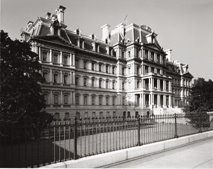
The American Prospect looks at the shadowy Office of the Vice President (OVP), which has been the behind the scenes driver of the most odious policies of the Bush administration.
More often than not, from policy toward China and North Korea to the invasion of Iraq to pressure for regime change in Iran and Syria, and on issues from detentions to torture to spying by the National Security Agency, the muscle of the vice president's office has prevailed.
Usually, that muscle is exercised covertly. Last February, for example, after Hamas won the Palestinian elections, King Abdullah of Jordan visited Washington to discuss the implications of the vote. With the support of some officials in the State Department, the young king suggested that Washington should bolster beleaguered President Mahmoud Abbas, the Fatah leader, to counter the new power of Hamas.
Then John Hannah intervened. A former official at the Washington Institute for Near East Policy (WINEP), a pro-Zionist think tank founded by the American-Israel Public Affairs Committee, Hannah is a neoconservative ideologue who, after the resignation of Irving Lewis "Scooter" Libby, moved up to become Vice President Dick Cheney's top adviser on national security.
Hannah moved instantly to undermine Abdullah's influence. Not only should the United States not deal with Hamas, but Abbas, Fatah, and the entire Palestinian Authority were no longer relevant, he argued, according to intelligence insiders. Speaking for the vice president's office, Hannah instead sought to align U.S. policy with the go-it-alone strategy of Israel's hard-liners, including Prime Minister Ehud Olmert and his stricken patron and predecessor, Ariel Sharon. Olmert soon stunned observers by declaring that Israel would unilaterally set final borders in the West Bank, annexing large swaths of occupied land, by the year 2010. His declaration precisely mirrored Hannah's argument that Israel should act alone...
Hannah's intervention is typical of how the OVP staff has engaged at all levels of the U.S. policy-making process to overcome opposition from professionals in the State Department, the intelligence community, and even the National Security Council (NSC) itself...
For the Cheneyites, Middle East policy is tied to China, and in their view China's appetite for oil makes it a strategic competitor to the United States in the Persian Gulf region. Thus, they regard the control of the Gulf as a zero-sum game. They believe that the invasion of Afghanistan, the U.S. military buildup in Central Asia, the invasion of Iraq, and the expansion of the U.S. military presence in the Gulf states have combined to check China's role in the region. In particular, the toppling of Saddam Hussein and the creation of a pro-American regime in Baghdad was, for at least 10 years before 2003, a top neoconservative goal, one that united both the anti-China crowd and far-right supporters of Israel's Likud. Both saw the invasion of Iraq as the prelude to an assault on neighboring Iran.
In an acknowledgement that there are believers in the "Steady State Chaos" strategy of intervention--articulated by M1 on SMC, there is an interesting factoid about OVP official David Wurmser:
(I)n a series of papers and a book, Wurmser argued that toppling Saddam was likely to lead directly to civil war and the breakup of Iraq, but he supported the policy anyway: "The residual unity of [Iraq] is an illusion projected by the extreme repression of the state." After Saddam, Iraq will "be ripped apart by the politics of warlords, tribes, clans, sects, and key families," he wrote. "Underneath facades of unity enforced by state repression, [Iraq's] politics is defined primarily by tribalism, sectarianism, and gang/clan-like competition." Yet Wurmser explicitly urged the United States and Israel to "expedite" such a collapse. "The issue here is whether the West and Israel can construct a strategy for limiting and expediting the chaotic collapse that will ensue in order to move on to the task of creating a better circumstance."
The American Prospect article is full of unflattering anecdotes about members of the OVP, most of whom are unknown to the general public. These functionaries know that they have an oversized influence in decision making in this administration, and are not hesitant to throw their weight around.
Saturday, April 22, 2006
Hastert, Frist Demand Probe Of Gasoline Prices

Who would have thought that starting a war in the Middle East would result in higher oil prices?
Apparently not the leadership of the GOP.
Congressional leaders yesterday planned to ask President Bush to order investigations into possible price gouging by oil companies as crude oil prices hit new highs on world markets and average gasoline prices in the nation's capital blew through the $3-a-gallon mark.
House Speaker J. Dennis Hastert (R-Ill.) and Senate Majority Leader Bill Frist (R-Tenn.) are preparing to send a letter to the president Monday asking him to direct the Federal Trade Commission and Justice Department to investigate alleged price gouging and instruct the Environmental Protection Agency to issue waivers that might make it easier for oil refiners to produce adequate gasoline supplies, Hastert spokesman Ron Bonjean said.
Hastert and Frist's letter comes amid charges by some consumer groups and Democrats that oil companies have manipulated refineries and oil inventories to drive up prices. Hastert also took aim at the rich pay package for Exxon Mobil Corp.'s retired chief executive, which he called "unconscionable."
Hastert and Frist (and the other Republicans) don't want the gasoline price issue to cost them in the midterms.
However, they supported an ill-conceived military adventure in an economically vital region.
The chickens will have to come home to roost sooner or later. The Fall elections sound like just the right time.
Friday, April 21, 2006
Attempts To Scuttle Ex-AIPAC Employees Prosecution
The attempt by some in Washington to scuttle the espionage prosecution of former American Israel Public Affairs Committee employees Steven J. Rosen and Keith Weissman continues today with a Washington Post article arguing that these men did nothing that journalists, lobbyists, think tankers, et al., do every day.
As if this is somehow exculpatory.
The Post gathers a blue-ribbon cast of establishment types to defend the former Israel lobby employees:
Martin S. Indyk, a former ambassador to Israel says "(Rosen's) job was to trade in information. That was his great skill. He's essentially on trial for doing his job well."
Defense lawyers make similar points and have enlisted a surprising ally: Viet D. Dinh, former head of the Justice Department's Office of Legal Policy and an author of the Bush administration's USA Patriot Act. Dinh helped write a memorandum that called for the dismissal of the Espionage Act charges against the lobbyists. The memo said that in the 90 years since the act was drafted, "there have been no reported prosecutions of persons outside government for repeating information that they obtained verbally."
The memo also said that in receiving leaked classified information and relaying it to others, the lobbyists were doing what journalists, think-tank scholars and congressional staff members "do perhaps hundreds of times every day."
People speed on the nation's highways many thousands of times a day, that doesn't mean that the relatively few people who are caught and ticketed can beat the rap by using this defense.
Rosen was known in Washington for his then-novel approach to lobbying:
At AIPAC, Rosen helped pioneer executive-branch lobbying, a style of advocacy that was not widespread when he began it in the mid-1980s, but is now a routine complement to the more traditional lobbying of Congress. Before Rosen, AIPAC had believed that the way to alter American foreign policy was to get senators to sign a letter. His insight was that he could also affect the process by dealing with the staff-level bureaucrats in the executive branch who originated the policies.
He was certainly right about that. He clearly was no dummy.
As AIPAC's director of foreign policy issues, he headed a 10-person department that provided the $47 million-a-year, 200-employee organization with analyses about the Middle East. To stay on the cutting edge, he aggressively swapped information and gossip with academics, journalists and employees of the Israeli government and of the State Department, the Pentagon and the White House.
Rosen did not lobby the governments' highest-ranking officials. He concentrated instead on the workaday policy-development aides and left to other AIPAC officials dealings with the likes of the secretary of state. "He was very good at what he did," said Dennis Ross, the Middle East point man for Presidents George H.W. Bush and Bill Clinton. "He was a smart guy. He knew the issues extremely well. He was knowledgeable about Israel and what Israel's concerns would be."
The full-court press to defend Rosen and Weissman is quite illustrative when considered in light of the Mearsheimer/Walt thesis about the influence of the Israel lobby on American foreign policy and the mainstream media.
Thursday, April 20, 2006
DSM Authors On Mood and Psychotic Disorders All On Big Pharma Payroll

Here's a case of medical political skullduggery:
Every psychiatric expert involved in writing the standard diagnostic criteria for disorders such as depression and schizophrenia has had financial ties to drug companies that sell medications for those illnesses, a new analysis has found...
"I don't think the public is aware of how egregious the financial ties are in the field of psychiatry," said Lisa Cosgrove, a clinical psychologist at the University of Massachusetts in Boston, who is publishing her analysis today in the peer-reviewed journal Psychotherapy and Psychosomatics...
Cosgrove said she began her research after discovering that five of six panel members studying whether certain premenstrual problems are a psychiatric disorder had ties to Eli Lilly & Co., which was seeking to market its drug Prozac to treat those symptoms. The process of defining such disorders is far from scientific, Cosgrove added: "You would be dismayed at how political the process can be."...
Darrel Regier, director of the association's division of research, said that concerns over disclosure are a relatively recent phenomenon, which may be why the last edition, published in 1994, did not note them. Regier and John Kane, an expert on schizophrenia who worked on the last edition, agreed with the need for transparency but said financial ties with industry should not undermine public confidence in the conclusions of its experts. Kane has been a consultant to drug companies including Abbott Laboratories, Eli Lilly, Janssen and Pfizer Inc...
The DSM defines disorders in terms of constellations of symptoms. While neuroscience and genetics are revealing biological aspects to many disorders, there has been unease that psychiatry is ignoring social, psychological and cultural factors in its pursuit of biological explanations and treatments.
"As a profession, we have allowed the biopsychosocial model to become the bio-bio-bio model," Steven Sharfstein, president of the American Psychiatric Association, said in an essay last year to his colleagues. He later added, "If we are seen as mere pill pushers and employees of the pharmaceutical industry, our credibility as a profession is compromised."
Aldous Huxley (Brave New World) saw this coming.
I wonder what Tom Cruise and his ilk would have to say about this revelation.
Not Plamegate Related, They Say

Although the administration is denying it, rumor has it that yesterday's "re-shuffling" of responsibilities in the White House may be connected to an imminent development in the "Plamegate" investigation.
Publicly however, the reason for the shake-up is to restore confidence in the administration leading up to Fall mid-term elections.
President Bush's new chief of staff accelerated his election-year White House shake-up yesterday as Deputy Chief of Staff Karl Rove surrendered the policy management duties he assumed last year and press secretary Scott McClellan resigned as the public face of an administration under fire...
(T)he changes made public so far mainly have moved around figures who have been inside the Bush orbit for years, and White House officials made clear yesterday that no major shifts in policy are envisioned. With midterm congressional elections looming, strategists said the main goal was to make public gestures that would restore faith in Bush's ability to lead...
"They needed to have the optics that there's going to be a change -- a message-delivery change and a different approach to policy, particularly domestic policy," the Republican said. "That's all it is. There's not going to be any change in policy. It gets Washington talking about different things."
Looks like McClellan didn't want to have to face the press in the event of a Rove indictment.
With endless patience, McClellan has absorbed months of battering at daily briefings over the president's second-term problems. Although he never expressed it publicly, McClellan's colleagues said he was frustrated that his credibility had been questioned after he relayed Rove's assertion in 2003 that Bush's top adviser had nothing to do with the leak of a CIA operative's identity -- a claim later discredited by grand jury testimony.
Bush publicly declared following his re-election that he had received enough political capital to enact the Republican Party's dream legislation. Now it appears that expectations have faded along with the President's poll numbers.
Longtime Bush confidant Karl Rove -- who had hoped to use his position of deputy chief of staff to usher in an expansive conservative agenda -- was relieved of his policy portfolio to concentrate on long-term strategy and planning for a November midterm election that looks increasingly bleak for Republicans...
Despite his power, Rove has not been immune to criticism. Inside the White House, some aides were unhappy that he had sent McClellan out to say inaccurately that Rove had no involvement in the CIA leak case. Outside allies feared that Rove was so invested in the policies he had helped to shape and sell to Bush that he lost his ability to see where the administration had gotten off track.
It is no coincidence that major moves involving both Rove and McClellan occurred on the same day. Something big is afoot.
Wednesday, April 19, 2006
Contracting Skullduggery in Occupied Iraq

Sometime a business environment is just too ripe with opportunity for abuse.
An American businessman who is at the heart of one of the biggest corruption cases to emerge from the reconstruction of Iraq has pleaded guilty to conspiracy, bribery and money-laundering charges, according to documents unsealed yesterday in federal court in Washington.
As part of the plea, Philip H. Bloom admitted his part in a scheme to give more than $2 million in cash and gifts to U.S. officials in exchange for their help in getting reconstruction contracts for his companies. Bloom's firms won $8.6 million in reconstruction deals, with an average profit margin of more than 25 percent...
According to Bloom's plea agreement, which was signed in February, he faces up to 40 years in prison, five years of supervised release and a fine of $750,000. He also must repay the government $3.6 million and forfeit $3.6 million in assets.
John N. Nassikas, Bloom's attorney, said that his client is cooperating with investigators and that he hopes to have Bloom's prison sentence reduced.
Bloom's cooperation may provide investigators with further insight into a case that highlights how some were able to exploit the chaotic, freewheeling and cash-rich environment that characterized Iraq in the months after the U.S. invasion. That initial period was marked by little oversight, but that changed as auditors have fanned out across the country looking for signs of impropriety...
The court papers unsealed yesterday paint a picture of how Bloom, a businessman with operations in the United States and Romania, used gifts of cash, cars, plane tickets and jewelry to secure lucrative reconstruction contracts from December 2003 to December 2005. Bloom also supplied women to provide sexual favors at his Baghdad villa to the CPA officials who helped ensure that his companies won the contracts he wanted.
Bloom's "lobbying" would have not been regarded as unusual if he were to have had the good sense to operate out of Washington, rather than Baghdad.
Tuesday, April 18, 2006
Payback Time For Illinois Ex-Gov. Ryan

The ex-Governor of Illinois, George Ryan, must have pissed off the wrong people when he commuted the death sentences of all 167 prisoners on his state's death row in 2003.
After a historic, marathon trial, a federal jury in its 11th day of deliberations found Ryan guilty on all 18 counts of steering state business to cronies for bribes, of gutting corruption-fighting efforts to protect political fundraising and of misusing state resources for political gain.
Ryan's co-defendant, lobbyist and longtime friend Lawrence Warner, was also found guilty on all 12 counts against him...
The conviction marked a stunning fall from grace for Ryan, the third former governor to be convicted of wrongdoing in Illinois history. A onetime legislator from Kankakee, he rose to House speaker before holding statewide office for 20 consecutive years as lieutenant governor, secretary of state and governor...
The verdicts were a resounding victory for the prosecution. The jury found Ryan guilty on all 18 counts of racketeering conspiracy, mail fraud, lying to the FBI, obstructing the Internal Revenue Service and filing false tax returns. Warner was convicted on all 12 counts of racketeering conspiracy, extortion, money laundering and evading cash-reporting requirements.
Ryan faces as much as 10 to 15 years in prison under federal sentencing guidelines, veteran criminal-defense lawyers said. But his prison term could be substantially lower because of his age--72--and his lengthy public service.
Pallmeyer scheduled sentencing for Aug. 4.
Plamegate prosecutor U.S. Attorney Patrick J. Fitzgerald's office handled this case. Yesterday's verdict brings the number of convictions to 75 out of 79 defendants in "Operation Safe Road."
Monday, April 17, 2006
Iran Info-Op Update 4-17-06
It just wouldn't feel like a normal workday without a good dose (or two or three...) of anti-Iran info-op nuggets.
Of all the claims that Iran made last week about its nuclear program, a one-sentence assertion by its president has provoked such surprise and concern among international nuclear inspectors they are planning to confront Tehran about it this week.
The assertion involves Iran's claim that even while it begins to enrich small amounts of uranium, it is pursuing a far more sophisticated way of making atomic fuel that American officials and inspectors say could speed Iran's path to developing a nuclear weapon.
Iran has consistently maintained that it abandoned work on this advanced technology, called the P-2 centrifuge, three years ago. Western analysts long suspected that Iran had a second, secret program--based on the black market offerings of the renegade Pakistani nuclear engineer Abdul Qadeer Khan--separate from the activity at its main nuclear facility at Natanz. But they had no proof.
Suspicions arose because inspectors knew that Dr. Khan had supplied Libya and North Korea with actual P-2 centrifuges in the late 1990's, and they repeatedly heard that he had done likewise with Iran.
B. S .A. Tahir, the chief operating officer of the Khan network, now in prison in Malaysia, has reportedly said that Iran received far more P-2 technology than it has admitted and that some shipments took place after Dr. Khan and the Iranians supposedly ceased doing business around 1995.
The "mushroom cloud" scenario is usually a winning hand when trying to scare people into going along with a political or military initiative, but there are additional strategems in play today.
We need to work Iran's support of terrorists into the conversation. Who have been the poster boys for the public face of terrorism since the 1960's?
Iran said Sunday that it would give $50 million in aid to the Hamas-led Palestinian government after the United States and the European Union froze financing.
Iran's foreign minister, Manouchehr Mottaki, announced the donation on the last day of a pro-Palestinian conference.
"We warn that if the aid is cut and if this continues in the near future," the Palestinians "will witness a humanitarian disaster and the occupiers and their supporters will be responsible," Mr. Mottaki said, referring to Israel.
Today's tour de force concludes with the scary revelation that the freedom hating Islamic Republic of Iran did not celebrate Easter with an official Easter egg hunt. But they are hunting for spare parts for the then-advanced weaponry they purchased from the U.S. during the Shah era.
Over the past two years, arms dealers have exported or attempted to export to Iran experimental aircraft; machines used for measuring the strength of steel, which is critical in the development of nuclear weapons; assembly kits for F-14 Tomcat fighter jets; and a range of components used in missile systems and fighter-jet engines.
"Iran's weapons acquisition program is becoming more organized," said Stephen Bogni, acting chief of the Arms and Strategic Technology Investigations Unit of U.S. Immigration and Customs Enforcement (ICE). "They are looking for more varied and sophisticated technology. Night-vision equipment, unmanned aircraft, missile technology" and weapons of mass destruction...
Since 2002, there have been 17 major cases involving the illegal shipment of weapons technology to Iran, outpacing the 15 cases involving China, the other main nation seeking U.S. military goods, according to data provided by the Department of Homeland Security. Since 2000, the U.S. government has instituted 800 export investigations involving Iran.
Although arms dealers work nationwide, many of the Iranian cases have connections to Southern California, which remains a center for aeronautics and is home to the biggest concentration of Iranians outside of Tehran. Some neighborhoods of Los Angeles, such as Brentwood on the west side and parts of the San Fernando Valley, are jokingly referred to as "Irangeles."
Federal agents said the main method for obtaining U.S. technology is not through espionage but through simple business deals. "We're not talking about 007 running around trying to steal these parts," Bogni said. "We're talking about the Iranian government putting out shopping lists to brokers and greedy businessmen."
I've known my share of greedy businessmen, but I doubt that even any of them would actually sell weapons of mass destruction to Iran. Methinks the boys in the psy-op shop may have overdone it a bit with that extraneous detail.
AT&T and the NSA

A former employee of AT&T has provided some details of his company's participation in the extra-legal NSA warrantless eavesdropping program.
Mark Klein, who says he was an AT&T technician for more than 20 years, says that the company aids the National Security Agency in "conducting what amounts to vacuum-cleaner surveillance of all the data crossing the Internet -- whether that be people's e-mail, Web surfing, or any other data," according to a statement Klein released. AT&T has given the NSA extraordinary access to its central switching offices, the nerve centers of its digital networks, Klein contends.
At the NSA's behest, Klein says, the telecom giant constructed a "secret room," off-limits to most of its technicians, that siphoned information from the company's residential Internet service. The secret system also captured information from "peering links," which connect AT&T's infrastructure to other telecommunications networks, potentially giving the NSA access to information traversing "the whole country, as well as the rest of the world."...
With technical specificity, Klein describes how AT&T constructed, at a San Francisco office, a system of "splitter" cables to divert streams from the main network into the secret room, which he says was built after an NSA agent visited the company. Klein's statement lays out a technically plausible scenario and comports with what individuals familiar with the NSA's domestic operations say the agency is doing -- conducting automated analyses of very large streams of telecom traffic in the hopes of finding telltale signs of terrorist activity.
Klein's claims also add another wrinkle to the evolving NSA story. He says that documents instructing AT&T employees how to connect the peering links to the secret room stated that a sophisticated monitoring device was installed there.
Built by Narus, a company based in Mountain View, Calif., the device, which Klein called a "semantic traffic analyzer," collects large amounts of data that can help reveal a message's origin, destination, and meaning...
An AT&T spokesman declined to discuss Klein's allegations or any work the company might do for the NSA. Klein's written statements were submitted by the Electronic Frontier Foundation, a privacy-rights group, to a federal court as part of the group's lawsuit against AT&T.
That litigation may prompt other telecom carriers and Internet service providers to wonder if they're targets for lawsuits. Telecom executives have told journalists that they have complied with the NSA's requests for access to their networks. One former government official, who is knowledgeable about the NSA's surveillance program, said that AT&T is probably on safe legal ground, particularly if it is acting pursuant to a presidential order.
See also Only All The Meatballs Are Enough.
Sunday, April 16, 2006
OPLAN TIRANNT

The Pentagon has been working for nearly three years on the war plan for dealing with the freedom hating Iranians. The plan is appropriately code-named TIRANNT--allegedly for "theater Iran near term."
As game time approaches, details of TIRANNT have been leaked to the intrepid defense analyst William M. Arkin.
The core TIRANNT effort began in May 2003, when modelers and intelligence specialists pulled together the data needed for theater-level (meaning large-scale) scenario analysis for Iran. TIRANNT has since been updated using post-Iraq war information on the performance of U.S. forces. Meanwhile, Air Force planners have modeled attacks against existing Iranian air defenses and targets, while Navy planners have evaluated coastal defenses and drawn up scenarios for keeping control of the Strait of Hormuz at the base of the Persian Gulf.
A follow-on TIRANNT Campaign Analysis, which began in October 2003, calculated the results of different scenarios for action against Iran to provide options for analyzing courses of action in an updated Iran war plan. According to military sources close to the planning process, this task was given to Army Gen. John P. Abizaid, now commander of CENTCOM, in 2002...
The day-to-day planning for dealing with Iran's missile force falls to the U.S. Strategic Command in Omaha. In June 2004, Rumsfeld alerted the command to be prepared to implement CONPLAN 8022, a global strike plan that includes Iran. CONPLAN 8022 calls for bombers and missiles to be able to act within 12 hours of a presidential order. The new task force, sources have told me, mostly worries that if it were called upon to deliver "prompt" global strikes against certain targets in Iran under some emergency circumstances, the president might have to be told that the only option is a nuclear one...
On the surface, Iran controls the two basic triggers that could set off U.S. military action. The first would be its acquisition of nuclear capability in defiance of the international community...
The second trigger would be Iran's lashing out militarily (or through proxy terrorism) at the United States or its allies, or closing the Strait of Hormuz to international oil traffic. Sources say that CENTCOM and the Joint Chiefs of Staff have developed "flexible deterrent options" in case Iran were to take such actions.
I'm betting on the third scenario:
In a world of ready war plans and post-9/11 jitters, there is an ever greater demand for intelligence on the enemy. That means ever greater risks taken in collecting that intelligence. Meanwhile, war plans demand that forces be ready in certain places and on alert, while the potential for WMD necessitates shorter and shorter lead times for strikes against an enemy. So the greater danger now is of an inadvertent conflict, caused by something like the shooting down of a U.S. spy plane, by the capturing of a Special Operations or CIA team, or by nervous U.S. and Iranian forces coming into contact and starting to shoot at one another.
It would be easiest to arrange the "inadvertent conflict" (sic) pretext. Thus, following the "keep it simple, stupid" maxim--the smart money would be on the United States taking that route to our "kinetic" future.
National Security Presidential Directive 46

There is a new classified Presidential Directive spelling out the strategy for fighting the "Global War on Terror."
As can be expected, there is institutional fighting over who gets the sexy assignments and spooky missions in "The Long War."
The story of the making of National Security Presidential Directive 46 is at one level a familiar tale of a Washington turf battle that pits diplomats, soldiers, spooks and new legions of terrorism experts in a scramble for resources and glory. The document is co-titled Homeland Security Presidential Directive 15 because it holds the newest Cabinet department responsible for preventing attacks on U.S. territory...
The most contentious issues -- particularly how far the Defense Department should go in carrying out Bush's direct order to "disrupt and destroy" jihadist terrorist networks, even if they operate in friendly or neutral countries -- were left to be dealt with in annexes that are being negotiated by the departments of State and Defense and the CIA. An NSC spokesman declined to comment on the contents of the document or on any ongoing differences about implementation.
The newest Washington buzzword gets a workout today:
Rumsfeld is said to have pushed for a presidential directive that would contain clearer definitions and authority for the Pentagon to carry out its "kinetic" missions abroad.
"This war erases that old bright line between conventional warfare and diplomacy," one official told me. "It has moved soldiers and foreign policy experts alike up a ladder of escalation, from trying to bring in bin Laden dead or alive to today's mission of destroying the entire jihadist movement and its ideology. We can't use old thinking and win. We can't wait and win."...
Secretary of State Condoleezza Rice stated her department's concerns much more bluntly during a videoconference linking Bush's top aides in mid-January. Letting the Pentagon operate outside the U.S. ambassador's control to roll up extremist networks in foreign countries would make U.S. policy "almost exclusively kinetic" -- that is, warlike -- she argued, to Rumsfeld's discomfort, according to a briefing given to colleagues by one official involved in the meeting.
In testimony before the House Armed Services Committee on April 4, Henry A. Crumpton, the State Department's coordinator for counterterrorism, made an oblique public reference to the State Department's continuing desire to change relatively little. "Our best means of countering the multilayered terrorist threat is to engage coordinated networks of interagency Country Teams operating under the ambassador" in "an intimately connected whole-of-government approach. We are not there yet, but we have made progress," he noted...
The New York Times lifted a corner of the veil surrounding the larger conceptual battles by reporting in March on State and CIA opposition to the Pentagon's use of Military Liaison Elements, small teams of Special Operations forces charged with finding and countering jihadist networks. They work with local security forces or on their own in countries where central authority is weak or nonexistent, such as Somalia.
We certainly wouldn't want anyone mistakenly thinking that U.S. policy is "almost exclusively kinetic."
Saturday, April 15, 2006
New State Dept. Office To Promote Regime Change In Iran

The State Department has created a new Office of Iranian Affairs to try to convince the citizens of the Islamic Republic of the errors of their freedom-hating leaders.
The office is another fine product from the Cheney family. The Vice President's daughter Elizabeth will be in charge of the effort.
While the United States has marshaled international support for diplomatic pressure on Iran, some Asian and European allies have expressed misgivings about other avenues of pressure, which are seen as aimed at undermining the government in Tehran.
One Asian diplomat said the effort was reminiscent of the subsidies the United States provided to Iraqi exile groups in the 1990's. "They don't call it 'regime change,' but that is obviously what it is," he said. But he had to be promised anonymity before he would discuss it, not wanting to create a public rift between his country and the United States on a significant matter of foreign policy...
To find people to promote change in Iran, the State Department has opened a competition for grant applications. A Web site announcement says that applicants "must outline activities linked to reform and demonstrate how the proposed approach would achieve sustainable impact in Iran."
A State Department official said that numerous applications had come in and that the department would have little trouble spending the $25 million in the next year. But he acknowledged that various groups were squabbling over how best to promote reform and who would be most effective in doing so...
"It sounds good to fund civil society groups, but not when you don't know who the groups are," said Vali R. Nasr, an Iranian-born professor of national affairs at the Naval Postgraduate School in Monterey, Calif. "No real group wants a direct affiliation with the United States. It will just get them into trouble with the government."
Administration officials said a few top American officials had been traveling the country, particularly to Los Angeles, to meet with Iranian exile organizations, many of them supporters of the monarchy of Shah Reza Pahlavi, who was overthrown in 1979. Some of the Los Angeles groups operate satellite radio and television stations that beam programs into Iran.
Lorne W. Craner, president of the International Republican Institute, a foundation linked to the Republican Party, said, "There are plenty of people out there who have a checkered past who you would not want to work with."
The institute, which receives money from Congress and grants from the State Department, has in the last couple of years linked up with groups and individuals in Iran and offered them training at places outside the country. The groups cannot be identified for fear of their safety, he said.
The idea that the Iranian people would buy into the monarchists' agenda is preposterous. Hopefully, very little of the money for this operation will be spent on the Los Angeles emigres.
Friday, April 14, 2006
N.H. Scandal With W.H. Link

The harassment of the Democratic Party in New Hampshire on election day 2002, which features an inconvenient link to the White House political office then-headed by
See also Phone Pranks In New Hampshire.
A three-year-old political scandal in New Hampshire -- where Republican operatives conspired to jam Democratic get-out-the-vote phone lines on Election Day 2002 -- has suddenly become a national headache for GOP leaders, who are being pressed to explain why one author of the scheme was repeatedly calling the White House.
A Democratic activist group, combing through evidence from a trial last year in which the former New England regional director of the Republican National Committee was convicted, uncovered 22 calls from New Hampshire officials to the White House political office on Nov. 5-6, 2002. During the same time, according to prosecutors, state GOP officials started -- and then frantically sought to stop -- a plan to have a telemarketer bombard the phone banks of Democrats and a local firefighters association that was offering voters rides to the polls...
Ken Mehlman, former director of the White House political office and current chairman of the Republican National Committee is fighting Democratic efforts to force him to testify under oath in a civil suit about the New Hampshire scandal...
While under no legal obligation to do so, the RNC has paid more than $2.5 million in legal fees incurred by Tobin, who in 2004 was the New England director for the Bush-Cheney campaign.
Hmm...
"You have somebody who's committing a felony, and he's calling [the White House] during the planning, the execution and when it's falling apart," (Paul Twomey, of Epsom, N.H., an attorney for the Democratic Party in its civil lawsuit) said, adding that he will request records listing what outgoing calls were made from the White House during the same time. Twomey told New Hampshire reporters that the RNC's coverage of the legal fees "raises questions of who they were protecting, how high does this go and who was in on this."
Why must those pesky Democrats bring up such old news?
CIFA and DSS May Merge

The Pentagon's Counterintelligence Field Activity (CIFA) may be merged with the Defense Security Service (DSS) to form what is being described by Newsweek magazine as "America's Secret Police."
An informal panel of senior Pentagon officials has been holding a series of unannounced private meetings during the past several weeks about how to proceed with a possible merger between the Counterintelligence Field Activity (CIFA), a post-9/11 Pentagon creation that has been accused of domestic spying, and the Defense Security Service (DSS), a well-established older agency responsible for inspecting the security arrangements of defense contractors. DSS also maintains millions of confidential files containing the results of background investigations on defense contractors' employees...
Both Pentagon insiders and privacy experts fear that if CIFA merges with, or, in effect, takes over DSS, there would be a weakening of the safeguards that are supposed to regulate the release of the estimated 4.5 million security files on defense-contractor employees currently controlled by DSS. Those files are stored in a disused mine in western Pennsylvania.
According to one knowledgeable official, who asked for anonymity because of the extreme sensitivity of the subject, since its creation CIFA has on at least a handful of occasions requested access to the secret files stored in the mine without adequate explanation. As a result, the source said, DSS rejected the requests. A merger between CIFA and DSS would weaken those internal controls, the source said.
CIFA merger with DSS could also alter the job responsibilities of the 280 inspectors employed by DSS to inspect security arrangements and procedures at defense contractors' offices. According to the official source, these inspectors are responsible for making sure that contractors have taken proper measures to protect classified information. But if DSS merges with CIFA, there are fears that CIFA will pressure the DSS inspectors to expand their mandate to include inspecting contractors to see if they are protecting information that could be considered "sensitive but unclassified", a term the Bush administration has tried to use to expand restrictions on access to government records. Security professionals regard that expansion as too elastic and open to misinterpretation. By acquiring control of the DSS inspector force, a merged CIFA-DSS would also have something that CIFA at the moment claims not to have, which is a force of field investigators. Today CIFA has to rely for raw field reports on other defense and military intelligence agencies, such as branches of Army, Navy and Air Force intelligence.
Newsweek failed to stress the positive aspect of the proposed merger.
CIFA would be so busy keeping an eye on defense contractors (an under-appreciated necessity) that they might find it difficult to find time to spy on anti-war protesters.


