Wednesday, May 31, 2006
Shakeup At NSA

The Deputy Director of the National Security Agency, who helped oversee the warrantless surveillance program and who allegedly helped grease the skids in obtaining NSA contracts for his former employer, is being replaced in a broader shakeup at the SIGINT agency.
The National Security Agency's second-highest official is being forced out by the agency's director, who is moving to install his own leadership team nine months into his tenure, current and former government officials said yesterday.
Lt. Gen. Keith B. Alexander, the NSA's director, announced in a memo to agency employees last week that Deputy Director William B. Black Jr. would be taking a new position in mid-August as the NSA's liaison officer to its British intelligence counterpart, the officials said.
The change is essentially a swap because Black's successor, John C. "Chris" Inglis, is now the agency's British liaison, a position often considered a final stop before retirement...
Alexander has been looking to replace Black since taking over in August but decided that it was smarter to delay the decision, said a former government official who spoke on condition of anonymity because of the sensitivity of personnel decisions.
"He has chosen this way of axing" Black, the former official said...
Inside the agency, Black was controversial because of his management style and because of the ties he forged between his former employer, Science Applications International Corp., and the NSA, former intelligence officials said. Black had served at the NSA for nearly four decades before taking a management job at Science Applications in 1997.
The company won a number of large contracts with the NSA after Black returned to the spy agency, including a $280 million contract to oversee the NSA's Trailblazer program, which sought to overhaul the way the NSA sifts and analyzes data. Trailblazer ultimately proved a flop and has been abandoned.
Black insisted that he make all major decisions on Trailblazer, and that approach was typical of his management style, which circumvented other senior NSA managers, a former senior intelligence official said.


Tuesday, May 30, 2006
Maybe There Is Such A Thing As Bad Publicity

It is doubtful whether Rep. Robert Ney (R-OH) would be agreeing these days with Irish dramatist Brendan Behan's truism that "there is no such thing as bad publicity."
Behan's words of wisdom are the essence of a winning strategy in Hollywood, but not in the "culture of corruption" that defines Washington today. Especially when you are running for re-election to the House.
Testimony in the trial of a former White House budget aide accused of lying about his contacts with the lobbyist Jack Abramoff is expected to result in new scrutiny of Representative Bob Ney, an Ohio Republican caught up in the influence-peddling scandal centered on Mr. Abramoff.
Mr. Ney's former chief of staff, Neil G. Volz, who has pleaded guilty to conspiring with Mr. Abramoff to give illegal gifts to Mr. Ney, has been called to testify this week at the trial of David H. Safavian, the White House aide. Mr. Volz is expected to describe how Mr. Abramoff organized a $130,000 golf trip to Scotland by private jet in August 2002 for a group that included Mr. Ney and three House aides...
Mr. Volz's testimony is scheduled to take place in the wake of several embarrassments for Mr. Ney, who is facing a difficult re-election fight this fall. These include the disclosure last week that his current chief of staff and another former House aide were resisting defense subpoenas and threatening to assert their Fifth Amendment rights against compelled self-incrimination if called to the stand in Mr. Safavian's trial...
While Mr. Ney has insisted he is not guilty of wrongdoing, the Justice Department has repeatedly made clear that he is a focus of the criminal investigation of Mr. Abramoff's lobbying operations on Capitol Hill and may face indictment. The House ethics committee announced this month that it was opening an investigation of Mr. Ney's ties to Mr. Abramoff.
A spokesman for Mr. Ney, Brian Walsh, said the lawmaker had no comment on the decision by Mr. Ney's current chief of staff, William Heaton, and a former aide, Paul D. Vinovich, to resist subpoenas by asserting their Fifth Amendment rights. Both men joined Mr. Ney and Mr. Abramoff on the golfing trip. Mr. Walsh said Mr. Ney continued to cooperate with the Justice Department's investigation...
The disclosures about the subpoenas to Mr. Heaton and Mr. Vinovich, and their efforts to resist testifying, came in exchanges at Mr. Safavian's trial last week among the trial judge, Paul L. Friedman; prosecutors; and Mr. Safavian's lawyer, Barbara Van Gelder.
Ms. Van Gelder had said that defense witnesses she had subpoenaed were refusing to testify, citing their Fifth Amendment rights. The chief prosecutor, Peter Zeidenberg, then disclosed that Mr. Vinovich was among the potential witnesses who had a "Fifth Amendment" concern.
Despite a few political snags, Rep. Ney has recently been expressing confidence in his ability to win re-election in the Fall.
I couldn't ask for a better intro to the story that can be found directly below.
Electronic Voting Vulnerabilities Actually Noted By MSM

The possibility of electronic voting skullduggery is one of those subjects that cannot be raised in polite company in Washington.
Given the reticence to bring up this touchy issue, a not terribly probing article in today's Washington Post is noteworthy for simply breaking the taboo.
A coalition of voting rights activists and prominent computer scientists argues that some of the machines are not sufficiently secure against tampering and could result in disputed elections, while voting machine vendors and many election officials say that view is exaggerated.
The latest dispute occurred several weeks ago after it was discovered at a test in Utah that someone with a reasonable knowledge of computer code could gain access to and tamper with the system software on a popular brand of voting machine manufactured by Diebold Election Systems. The developments prompted California and Pennsylvania to send urgent warnings to counties that use Diebold's touch-screen voting systems to take additional steps to secure them...
In California, David Jefferson, a computer scientist at Lawrence Livermore National Laboratory who consults with the state on its elections, said he was "stunned when he found out" about the vulnerability identified in the Utah test and agreed with the "frequently expressed opinion that this is the worst vulnerability that we have ever seen."
But Diebold spokesman David Bear said it was a "functionality" that company engineers had built into the voting machines so their software could be easily updated, and it only becomes an vulnerability if an unauthorized person gains unfettered access to the machine, and there are safeguards against that happening...
By passing the 2002 Help America Vote Act and spending more than $2 billion to upgrade voting machines nationwide, Congress hoped to avoid this kind of exchange. HAVA was a response to the contested 2000 presidential election in Florida, which had brought the use of old punch-card voting machines into focus.
The newer technology, such as touch-screen and optical scan systems, held the promise of making voting more secure, transparent and accessible. But as the new technology was implemented, voting rights activists raised questions about whether vendors had paid enough attention to security. Activists pushed for the use of technology that still provided a paper record.
Anyone interested in a more probing look at the "tamper-proof" electronic voting machines is encouraged to visit BlackBoxVoting.org.
Monday, May 29, 2006
Blair Caved To U.S. Pressure To Change Speech
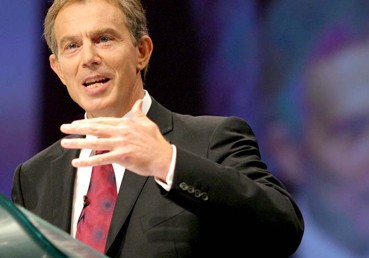
The London Sunday Telegraph is reporting that British Prime Minister Tony Blair yielded to White House pressure to harden his stance against Iran in a speech delivered on Friday at Georgetown University.
Blair was also compelled to modify his words on global warming and on whether an American should continue to permanently hold the position of head of the World Bank.
Tony Blair made significant changes to one of his most important foreign policy speeches after bowing to American objections, The Sunday Telegraph has learned...
Objections by President George W Bush's inner circle played a key role in the alterations, which were made just before Mr Blair delivered his landmark address at Georgetown University in Washington, on Friday, British sources have revealed.
Only three hours before the speech was delivered, Downing Street officials were briefing journalists that the Prime Minister would stress that "change should not be imposed" on Iran, reflecting the British view that bombing or invading Iran is not a realistic option.
American officials had insisted, however, that the possibility of military action remained "on the table", arguing that this helped to exert maximum pressure on President Mahmoud Ahmadinejad.
By the time he made his speech, Mr Blair had significantly bowed to the American position, claiming "I am not saying we should impose change" and leaving the door open for a military attack.
He also backed away from a planned demand for a change in the running of the world's biggest financial institutions, the International Monetary Fund and the World Bank. The Prime Minister originally intended to spell out a plan for Europe and the United States to give up their exclusive rights to install their own nationals as heads of the bank and the IMF respectively.
This would help to persuade smaller nations to give up their effective right to choose the United Nations secretary general, in favour of a move to install a leading international figure. Instead, Mr Blair's speech glossed over the issues, merely citing a "powerful case for reform".
Another planned section was intended to take a tough line on global warming and the Kyoto Treaty, which Washington still has not signed.
In the event, Mr Blair merely claimed: "We must act on climate change", but did not go into detail. At this point, as a mobile telephone rang in the audience, he even made a joke about American interference. "I hope that isn't the White House telling me they don't agree with that," he said. "They act very quickly, these guys."
The White House interfering with an address by the British Prime Minister is the final proof that the "special relationship" between the United States and Great Britain under Bush has a quite different meaning than previously understood by defense (Br. defence) and security cognoscenti since WWII.
Haditha War Crimes Coverup Alleged
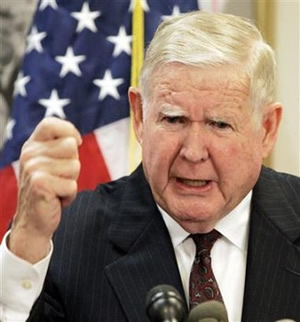
A Congressman who is known to be among the lawmakers closest to the military alleged yesterday that there was a concerted coverup in the case of the unprovoked murders by Marines in Haditha.
A powerful member of Congress alleged yesterday that there has been a conscious effort by Marine commanders to cover up the facts of a November incident in which rampaging Marines allegedly killed 24 Iraqi civilians.
"There has to have been a coverup of this thing," Rep. John P. Murtha (Pa.), ranking Democrat on the House Appropriations defense subcommittee, charged in an interview on ABC's "This Week." "No question about it."
John W. Warner (R-Va.), chairman of the Senate Armed Services Committee, also raised the issue of whether the military chain of command reacted properly and legally.
"There is this serious question . . . of what happened and when it happened, and what was the immediate reaction of the senior officers in the Marine Corps when they began to gain knowledge of it," he said on the same program. He added, "That is seriously a question that is going to be examined."...
Murtha, who like Warner is a former Marine, said that there was a preliminary investigation by the military but that "it was stifled."...
Murtha said he understands the stress being put on Marines fighting in western Iraq's turbulent Anbar province: "The pressure builds every time they go out," with roadside bombs exploding "every day they go out."
But, he said, "I will not excuse murder, and this is what has happened," adding that there is "no question in my mind about it." He reiterated a previous statement that shootings of women and children occurred "in cold blood" and that there was no firefight in which civilians were killed in a crossfire, as some Marines asserted after the event.
"This is worse than Abu Ghraib," he said, referring to the abuse of Iraqi detainees by U.S. soldiers at a prison west of Baghdad that, when revealed in spring 2004, became a major setback for the U.S. effort in Iraq.
Murtha was most emphatic in discussing his belief that senior Marine officers acted to prevent the facts of the case from emerging. "The problem is, who covered up? And why did they cover it up?" he asked...
"We don't know how far it goes," Murtha said of the alleged coverup. "The Marines knew about it all this time. Somebody in the chain of command decided not to allow this to happen. How far up it went, I don't know."
Payments from the U.S. military to the families of the innocent victims in Haditha are under scrutiny in the investigations according to "a United States defense official, who declined to be identified because details of the investigation are not supposed to be revealed," the New York Times is reporting today.
The United States defense official said the payments were also a focus of investigators trying to determine whether the killings were improperly covered up. On "This Week," Representative Murtha suggested that the decision to make payments was strong evidence that Marine officers up the chain of command had knowledge of the events. "That doesn't happen at the lowest level," he said. "That happens at the highest level before they make a decision to make payments to the families."
Saturday, May 27, 2006
Key Justice Officials Revolt Over Plan To Return Seized Documents
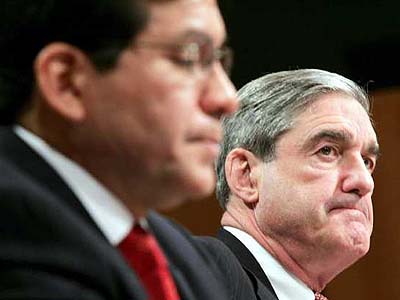
Key administration officials openly revolted against President Bush's plan to return a Democratic congressman's files which had been seized last weekend by the FBI.
Attorney General Alberto R. Gonzales, the F.B.I. director, Robert S. Mueller III, and senior officials and career prosecutors at the Justice Department told associates this week that they were prepared to quit if the White House directed them to relinquish evidence seized in a bitterly disputed search of a House member's office, government officials said Friday...
The possibility of resignations underscored the gravity of the crisis that gripped the Justice Department as the administration grappled with how to balance the pressure from its own party on Capitol Hill against the principle that a criminal investigation, especially one involving a member of Congress, should be kept well clear of political considerations.
The political skullduggery by congressional Republicans to derail federal investigations against members during the election season is now coming into public view:
Tensions were especially high because officials at the Justice Department and the F.B.I. viewed the Congressional protest, led by Speaker J. Dennis Hastert and House Republicans, as largely a proxy fight for battles likely to come over criminal investigations into other Republicans in Congress.
A battle supposedly over "separation of powers" between the executive and legislative branches was masking the opening efforts at obstructing investigations of lawmakers arising from the Jack Abramoff scandals.
And the President was in the verge of coming down in favor of congressional prerogatives over the investigative responsibilities of his own Justice Department.
The possibility of resignations by Attorney General Alberto R. Gonzales; his deputy, Paul J. McNulty; and FBI Director Robert S. Mueller III was communicated to the White House by several Justice officials in tense negotiations over the fate of the materials taken from Rep. William J. Jefferson's office, according to the sources, who spoke on the condition of anonymity because of the sensitivity of the issue.
Justice prosecutors and FBI agents feared that the White House was ready to acquiesce to demands from House Speaker J. Dennis Hastert (R-Ill.) and other lawmakers that the materials be returned to the Louisiana congressman, who is the subject of a criminal probe by the FBI. Vice President Cheney's chief of staff, David S. Addington, was among the leading White House critics of the FBI raid, telling officials at Justice and on Capitol Hill that he believed the search was questionable, several sources familiar with his views said.
Administration officials said yesterday that the specter of top-level resignations or firings at Justice and the FBI was a crucial turning point in the standoff, helping persuade President Bush to announce a cease-fire on Thursday. Bush ordered that the Jefferson materials be sealed for 45 days while Justice officials and House lawmakers work out their differences, while also making it clear that he expected the case against Jefferson to proceed...
Addington -- who had worked as a staffer in the House and whose boss, Cheney, once served as a congressman -- quickly emerged as a key internal critic of raiding the office of a sitting House member. He raised heated objections to the Justice Department's legal rationale for the search during a meeting Sunday with McNulty and others, according to several sources...
The view of the emerging political landscape was notably different at Justice, where officials feared they were quickly losing the debate. Prosecutors and FBI agents felt the materials were obtained from Jefferson through a lawful and court-approved search and that returning them -- as demanded by Hastert and others -- would amount to an intolerable political intervention in the criminal justice process.
It is ironic that Addington--the prime exponent of unchecked executive power--is coming down in this case in favor of congressional power over the executive.
Very interesting...
Friday, May 26, 2006
Bush Intervenes In FBI Probe Of Congressman

The word around Washington is that the Republicans want Democratic Congressman William Jefferson, the subject of a FBI search of his office, to remain an active member of the House so that they can point to the bipartisan nature of the corruption scandals on Capitol Hill.
This would account for one motive for President Bush intervening in the FBI investigation yesterday.
President Bush ordered the Justice Department yesterday to seal records seized from the Capitol Hill office of a Democratic congressman, representing a remarkable intervention by the nation's chief executive into an ongoing criminal probe of alleged corruption.Jefferson should not be too relieved by the sealing of the seized records, because the plan is still to feed him to the wolves--just on a timetable favorable to the GOP:
The order was aimed at quelling an escalating constitutional confrontation between the Justice Department and the House, where Republican and Democratic leaders have demanded that the FBI return documents and copies of computer files seized from the office of Rep. William J. Jefferson (D-La.).
In a six-paragraph statement, Bush cast the dispute in historic terms and said he issued the order to give Justice Department officials and lawmakers more time to negotiate a compromise. "Our government has not faced such a dilemma in more than two centuries," Bush said. "Yet after days of discussions, it is clear these differences will require more time to be worked out."
Bush signaled in his statement, however, that he expected the documents to eventually be made available to prosecutors. "Those who violate the law -- including a Member of Congress -- should and will be held to account," Bush said. "This investigation will go forward, and justice will be served."
We thought so.
Meanwhile, things are heating up in the FBI investigation of the leak to the New York Times of the extra-legal NSA warrantless surveillance program:
Another potential entanglement with the FBI arose yesterday when the Capitol Hill newspaper Roll Call reported that federal agents are seeking to interview top House members from both parties as part of an investigation into leaks about the National Security Agency's domestic surveillance program to the New York Times.
I have been told that the administration idea here is to keep Congress on the defensive by investigating them and their staffs over the leak so that lawmakers shy away from investigating the legality of the program itself.
But getting back to the skullduggery involving high level involvement in the investigation of Rep. Jefferson, it was revealed that the approval for the search of the Congressman's office came from a high-level:
(Attorney General Alberto) Gonzales, who approved the search of Jefferson's office, issued a statement saying he was satisfied with the president's decision.
"Throughout this discussion period with the Congress over the court-authorized search of Congressman Jefferson's office, the Justice Department has sought to protect the integrity of this important ongoing public corruption investigation," Gonzales said. "The president's order does that and provides additional time to reach a permanent solution that allows this investigation to continue while accommodating the concerns of certain members of Congress."
I earlier spoke of one motive of the sealing of Jefferson's seized records--to keep a viable public face of Democratic corruption.
There is however, a larger motive in play according to Washington insiders:
Republicans were leading a challenge to the administration stemming from the criminal inquiry into a Democrat; Democrats were wrestling with how to separate themselves from Mr. Jefferson. And some were hinting that Republicans were more concerned with protecting themselves from future searches than with protecting the institution.
This is specifically the point I made on Wednesday night when news first broke about Dennis Hastert being "in the mix" of the federal investigation of the Abramoff corruption scandal.
At the same time, Bush is establishing a precedent for possible future interference in FBI and Justice Department probes of his administration. It is getting very close to a time that Karl Rove, Scooter Libby, and others would likely benefit from a presidential application of the brakes to the wheels of justice.
Thursday, May 25, 2006
Vice President May Become Witness In Libby Trial

A new court filing by Plamegate special prosecutor Patrick J. Fitzgerald shows that Vice President Cheney was at the top of the White House efforts to discredit former ambassador and administration critic Joseph Wilson.
Vice President Cheney was personally angered by a former U.S. ambassador's newspaper column attacking a key rationale for the war in Iraq and repeatedly directed I. Lewis "Scooter" Libby, then his chief of staff, to "get all the facts out" related to the critique, according to excerpts from Libby's 2004 grand jury testimony released late yesterday by Special Counsel Patrick J. Fitzgerald.
Libby also told the grand jury that Cheney raised as an issue that the former ambassador's wife worked at the CIA and that she allegedly played a role in sending him to investigate the Iraqi government's interest in acquiring nuclear weapons materials. That issue formed the basis of former ambassador Joseph C. Wilson IV's published critique.
In the court filing that included the formerly secret testimony, Fitzgerald did not assert that Cheney instructed Libby to tell reporters the name and role of Valerie Plame, Wilson's wife. But he said Cheney's interactions with Libby on that topic were a key part of the reason Libby allegedly made false statements to the FBI about his conversations with reporters around the time her name was disclosed in news accounts.
"The state of mind of the Vice President as communicated to defendant is directly relevant to the issue of whether defendant knowingly made false statements to federal agents and the grand jury regarding when and how he learned about Ms. Wilson's employment and what he said to reporters regarding this issue," he said.
The prosecutor also left open the possibility that Cheney will be called as a witness at Libby's trial, scheduled to begin next year, and denied an assertion last week by Libby's lawyers that Cheney would not be called.
Why would Libby's lawyers say that they would not call Cheney to the stand? Lawyers have an ethical obligation to pursue any avenue of inquiry which may help their client's defense.
An orchestrated effort to protect the Vice President would not be an unreasonable interpretation of the facts as they are currently known.
Wednesday, May 24, 2006
Dennis Hastert Under Federal Investigation in Lobbying Scandal, ABC News Reports

Dennis Hastert's criticism of the FBI search of the Capitol Hill office of Congressman William Jefferson (D-LA) has become more understandable in light of the following story.
Speaker of the House Hastert may want to stop such intrusions before he receives a visit of his own.
ABC News is reporting tonight that Hastert has been ratted out by one or more of the cooperating witnesses in the Abramoff lobbying scandal.
The Speaker of the House of Representatives, Dennis Hastert, is under investigation by the FBI, which is seeking to determine his role in an ongoing public corruption probe into members of Congress, ABC News has learned from senior U.S. law enforcement officials.
Federal officials say the information implicating Hastert was developed from convicted lobbyists who are now cooperating with the government.
Part of the investigation involves a letter Hastert wrote three years ago, urging the Secretary of the Interior to block a casino on an Indian reservation that would have competed with other tribes.
The other tribes were represented by convicted lobbyist Jack Abramoff who reportedly has provided details of his dealings with Hastert as part of his plea agreement with the government.
The letter was written shortly after a fund-raiser for Hastert at a restaurant owned by Abramoff. Abramoff and his clients contributed more than $26,000 at the time...
A spokesman for Speaker Hastert told ABC News, "We are not aware of this. The Speaker has a long history and a well-documented record of opposing Indian Reservation shopping for casino gaming purposes."
In order to successfully bring a case against Hastert, the Justice Department is going to have to find overt acts performed by the Congressman in exchange for consideration given by the lobbyists.
That's why only "part of the investigation" involves the letter he would have likely written without any largesse from the lobbyists.
The former lobbyists, now federal informants, will be expected to provide the evidence that ties the Speaker--if guilty--to lawbreaking in the scandal.
"Old Friend" of Harriet Miers Admonished For Public Support During Nomination
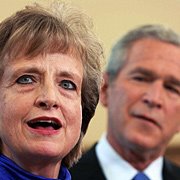
A Texas judge,
Texas Supreme Court Justice Nathan Hecht was admonished for improperly using his position to support close friend Harriet Miers when she was nominated to the U.S. Supreme Court last year.
The state Commission on Judicial Conduct said Hecht told White House staff to send media inquiries about Miers's career to him and discussed her qualifications in about 120 newspaper, radio and TV interviews.
In some interviews, Hecht, a Republican, said that Miers's nomination would be "good for the country" and that she would make a "good justice."
Texas judicial conduct rules prohibit judges from lending the prestige of their office to boost the private interests of themselves or others. They also prohibit judges from allowing their names to be used to endorse candidates.
Hecht's vocal support raised some eyebrows at the time.
She turned out to be insufficently attractive to Bush's conservative base, and was jettisoned without the benefit of the "up or down vote" so important to the GOP when Democrats find fault with Bush nominees.
Tuesday, May 23, 2006
New Lawsuit Against AT&T Over Release Of Records To NSA
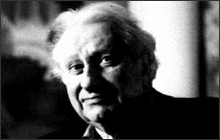
A famous American is participating in a new lawsuit against AT&T for violating the privacy of their customers by cooperating in the mass data-mining program instituted by the NSA after 9-11.
A lawsuit filed Monday on behalf of author Studs Terkel and other professionals seeks to stop AT&T from giving customer phone records to the National Security Agency without a court order.
The plaintiffs, who also include a doctor and a state lawmaker, said they rely on confidentiality in their work and are worried their clients will be less likely to phone them if they think the government collects lists of the numbers they are calling.
USA TODAY reported on May 11 that AT&T and other phone companies complied with an NSA request for the phone records of millions of ordinary Americans after the Sept. 11 attacks...
The six plaintiffs, whose legal team includes lawyers for the American Civil Liberties Union, claim the telephone giant violated the federal Electronic Communications Privacy Act, which prevents phone companies from releasing records to the government unless there is an emergency.
The lawsuit, filed in federal district court, seeks to include all Illinois AT&T customers as plaintiffs in a class action. The plaintiffs are not seeking monetary damages.
"Having been blacklisted from working in television during the McCarthy era, I know the harm of government using private corporations to intrude into the lives of innocent Americans," Terkel said in a statement. "When government uses the telephone companies to create massive databases of all our phone calls it has gone too far."...
The plaintiffs besides Terkel are State Rep. Barbara Flynn Currie, D-Chicago; Rabbi Gary Gerson of Temple B'nai Abraham Zion in Oak Park; Diane Geraghty, a Loyola University law professor; attorney James Montgomery, former corporation counsel for the City of Chicago; and Dr. Quinten Young, a doctor and advocate for health care reform...
The Bush administration has urged a judge to dismiss a similar case, saying it threatens to divulge state secrets and jeopardize national security. The government argued in briefs that the courts cannot decide the constitutionality of the president's asserted wartime powers to eavesdrop on Americans without warrants.
Administration apologists have in recent days stooped to saying that the telecom/NSA data-mining partnership is untrue.
It is curious then, that the government is resorting to a "state secret" and "national security" defense. The case could be argued by countering it's (supposedly fictitious) factual basis.
And if the best that the Bush administration can argue is that "the courts cannot decide the constitutionality" of a legal issue--precisely the function of the Supreme Court--they may not be happy with how this matter turns out.
Monday, May 22, 2006
Libby's Elaborate Narrative To Be Focus Of Fitzgerald's Case
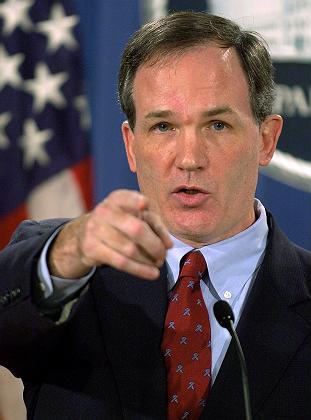
Scooter Libby's elaborate narrative, a vast web of lies made under oath--claiming that he first learned that Valerie Plame was a CIA officer from Tim Russert--is coming back to bite him as the focus of special prosecutor Patrick J. Fitzgerald's case against Vice President Cheney's former chief of staff.
Fitzgerald has said that at trial he plans to show that Libby knew Plame's employment at the CIA was classified and that he lied to the grand jury when he said he had learned from NBC News's Tim Russert that Plame, the wife of former ambassador Joseph C. Wilson IV, worked for the agency...
When Libby testified before the grand jury on March 5, 2004, he said, according to the government's indictment: "Mr. Russert said to me, did you know that Ambassador Wilson's wife, or his wife works at the CIA? And I said, no, I don't know that. And then he [Russert] said, yeah -- yes all the reporters know it. And I said, again, I don't know that."...
The indictment said Russert never disclosed anything about Plame in his conversation with Libby. Instead, prosecutors say, Libby learned about Plame's CIA employment in June 2003 from Cheney, Undersecretary of State Marc Grossman and at least one senior CIA official, according to court papers.
At last week's court argument on pretrial motions, Fitzgerald said Libby had a "motive to lie" to the grand jury. By "attributing to a reporter" his information about Plame's CIA status and emphasizing that he was "passing on" scuttlebutt but "didn't know if it were true," the prosecutor said, Libby in his testimony was deliberately casting his actions as "a non-crime" in a way that "looks much more innocent than passing on what you know to be classified."
Meanwhile the "has he been indicted or not" rumors about the fate of Karl Rove are being attacked today by Howard Kurtz of the Washington Post:
The claim that President Bush's top political strategist had been indicted in the CIA leak investigation was written by a journalist who has battled drug addiction and mental illness and been convicted of grand larceny. That didn't stop more than 35 reporters -- from all the major newspapers, networks and newsmagazines -- from calling Luskin or Rove's spokesman, Mark Corallo, to check it out.
The reports appeared on the liberal Web site Truthout.org, run by Marc Ash, a former advertising man and fashion photographer in California. Jason Leopold, the author of the stories, directed inquiries to Ash, who says that "we stand by the story. We have multiple points of independent confirmation of what we originally reported. Our problem is, the prosecutor's office is under no obligation to go public."...
Leopold's May 12 report said Rove had told the president and top administration officials that he would be indicted and planned to resign. The next day, a Saturday, Leopold reported that Fitzgerald had handed Rove's attorneys an indictment of their client on charges of perjury and lying to investigators, and that an announcement was expected the next week.
People outside Jason Leopold's immediate circle in Washington are saying that he was on the right track and that indictment is indeed coming.
A most visible clue is said to be the resignation of presidential spokesman Scott McClellan on the same day (April 19) that Karl Rove stepped down from his White House policy job.
Saturday, May 20, 2006
Dems To Focus On Fuel Costs In Midterms

The GOP had better convince their buddies in Big Oil to go easy on the profits (yeah, right) during the run-up to the Fall mid-term elections or else risk killing the goose that laid the golden egg.
The Democrats are planning on making the cost of fuel the big issue (not the Iraq quagmire) in the Fall.
Seeking to gain advantage on a potent election-year issue, Democrats are promoting ambitious ideas to lower gasoline prices, targeting key voting blocs such as farmers and autoworkers.
Party leaders are requesting that all House and Senate Democrats stage events back home over the Memorial Day recess to signal the start of the summer driving season. The lawmakers will pitch new Democratic proposals to reduce foreign oil imports and expand domestic alternative-energy supplies...
Democrats hope energy will help in Senate races in the biofuel-producing states of Missouri and Montana, as well as in House races across the agricultural Midwest and in commuter districts on both coasts...
Polls show mounting voter concern about high energy costs and the dent they are making in family budgets. A Pew Research Center survey this month showed that respondents ranked high gasoline prices second only to the Iraq war as the most important issue facing the country.
However, the chickenshit Democratic leadership is afraid to focus on the war for fear that the GOP will brand them cowards. Textbook pot calling the kettle black territory.
House and Senate Democrats are promoting separate energy packages. The differences reflect the challenge of reconciling the many regional interests and biases that influence energy debates in Congress.
The House plan focuses almost exclusively on crop-derived biofuels. "From corn in the Midwest, to soybeans in North Carolina, to sugar beets in Minnesota, we grow the crops that can be converted into the biofuels that power our cars," said House Minority Leader Nancy Pelosi (D-Calif.), when House Democrats announced the plan May 11.
Although narrowly focused, the House plan has a specific audience in mind: conservative rural voters, whom Democrats believe are particularly disgruntled with Republican leadership and for whom high gas prices are a particular burden...
At 352 pages, the Senate package includes benefits for almost every faction of the energy industry. It calls for the expanded use of flexible fuel vehicles, which can run on higher blends of biofuels, and would help local governments and individual gas stations install more biofuel pumps. Oil companies would be required to install the pumps at the gas stations that they own.
Senate Democrats would establish a nationwide renewable energy standard, mandating that 10 percent of electricity come from renewable sources by 2020. To reach that goal, they would subsidize the development of alternative energy technologies, such as wind, solar power and liquefied coal.
Ten percent? By 2020?
Sounds like a whole bunch of nothing.
Friday, May 19, 2006
Possible Air Force Contracting Skullduggery

A contract for a publicity campaign for perennial air show favorites--the Air Force's Thunderbirds--is at the crux of a federal investigation.
The Pentagon's inspector general and the FBI have launched a criminal investigation into the awarding of a $50 million contract to a Pennsylvania company to produce a high-tech promotional video and do other publicity work for the Air Force's Thunderbirds air show team, a senior Air Force official said yesterday.
The contract was canceled in February after a protest from a losing bidder led the Air Force and the Government Accountability Office to review the manner in which it had been awarded. Air Force Secretary Michael W. Wynne then asked the Pentagon's inspector general to look into the matter. The inspector general's office asked the FBI to become involved after coming to suspect that a crime might have been committed...
The Arizona Republic reported in March that the Pennsylvania company, Strategic Message Solutions, won the contract even though its bid was almost twice that of a competing proposal by an Arizona company, SRO Media. Retired Gen. Hal M. Hornburg had become a partner in Strategic Message Solutions not long after leaving the Air Force. The newspaper said it had obtained documents showing that Gen. T. Michael Moseley, the Air Force chief of staff, had helped steer the contract to Strategic Message Solutions.
The overcharging on the contract must be what the big fuss is all about here. Everybody knows that the defense industry recruits senior military officers upon retirement to procure military contracts for them. They are just not supposed to orchestrate any bid-rigging so sloppily that it makes the press and calls attention to the sweet arrangement.
The Government's All-Purpose Defense Against Court Cases

The United States is wielding it's trump card--national security--to quash lawsuits against the government more and more often in recent years.
Yesterday, the all-purpose defense again worked it's wonders.
A federal judge yesterday threw out the case of a German citizen who says he was wrongfully imprisoned by the CIA, ruling that Khaled al-Masri's lawsuit poses a "grave risk" of damage to national security by exposing government secrets.
U.S. District Judge T.S. Ellis III in Alexandria acknowledged that Masri "has suffered injuries" if his allegations are true and that he "deserves a remedy." Sources have said Masri was held by the CIA for five months in Afghanistan because of mistaken identity. Masri says he was beaten, sodomized and repeatedly questioned about alleged terrorist ties.
But Ellis said the remedy cannot be found in the courts. Masri's "private interests must give way to the national interest in preserving state secrets,'' the judge wrote in dismissing the lawsuit filed last year against former CIA director George J. Tenet and 10 unnamed CIA officials...
The ruling was a victory for Justice Department prosecutors, who had invoked the once rarely cited state-secrets privilege to argue for dismissal. Created in the 1950s, it allows the government to urge courts to dismiss cases on the grounds of damage to foreign policy or national security. The privilege has been used far more frequently since the Sept. 11, 2001, terrorist attacks.
Judges have usually acceded to the government's request. Last year, for example, the government won dismissal of a lawsuit by a Canadian citizen who claimed that he was taken to Syria by U.S. officials for detention and was tortured.
When defense attorneys in criminal cases attempt to use "graymail" by demanding access to classified documents in the discovery phase of a trial, the government vigorously objects.
When the government does the same thing by invoking the "national security" clause, judges just bend over and toss the case.
Thursday, May 18, 2006
Update On NSA Domestic Spying Program
The Justice Department is well on it's way to getting a lawsuit dismissed against AT&T for allegedly assisting the NSA's extra-legal warrantless domestic spying program.
A federal judge yesterday rejected a privacy group's request to release documents that it claims show AT&T Inc. helped the National Security Agency spy on Americans by providing access to customers' phone calls.
U.S. District Judge Vaughn R. Walker said at a hearing in San Francisco that the documents may contain AT&T trade secrets. The judge also ruled against an AT&T request to have the privacy group, the Electronic Frontier Foundation, return the documents to the company on the grounds that they were stolen...
The documents at issue in the case came from Mark Klein, a retired AT&T technician, who said in April that cables and equipment installed at an AT&T office in San Francisco in 2003 for the NSA "were tapping into" circuits carrying customers' dial-in services. He supplied documents to EFF to support his assertions, which were filed under seal.
The deck is certainly stacked against the Electronic Frontier Foundation in this case:
The Justice Department has asked Walker to dismiss the case because it could compromise national security. Such requests are rarely rejected, said William Weaver, a law professor at the University of Texas at El Paso, and author of a book about law and presidential secrecy.
"The case is going away. Courts almost never challenge the government on this," Weaver said. "It is the most deferred-to principle in law and a judge will not touch it."
In the separate matter of the data-mining by the NSA of the transactional data from most Americans phone calls, both Bell South and Verizon have now denied participating in the program.
However, their pleas of innocence must be taken with a grain of salt because President Bush has now signed a Presidential Memorandum allowing companies to bypass SEC regulations requiring full and truthful public statements when "national security" concerns are involved.
Ordinarily, a company that conceals their transactions and activities from the public would violate securities law. But a presidential memorandum signed by the President on May 5 allows the Director of National Intelligence, John Negroponte, to authorize a company to conceal activities related to national security. (See 15 U.S.C. 78m(b)(3)(A))
The New York Times is reporting this morning that cell phone calls may have been included in the wide net cast by the SIGINT agency.
The long-distance networks are sizable data pipes that sit in the middle of most telephone calls that leave local and sometimes regional call areas. The information yielded by long-distance call records can be vast, said Lisa Pierce, a telecommunications analyst with Forrester Research. "Any call that transits a long-distance network, regardless of whether it's an international or domestic, wireless or wire line, will have a call detail record," she said.
Ms. Pierce said that the network infrastructure was known as Signaling System 7 and that it created an automatic record of such things as the two numbers that are connected, and the time and duration of a call. This architecture also creates a record when a call is delivered onto a domestic long-distance network from overseas or from a cellphone. In some instances, when a cellphone caller places a long-distance call, the transmission originates on a cell network, then is delivered to a long-distance network that carries it across the country, where it might be connected to another cell network.
Anyone wishing to delve deeper into the labyrinth of the CATCH ALL program is well advised to refer to the reports by M1 on SMC, which have been scooping the entire rest of the media on this story for months.
Quiescent House Ethics Panel To Be Revived
The sedentary House ethics panel has chosen to reenter the political process here in Washington.
After 16 months of inactivity and partisan infighting, the House ethics committee launched investigations last night into bribery allegations against Reps. Robert W. Ney (R-Ohio) and William Jefferson (D-La.) and a separate inquiry into the widening scandal surrounding former congressman Randy "Duke" Cunningham (R-Calif.).
The committee said it would have ordered another investigation, into the overseas trips of former House majority leader Tom DeLay (R-Tex.), had the once-powerful lawmaker not announced that he will resign from the House on June 9...
The Cunningham inquiry could hold the most political significance, because it will look into activities that could snare lawmakers who so far have escaped official scrutiny. Cunningham confessed to accepting millions of dollars in bribes from two Southern California defense contractors, Mitchell J. Wade and Brent R. Wilkes.
The case took a new twist last month when Wade told prosecutors that Wilkes had an arrangement with a limousine company, which in turn had an arrangement with at least one escort service, one source said. Wade said limos would pick up Cunningham and a prostitute and bring them to suites that Wilkes maintained at the Watergate and Westin Grande hotels in Washington. Federal investigators are looking into whether other lawmakers also took part.
The fallout from the Jack Abramoff lobbying excesses will likely provide additional fodder (besides Ney) for the ethics committee, should it decide to follow up on the ample leads provided by the various related court cases.
Wednesday, May 17, 2006
Libby Judge Given Reporters' Notes
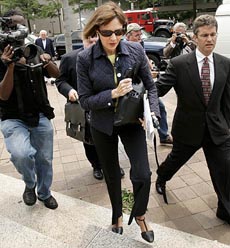
A long drawn-out battle over access to the notebooks of some reporters peripherally involved in the "Plamegate" leak case has been averted now that several mainstream media organizations have decided to "voluntarily" turn over the notebooks to the trial judge so that he can rule on their admissibility in the case.
Several media organizations agreed yesterday to let a federal judge overseeing the trial of former White House aide I. Lewis "Scooter" Libby review reporters' notebooks and other materials related to their work in the CIA leak case.
The New York Times and Time magazine said at a court hearing that they will turn over the materials to U.S. District Judge Reggie B. Walton this week so he can decide whether they must be shown to Libby's defense team...
The two publications, plus NBC, had filed motions seeking to quash subpoenas filed by Libby's attorneys on the grounds that the requests were too sweeping and that some of the material did not exist, was irrelevant or is protected. The Washington Post turned over enough subpoenaed information to satisfy Libby's attorneys; The Post said in a statement that it did so without violating promises to its sources.
Walton indicated that he accepted NBC's argument that it had no relevant materials...
Much of yesterday's hearing concerned the notebooks of former New York Times reporter Judith Miller, who spoke three times with Libby about Wilson's work in June and July 2003 and made repeated reference in her notes to Plame. Miller has said she also discussed Plame with other officials but could not recall their names. But she did not write an article about the matter.
The Times has provided Libby a redacted copy of the notebooks, but (Libby lawyer William) Jeffress argued that Libby needed to see other names and phone numbers in Miller's notebooks to determine who else she spoke with about Plame and if her memory about all the related conversations was confused.
The media outlets could have played hardball and dragged out this issue. But this would have resulted in Libby's defense fund--already burning cash at a great rate--being stressed even further.
Tuesday, May 16, 2006
Confidence In GOP Still Slipping
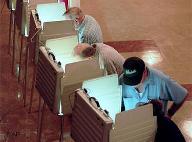
With the federally mandated use of electronic voting technology, the opinions of the American voters may not really matter. But the results of this new poll are interesting nevertheless.
Public confidence in GOP governance has plunged to the lowest levels of the Bush presidency, with Americans saying by wide margins that they now trust Democrats more than Republicans to deal with Iraq, the economy, immigration and other issues, according to a Washington Post-ABC News poll that underscores the GOP's fragile grip on power six months before the midterm elections.
Dissatisfaction with the administration's policies in Iraq has overwhelmed other issues as the source of problems for President Bush and the Republicans. The survey suggests that pessimism about the direction of the country -- 69 percent said the nation is now off track -- and disaffection with Republicans have dramatically improved Democrats' chances to make gains in November.
Democrats are now favored to handle all 10 issues measured in the Post-ABC News poll. The survey shows a majority of the public, 56 percent, saying they would prefer to see Democrats in control of Congress after the elections.
The American people are belatedly concluding that, contrary to administration assertions, the war in Iraq is not making the Middle East safe for democracy. Not to mention that it has spawned a new generation of terrorists.
Will the public punish the Republicans for the Iraq mess in the mid-term elections? Who knows. Chances are, even if these dismal polls hold up, the final tally may be adjusted to maintain the status quo.
Monday, May 15, 2006
NSA Whistleblower To Allege New Illegalities By SIGINT Agency
A former NSA officer will be alleging that heretofore publicly unknown illegal activities, possibly involving the use of satellite-based platforms, has been conducted by the NSA and that nominee for CIA director Gen. Michael Hayden was told personally that such operations were forbidden under U.S. law.
An article in GovExec has the details:
A former intelligence officer for the National Security Agency said he plans to tell Senate staffers (this) week that unlawful activity occurred at the agency under the supervision of Gen. Michael Hayden beyond what has been publicly reported, while hinting that it might have involved the illegal use of space-based satellites and systems to spy on U.S. citizens.
Russell Tice, who worked on what are known as "special access programs," has wanted to meet in a closed session with members of Congress and their staff since President Bush announced in December that he had secretly authorized the NSA to eavesdrop on U.S. citizens without a court order. In an interview late Thursday, Tice said the Senate Armed Services Committee finally asked him to meet (this) week in a secure facility on Capitol Hill...
He said he plans to tell the committee staffers the NSA conducted illegal and unconstitutional surveillance of U.S. citizens while he was there with the knowledge of Hayden, who has been nominated to become director of the CIA. Tice said one of his co-workers personally informed Hayden that illegal and unconstitutional activity was occurring...
"I think the people I talk to next week are going to be shocked when I tell them what I have to tell them. It's pretty hard to believe," Tice said. "I hope that they'll clean up the abuses and have some oversight into these programs, which doesn't exist right now."
Tice originally asked to meet with the Senate and House Intelligence committees, but they did not respond to his request. The NSA did not reply to written questions seeking comment for this story.
The NSA fired Tice for what it claimed were psychological problems, including paranoia. A number of NSA employees have been terminated under such pretexts in recent years, corresponding with the extra-legal endeavors of the SIGINT agency following 9-11.
Branding dissidents as being mentally ill is an old Soviet tactic to discredit one's opponents and discourage others from becoming whistleblowers. It is yet another dickless "get tough" approach from the discredited U.S. government.
Sunday, May 14, 2006
Some Operational Pitfalls Of Relying On Data Mining

One of the founders of Wired Magazine--techie extraordinaire--Simson L. Garfinkel of Harvard looks at the latest revelation coming from the broader extra-legal NSA warrantless eavesdropping program, the data mining of the call records of nearly all Americans in the name of keeping us "safe" from "terror."
Garfinkel shows how the effort can be a wild goose chase of an extremely wasteful kind.
Some cogent points:
(T)he real danger of this kind of unrestricted data mining isn't "false positives" -- that is, associations that don't really exist -- but meaningless positives. Investigating all of these positives takes time and money. And if the investigations are not done correctly, innocent lives can be ruined in the process. A principle of American jurisprudence is that it is better for a guilty person to go free than for an innocent person to be imprisoned. How will our society react to a system that requires many people to be investigated because only one of them might be a terrorist?...
Ultimately, (this) may be the greatest dilemma for those involved in collecting and mining data: What information does one not need to collect, and when is it safe to throw away a piece of data? It's human nature to hold on to information as long as possible -- once you eliminate it, you can't always get it back. And even if you could keep everything forever, would you want to? The cost of storing and protecting data is high. The more information you have, the more difficult it is to search and cross-reference it, which means you must spend more on computer systems. And perhaps the most insidious side effect of all: After spending all the money and effort to collect, keep and protect data, it is hard not to develop that nagging feeling that you really should be putting it to use.
Cheney--Not Intelligence Pros--Wanted NSA CATCH ALL Program
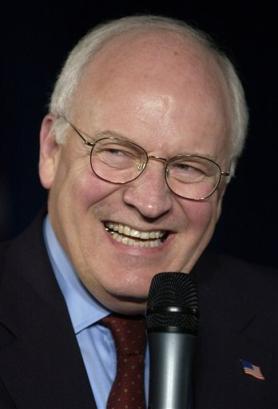
The extra-legal NSA warrantless eavesdropping was not conceived by U.S. intelligence experts but by Vice President Dick Cheney, today's New York Times reports.
As a matter of fact, the intelligence professionals opposed the idea for reasons that included the illegality of the operation.
In the weeks after the Sept. 11 attacks, Vice President Dick Cheney and his top legal adviser argued that the National Security Agency should intercept purely domestic telephone calls and e-mail messages without warrants in the hunt for terrorists, according to two senior intelligence officials.
But N.S.A. lawyers, trained in the agency's strict rules against domestic spying and reluctant to approve any eavesdropping without warrants, insisted that it should be limited to communications into and out of the country, said the officials, who were granted anonymity to discuss the debate inside the Bush administration late in 2001...
On one side was a strong-willed vice president and his longtime legal adviser, David S. Addington, who believed that the Constitution permitted spy agencies to take sweeping measures to defend the country. Later, Mr. Cheney would personally arrange tightly controlled briefings on the program for select members of Congress.
On the other side were some lawyers and officials at the largest American intelligence agency, which was battered by eavesdropping scandals in the 1970's and has since wielded its powerful technology with extreme care to avoid accusations of spying on Americans.
As in other areas of intelligence collection, including interrogation methods for terrorism suspects, Mr. Cheney and Mr. Addington took an aggressive view of what was permissible under the Constitution, the two intelligence officials said...
Both officials said they were speaking about the internal discussions because of the significant national security and civil liberty issues involved and because they thought it was important for citizens to understand the interplay between Mr. Cheney's office and the N.S.A.
This is precisely what we have been discussing all along about the over-reaching measures advocated by Cheney, Addington, and the administration in the "war on terror."
The chickenhawks in the White House (and on the internet) constantly push positions that professional military and intelligence officers--who have spent their careers dealing with such issues--know are counterproductive.
Another case in point--the Iraq War.
Treasury To Take Lead In Sanctions Against Iran
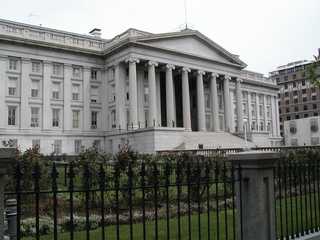
Veteran Washington Post reporter (now op-ed columnist) Jim Hoagland--an "international type" of the old school--today gives a glimpse of the U.S. plan for sanctions against Iran:
The Treasury Department, not the Pentagon, holds the key to the next steps if the United Nations does not mandate action against Iran. The asymmetric weapon of choice is Treasury's ability to deny foreign banks and firms access to the lucrative U.S. market if they cooperate with an international outlaw. The market-access threat recently helped blunt North Korea's counterfeiting of U.S. currency and would be devastating to the investment flows Iran needs to rebuild its deteriorating oil industry.
But Washington must act as if it has gone to the limits of its ability to consult and compromise with its partners before taking actions that will affect French, Russian and other international enterprises. And acting as if a deal is possible with Iran is the only way to get Moscow and Beijing to support the effort...
"We are in a who-blinks-first game," Bush said of Iran to a recent White House visitor. It is in fact a who-thinks-first, and best, game.
Saturday, May 13, 2006
Payback Time For Former Qwest CEO
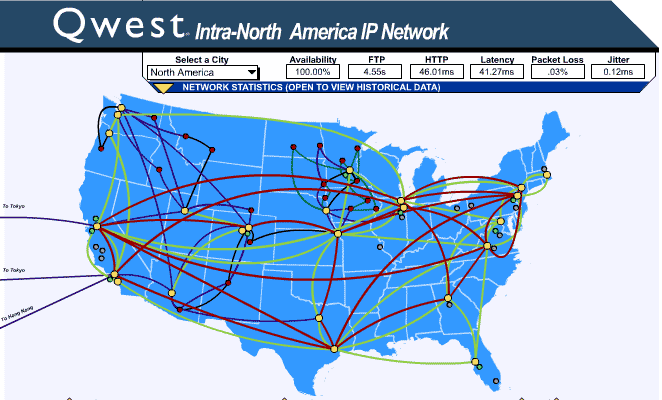
Joseph P. Nacchio, the then-CEO of telcom company Qwest who refused to participate in the NSA data mining operation because "a disinclination on the part of the authorities to use any legal process," is now facing federal charges stemming from the time of his leadership of the company, according to today's New York Times.
Qwest was apparently alone among the four major telephone companies to have resisted the requests to cooperate with the government effort. A statement issued on behalf of Mr. Nacchio yesterday by his lawyer, Herbert J. Stern, said that after the government's first approach in the fall of 2001, "Mr. Nacchio made inquiry as to whether a warrant or other legal process had been secured in support of that request."
"When he learned that no such authority had been granted, and that there was a disinclination on the part of the authorities to use any legal process," Mr. Nacchio concluded that the requests violated federal privacy requirements "and issued instructions to refuse to comply."
The statement said the requests continued until Mr. Nacchio left in June 2002. His departure came amid accusations of fraud at the company, and he now faces federal charges of insider trading.
The question of the legality of telecom participation is--despite administration apologists--still not clear:
The law governing the release of phone company data has been modified repeatedly to grapple with changing computer and communications technologies that have increasingly bedeviled law enforcement agencies. The laws include the Communications Act, first passed in 1934, and a variety of provisions of the Electronic Communications and Privacy Act, including the Stored Communications Act, passed in 1986.
Wiretapping--actually listening to phone calls--has been tightly regulated by these laws. But in general, the laws have set a lower legal standard required by the government to obtain what has traditionally been called pen register or trap-and-trace information--calling records obtained when intelligence and police agencies attached a specialized device to subscribers' telephone lines.
Those restrictions still hold, said a range of legal scholars, in the face of new computer databases with decades' worth of calling records. AT&T created such technology during the 1990's for use in fraud detection and has previously made such information available to law enforcement with proper warrants.
Orin Kerr, a former federal prosecutor and assistant professor at George Washington University, said his reading of the relevant statutes put the phone companies at risk for at least $1,000 per person whose records they disclosed without a court order.
"This is not a happy day for the general counsels" of the phone companies, he said. "If you have a class action involving 10 million Americans, that's 10 million times $1,000 "that's 10 billion."...
Legal experts said the companies faced the prospect of lawsuits seeking billions of dollars in damages over cooperation in the program, citing communications privacy legislation stretching back to the 1930's. A federal lawsuit was filed in Manhattan yesterday seeking as much as $50 billion in civil damages against Verizon on behalf of its subscribers...
The New Jersey lawyers who filed the federal suit against Verizon in Manhattan yesterday, Bruce Afran and Carl Mayer, said they would consider filing suits against BellSouth and AT&T in other jurisdictions.
"This is almost certainly the largest single intrusion into American civil liberties ever committed by any U.S. administration," Mr. Afran said. "Americans expect their phone records to be private. That's our bedrock governing principle of our phone system." In addition to damages, the suit seeks an injunction against the security agency to stop the collection of phone numbers.
Of course, there is the other side of the argument:
Several legal experts cited ambiguities in the laws that may be used by the government and the phone companies to defend the National Security Agency program.
"There's a loophole," said Mark Rasch, the former head of computer-crime investigations for the Justice Department and now the senior vice president of Solutionary, a computer security company. "Records of phones that have called each other without identifying information are not covered by any of these laws."
Not so fast, smart guy:
Civil liberties lawyers were quick to dispute that claim.
"This is an incredible red herring," said Kevin Bankston, a lawyer for the Electronic Frontier Foundation, a privacy rights group that has sued AT&T over its cooperation with the government, including access to calling records. "There is no legal process that contemplates getting entire databases of data."
The group sued AT&T in late January, contending that the company was violating the law by giving the government access to its customer call record data and permitting the agency to tap its Internet network. The suit followed reports in The New York Times in December that telecommunications companies had cooperated with such government requests without warrants.
One has to wonder if Qwest's Nacchio defied the government because he is a miscreant--or as is much more likely--he was targeted by federal prosecutors because of his stance on the warrantless NSA program.
Friday, May 12, 2006
More Questions About The NSA/Telecoms Relationship
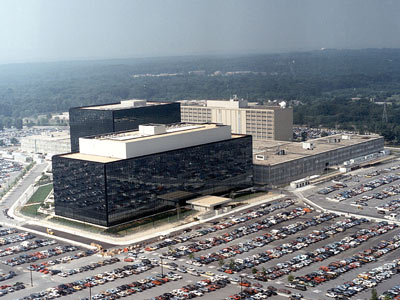
The debate is on in Washington about what laws, if any, were broken--and by whom--in the course of conducting the NSA CATCH ALL part of the extra-legal warrantless eavesdropping program.
Some are saying the government may be off the hook constitutionally, while leaving the telecom companies exposed to criminal liability:
The U.S. government's secret collection of Americans' phone records may not breach the Fourth Amendment's privacy guarantee, legal analysts said Thursday, but it could violate federal surveillance and telecommunication laws...
A communication act dating to 1934 and more recent electronic privacy laws generally require phone companies to protect the confidentiality of customers' communication. "There really isn't any precedent for this kind of thing," said Lee Tien, a lawyer at the Electronic Frontier Foundation, which filed a class-action lawsuit against AT&T after the NSA's eavesdropping program was revealed in December. The suit accuses AT&T of helping the NSA spy on phone users.
In order to have legal cover, the telecom companies had better have something in writing, like the NSA does allegedly does with a United States Signals Intelligence Directive (USSID) signed by the president authorizing their participation in the program.
The bypassing of FISA is once again an issue:
Lawyers who specialize in national security and communications, in and out of government, said it is difficult to assess the legality of the program because some of its features remain unknown. The Foreign Intelligence Surveillance Act, enacted in 1978, requires a court order before the government can eavesdrop on the content of domestic calls or keep live track of the phone numbers dialed by a U.S. telephone. But it does not cover wholesale acquisition of call records after the fact.
Privacy laws restrict distribution of customer records to third parties, including the government, but there are exceptions. With a court order, a subpoena or a "national security letter" from the FBI, a telephone company may be compelled to hand over records of specified individuals. In other circumstances, the law may be murkier...
"The statutes weren't drafted with the dragnet approach in mind," said Orin S. Kerr, a George Washington University law professor and former Justice Department lawyer. "And if this happened, who committed the violation? Is it the government or is it the phone company? It's really not clear."
One government lawyer who has participated in negotiations with telecommunications providers said the Bush administration has argued that a company can turn over its entire database of customer records -- and even the stored content of calls and e-mails -- because customers "have consented to that" when they establish accounts. The fine print of many telephone and Internet service contracts includes catchall provisions, the lawyer said, authorizing the company to disclose such records to protect public safety or national security, or in compliance with a lawful government request.
No one should expect the lawmakers on Capitol Hill to do much about the new revelations--despite assertions of a desire to reach the truth of the matter.
A report on extensive government collection of Americans' telephone data roiled Congress yesterday, with many Republicans rallying to the president's defense while one key GOP chairman and many Democrats called for hearings, new restrictions and the possible subpoenaing of telephone company executives...
"The first move by the committee will be to ask the [phone] companies to come in," Senate Judiciary Chairman Arlen Specter (R-Pa.) told his colleagues yesterday. "I am prepared to consider subpoenas" if executives do not appear voluntarily. Specter, who is Congress's most outspoken GOP critic of warrantless wiretaps of Americans, also said he would like to bring Attorney General Alberto R. Gonzales back to his panel for questions, "if it would do any good."
I wonder if Specter can be convinced to swear in the witnesses this time, unlike his gladhandling of Alberto Gonzales when the AG was called before the Judiciary Committee on this issue earlier this year.
Specter faces an uphill battle in any case:
Specter appeared to be on a collision course with Senate Majority Leader Bill Frist (R-Tenn.), who strongly defended President Bush's surveillance policies. "We'll discuss whether or not hearings are necessary," Frist told reporters. But Specter spokesman Bill Reynolds said the chairman ultimately decides which hearings are held...
But Senate Intelligence Committee Chairman Pat Roberts (R-Kan.) said Congress is adequately briefed and "calls for further oversight are unnecessary."
"To suggest that there's some sort of coverup is not correct, and the motivation of those who would suggest otherwise is obvious," Sen. John Cornyn (R-Tex.) said at yesterday's Judiciary Committee hearing where Feinstein and others spoke. "We need to be conscious of what's at stake: the security and safety of the American people."
Specter is still angry about Justice Department stonewalling of his investigation of how they handled the legal issues in the warrantless eavesdropping that was already revealed:
Some members of Congress also reacted angrily to the news that the ethics office at the Justice Department had been refused the security clearances necessary to conduct a planned investigation of department lawyers who approved N.S.A.'s eavesdropping.
Mr. Specter called the denial of clearances to the department's own investigators "incomprehensible" and said he and other senators would ask that the clearances be granted to employees of the department's Office of Professional Responsibility.
The extra-legal NSA warrantless eavesdropping program opens a whole bunch of questions about how the U.S. evolved in a short period of time into a national security state.
The upcoming confirmation hearings for General Michael Hayden to be the director of the CIA will, in theory, provide a perfect forum for addressing the pertinent issues. However, it can be guaranteed that Gen. Hayden will refuse to respond to such questions, citing national security.
Kentucky Governor Fletcher Indicted
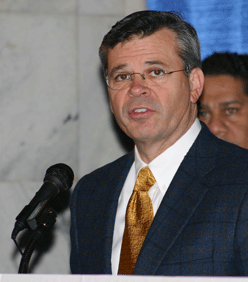
A long-running grand jury investigation into corruption in Kentucky has snared a big fish.
Gov. Ernie Fletcher was indicted yesterday on three misdemeanor counts alleging that he directed an illegal conspiracy to place his political allies in state jobs at the expense of those who might oppose him.
He is the first Republican governor since 1971 and the first of either party in Kentucky to be indicted. He entered office in 2003 on a pledge to cut "waste, fraud and abuse" in state government.
The indictments charge Fletcher with one count each of criminal conspiracy, first-degree official misconduct and violating the prohibition against political discrimination.
Fletcher's attempt to clean up government included pardoning many of his political associates:
Fletcher is the 14th person indicted by the grand jury, which for the past year has been investigating allegations of political patronage in his administration. All but Fletcher are covered by a pardon order he issued Aug. 29.
Fletcher is claiming partisan political motivation on the part of the prosecutor. Normally, such a charge would be worthy of contempt, but in this case, a jury dealing with the facts might have a hard time ignoring Fletcher's claim:
His office filed a motion in Franklin Circuit Court seeking to disqualify Democratic Attorney General Greg Stumbo and his office from the case. The motion says Stumbo wants to run against Fletcher and therefore has a conflict of interest...
The indictment also charges Fletcher perpetrated the conspiracy by making "repeated public statements" denying any conspiracy and saying publicly that his internal investigation into the allegations at the Transportation Cabinet revealed no merit system abuses occurred...
Fletcher, interviewed at the Frankfort airport yesterday, said he had "no intention" of pardoning himself.
In a comment, the governor "compared the indictments to "noodling," the sport of catching fish by hand, without a hook and bait."
Mark Your Calendar
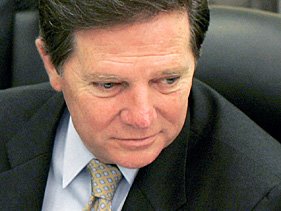
Somehow I doubt that this will be the last we see of "The Exterminator":
Rep. Tom DeLay, the former majority leader whose career was undermined by scandal, said he would resign from the House on June 9. "As you are aware," the Texas Republican wrote House Speaker J. Dennis Hastert (R-Ill.), "I have recently made the decision to pursue new opportunities to engage in the important cultural and political battles of our day from an arena outside of the U.S. House of Representatives."
Provided DeLay stays out of prison (no sure thing), he will be ideally situated to become the city's top lobbyist when the cooling off period ends.
Democrats Say No Impeachment Of Bush On Agenda
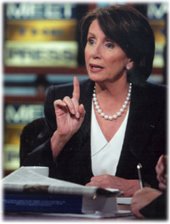
The spineless Democratic leadership in congress is afraid to alienate the moderate voters who may be tempted to vote for the Party in November.
(T)he House's top Democrat has told colleagues that the party will not seek to impeach President Bush even if it gains control of the House in November's elections, her office said last night.
Minority Leader Nancy Pelosi (Calif.) told her caucus members during their weekly closed meeting Wednesday "that impeachment is off the table; she is not interested in pursuing it," spokesman Brendan Daly said.
Some House Democrats, including ranking Judiciary Committee member John Conyers Jr. of Michigan, have called for impeachment hearings into allegations that Bush misled the nation about Iraq's alleged weapons of mass destruction and that he violated federal law by approving warrantless wiretaps on Americans. In an interview with The Washington Post last week, Pelosi said a Democratic-controlled House would launch investigations of the administration on energy policy and other matters. She said impeachment would not be a goal of the investigations, but she added: "You never know where it leads to."
GOP activists seized on the remarks to warn potential donors of Bush's possible peril if Democrats pick up the 15 net House seats they need to become the majority. The National Republican Congressional Committee republished The Post's Sunday article in a letter to supporters and donors that stated: "The threat of the Democrats taking the majority in the House this November is very real."
By being overly concerned with the opinions of cowards who don't have the guts to contemplate the necessity of impeaching President Bush, the Democrats prove yet again that--no matter how many illegal or unconstitutional acts are brazenly admitted to by the White House--no accounting of such actions is required.
Do not forget, some Democrats voted for President Clinton's impeachment.
Thursday, May 11, 2006
The Other Jerry Lewis

We are not talking about the comedian who is highly esteemed by the French, and by the inhabitants of no other nation on the planet.
It is instead the veteran Republican politician from the inland empire east of Los Angeles that is making news today.
According to the Los Angeles Times:
Federal prosecutors have begun an investigation into Rep. Jerry Lewis, the Californian who chairs the powerful House Appropriations Committee, government officials and others said, signaling the spread of a San Diego corruption probe.
The U.S. attorney's office in Los Angeles has issued subpoenas in an investigation into the relationship between Lewis (R-Redlands) and a Washington lobbyist linked to disgraced former Rep. Randy "Duke" Cunningham (R-Rancho Santa Fe), three people familiar with the investigation said.
The investigation is part of an expanding federal probe stemming from Cunningham's conviction for accepting $2.4 million in bribes and favors from defense contractors, according to the three sources.
It is not clear where the investigation is headed or what evidence the government has. But the probe suggests that investigators are looking past Cunningham to other legislators and, perhaps, the "earmarking" system that members of Congress use to allocate funds...
The government is looking into the connection between Lewis and his longtime friend Bill Lowery, the sources said. Lowery, a lobbyist, is a former congressman from San Diego.
As chairman of the Appropriations panel, Lewis has earmarked hundreds of millions of dollars in federal contracts for many of Lowery's clients, one of the sources said.
Lewis said he knew Lowery well, having spent 12 years in Congress with him, but denied favoring earmarks for Lowery's clients.
"Absolutely not," Lewis said. He said all the earmarks he authorized benefited "my constituents and my people." He said he was particularly proud of helping fund programs such as the cancer treatment center at Loma Linda University, a client of Lowery's. "That would never have been accomplished without an earmark," he said.
The Lewis investigation is in the early stages and has not been presented to a grand jury, the sources said. They spoke on condition of anonymity because they were either involved in the probe or were not authorized to speak about ongoing investigations...
The probe focuses on what one source said was an unusually close relationship between Lewis and Lowery, who served on the House Appropriations Committee together from 1985 to 1993.
Shortly after leaving Congress, Lowery founded Copeland Lowery Jacquez Denton & White, a Washington lobbying firm whose clients include Brent R. Wilkes, a defense contractor who is the focus of a separate probe in San Diego.
Wilkes has been identified by his lawyer as the unindicted "co-conspirator No. 1" in the Cunningham corruption case...
Wilkes and his companies have given Lewis at least $60,000 in campaign contributions over the years, making them among the lawmaker's largest contributors.
At the same time, Wilkes has paid Lowery's firm more than $160,000 in lobbying fees...
Investigators are said to be particularly interested in the intermingling of Lewis' and Lowery's staffs and whether it led to favorable treatment for Lowery's clients in securing government contracts.
Jeff Shockey, a key Lewis staffer, went to work for Lowery as a lobbyist in 1999 and then returned to Lewis' staff last year. According to a source familiar with the investigation, Shockey received $600,000 in severance payments from Lowery's firm before returning to Lewis to become the deputy staff director for the House Appropriations Committee--with an annual salary of $170,000.
"He is now the gatekeeper for more than $850 billion," said Keith Ashdown of Taxpayers for Common Sense, referring to the Appropriations Committee's role in disbursing government funds...
Lewis is one of the senior members of Congress, with 27 years on Capitol Hill. At one time, he was head of California's GOP delegation, and became a "cardinal"--as the chairs of Appropriations subcommittees are known--serving most recently as chairman of the Appropriations defense subcommittee and managing the biggest spending bill in the federal budget.
Last year, Lewis became chairman of the full committee, historically one of the most powerful jobs in Washington.
Roberts' Papers Still Missing

Papers written by now-Chief Justice John Roberts when he worked for the Reagan White House--which "disappeared" while in the custody of Bush White House lawyers--are still missing.
The country has John G. Roberts Jr. as its newest chief justice. What it doesn't have is an answer to the mystery of the missing file of his work papers on affirmative action.
The file, compiled during Roberts's tenure as an associate counsel in the Reagan White House, vanished in July when lawyers from the Bush administration were reviewing the materials at the Ronald Reagan Presidential Library in Simi Valley, Calif., as part of a vetting process before Roberts's formal nomination to the Supreme Court.
A newly released report from the National Archives inspector general's office shows that federal investigators failed in their first attempt to nail down what happened to the file, which became a flashpoint in Roberts's otherwise smooth confirmation process.
"This investigation is unresolved and the file is still missing," says the 64-page IG report, released in response to a Freedom of Information Act request from a Washington area researcher and posted Tuesday on the Web site Memory Hole. ". . . The OIG was unable to determine whether the missing file was taken intentionally, unintentionally, or lost."
Investigators did conclude, however, that the Archives staff did not follow agency policies and procedures in providing tens of thousands of pages of requested material to the two lawyers, who were allowed to review the documents in a private office "because it would be discreet and keep them out of sight of the main research room."
The lawyers working for the White House "were allowed to bring personal belongings with them into the room while they worked," investigators wrote. The lawyers also were left alone in the office with the records for as long as 30 minutes while they participated in conference calls with the White House, the report said...
The White House has declined to publicly reveal the identities of the lawyers who conducted the document review, and their names and those of Archives officials were redacted in the IG report.
If someone was looking at some diamond rings at a jewelry store and some of the rings "disappeared" while in the customer's custody, all hell would break loose.
Needless to say, the customer would be telling his story to a judge at his or her trial.
Wednesday, May 10, 2006
Ahmadinejad's Letter To President Bush

The full text of yesterday's 18-page letter from Iranian President Mahmoud Ahmadinejad to President Bush is not easy for Americans to find on websites of U.S. media outlets. The U.S. media briefly described some of the contents, but left some revealing passages unreported.
I was able to find a United Nations' translation of the full text of the letter on the Hong Kong-based Asia Times Online.
Ahmadinejad begins by questioning Bush's actions in light of his oft-stated belief in Christianity. Mentioning things like starting wars that kill innocents, and holding prisoners without trial.
He brings up U.S. support for Israel, asks why that regime is being supported.
Then points out U.S. opposition of democratically elected governments in Latin America, and mentions the looting of natural resources from Africa.
The Iranian leader gives Bush a list of complaints about U.S. treatment of Iran itself:
The brave and faithful people of Iran too have many questions and grievances, including: the coup d'etat of 1953 and the subsequent toppling of the legal government of the day, opposition to the Islamic revolution [of 1979], transformation of an embassy into a headquarters supporting the activities of those opposing the Islamic Republic (many thousands of pages of documents corroborates this claim), support for Saddam in the war waged against Iran, the shooting down of the Iranian passenger plane, freezing the assets of the Iranian nation, increasing threats, anger and displeasure vis-a-vis the scientific and nuclear progress of the Iranian nation (just when all Iranians are jubilant and collaborating with their country's progress), and many other grievances that I will not refer to in this letter.
Then the Iranian leader gets to the part which I find very intriguing. He condemns the 9-11 attacks, then adds:
All governments have a duty to protect the lives, property and good standing of their citizens. Reportedly your government employs extensive security, protection and intelligence systems - and even hunts its opponents abroad. September 11 was not a simple operation. Could it be planned and executed without coordination with intelligence and security services--or their extensive infiltration? Of course this is just an educated guess. Why have the various aspects of the attacks been kept secret? Why are we not told who botched their responsibilities? And, why aren't those responsible and the guilty parties identified and put on trial?
Ahmadinejad is clearly referring to the key to the 9-11 attacks--how the hijackers were able to know ahead of time that the U.S. military was to be conducting hijacking exercises, the perfect cover for real hijackings--on the morning of Sept 11, 2001. The proof that inside help was given to the hijack plotters is the simultaneity of the hijack exercises and the real hijackings. Although this does not point to the specific malefactors, circumstantial evidence of lesser quality has been used to successfully identify countless people suspected of crimes.
The Iranian president accurately points to the information operations since 9-11 that have swayed the American people to support the most questionable foreign policy objectives in decades:
All governments have a duty to provide security and peace of mind for their citizens. For some years now, the people of your country and neighbors of world trouble spots do not have peace of mind. After 9-11, instead of healing and tending to the emotional wounds of the survivors and the American people--who had been immensely traumatized by the attacks--some Western media only intensified the climates of fear and insecurity--some constantly talked about the possibility of new terror attacks and kept the people in fear. Is that service to the American people? Is it possible to calculate the damages incurred from fear and panic?
American citizens lived in constant fear of fresh attacks that could come at any moment and in any place. They felt insecure in the streets, in their place of work and at home. Who would be happy with this situation? Why was the media, instead of conveying a feeling of security and providing peace of mind, giving rise to a feeling of insecurity?
Some believe that the hype paved the way--and was the justification--for an attack on Afghanistan. Again I need to refer to the role of media. In media charters, correct dissemination of information and honest reporting of a story are established tenets. I express my deep regret about the disregard shown by certain Western media for these principles. The main pretext for an attack on Iraq was the existence of WMDs. This was repeated incessantly - for the public to, finally, believe - and the ground set for an attack on Iraq.
Will the truth not be lost in a contrive and deceptive climate? Again, if the truth is allowed to be lost, how can that be reconciled with the earlier mentioned values?
Ahmadinejad is clearly aware of, and is objecting to the current anti-Iran info-op which we have been covering here for many months. He knows the goals of the campaign and is issuing his protestation before the bombs start dropping.
The Iranian leader ends his letter to President Bush by trying to stress the commonality of Christian and Islamic prophets and teachings, and tries to reach a common ground between the two men.
Do you not think that if all of us come to believe in and abide by these principles, that is, monotheism, worship of God, justice, respect for the dignity of man, belief in the Last Day, we can overcome the present problems of the world--that are the result of disobedience to the Almighty and the teachings of prophets--and improve our performance?
Ahmadinejad's approach might curry some favor with a truly religious man. Unfortunately, Bush's actions mark him as far from a believer in the teachings of his avowed saviour. That's why the Iranian president's effort to reach out to the American president will fall on deaf ears.
The U.S. media's reluctance to fully report on the letter--understandable in light of the allegations made by Ahmadinejad about media propagandizing--is the reason most Americans won't learn of the full details of this communication between leaders.


