Friday, March 31, 2006
Money Sometimes Don't Mean Shit
A: Zero
New "527" Group Rules In Offing

The GOP attempts to weaken the influence of "527" groups hit a temporary roadblock yesterday when a judge refused to immediately impose new regulations on the use of these campaign finance tools.
The Democratic Party-favored "527s" respite will only be brief, however, since the judge ordered the FEC to start implementing rules to rein in these groups or explain why it is not necessary.
U.S. District Judge Emmet G. Sullivan has rejected requests by the Bush-Cheney campaign and by two advocates of campaign finance legislation to order the Federal Election Commission to impose tough regulations on "527" political committees that put more than $400 million into the 2004 elections.
Instead, in a ruling issued late Wednesday evening, the judge gave the FEC a choice: Either explain in detail why regulations are not needed or begin proceedings to develop such rules...
The judge warned that if the FEC continues to treat 527 committee complaints on a case-by-case basis instead of issuing encompassing rules, it will have to explain how the interests of complainants will be protected under time-consuming processes that often do not produce any action until the election is over...
Sullivan's decision means the FEC must once again tackle the tough issue of the independent political committees, which were used in 2003-04 to get around legislation banning the use of large donations from unions, corporations and rich people -- also known as "soft money."
The transfer of wealth to the rich is what American democracy is really all about, the Republican and Democratic parties are both engineered for this purpose.
That's why the really big money gives to both parties.
If "527" groups are stifled in any real way, this will not stop the spigot of funds to favored candidates.
The real owners of the United States will simply have their lawyers work out another mechanism to maintain the ongoing theft of the nation's bounty from the citizens.
NASA To No Longer Require Minders When Scientists Talk To Media

After being rightfully criticized for various intrusions on the free speech of their scientists, NASA is taking steps to permit more unfettered discussion of controversial topics.
NASA Administrator Michael D. Griffin unveiled new rules yesterday that govern the release of agency information to news media and the public, his most detailed response yet to embarrassing allegations that NASA's public affairs office had sought to suppress the release of scientific information not consistent with the views of the Bush administration.
The new eight-page policy, written by an internal team of scientists, lawyers, public affairs specialists and managers, states that NASA scientists are free to talk to members of the media about their scientific findings and even express personal interpretations of those findings -- the heart of the controversy that has engulfed the agency since January.
It also makes clear that scientists are not required to have a public affairs officer with them when they speak with members of the media, though Griffin emphasized yesterday in comments broadcast to NASA employees that he believes such behavior is unwise.
"If you're not a media professional, then to go into an interview without a media professional is courting trouble," he said. "But you can do as you like."
Griffin had promised the revamped policy in February, after NASA employees complained publicly that information had been manipulated in ways that suited the Bush administration.
The Bush administration's modus operandi is to manipulate information to better suit their various agendas. The NASA scientists are on a much stronger footing than the hapless bureaucrats at other agencies who cant come forward to complain because of the classified nature of the information being "influenced" by the administration.
Thursday, March 30, 2006
Bush Knowingly Lied About Aluminum Tubes in 2003 SOTU
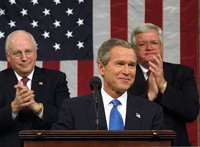
A new article by Murray Waas in the National Journal shows that President Bush's 2003 State of the Union claims about Iraq's aluminum tubes being for nuclear weapons production was known to him to be a highly disputed piece of intelligence.
A dissent (or alternate view) from the State and Energy Department's intelligence arms saying that the tubes could not be used in a uranium enrichment centrifuge was included in the one-page President's Summary of the National Intelligence Estimate (NIE).
Karl Rove, President Bush's chief political adviser, cautioned other White House aides in the summer of 2003 that Bush's 2004 re-election prospects would be severely damaged if it was publicly disclosed that he had been personally warned that a key rationale for going to war had been challenged within the administration. Rove expressed his concerns shortly after an informal review of classified government records by then-Deputy National Security Adviser Stephen J. Hadley determined that Bush had been specifically advised that claims he later made in his 2003 State of the Union address -- that Iraq was procuring high-strength aluminum tubes to build a nuclear weapon -- might not be true, according to government records and interviews.
Hadley was particularly concerned that the public might learn of a classified one-page summary of a National Intelligence Estimate, specifically written for Bush in October 2002. The summary said that although "most agencies judge" that the aluminum tubes were "related to a uranium enrichment effort," the State Department's Bureau of Intelligence and Research and the Energy Department's intelligence branch "believe that the tubes more likely are intended for conventional weapons."...
For one, Hadley's review concluded that Bush had been directly and repeatedly apprised of the deep rift within the intelligence community over whether Iraq wanted the high-strength aluminum tubes for a nuclear weapons program or for conventional weapons.
For another, the president and others in the administration had cited the aluminum tubes as the most compelling evidence that Saddam was determined to build a nuclear weapon -- even more than the allegations that he was attempting to purchase uranium...
"Presidential knowledge was the ball game," says a former senior government official outside the White House who was personally familiar with the damage-control effort. "The mission was to insulate the president. It was about making it appear that he wasn't in the know. You could do that on Niger. You couldn't do that with the tubes."
On July 18, the Bush administration declassified a relatively small portion of the NIE and held a press briefing to discuss it, in a further effort to show that the president had used the Niger information only because the intelligence community had vouched for it. Reporters noted that an "alternate view" box in the NIE stated that the State Department's Bureau of Intelligence and Research (known as INR) believed that claims of Iraqi purchases of uranium from Africa were "highly dubious" and that State and DOE also believed that the aluminum tubes were "most likely for the production of artillery shells."
But White House Communications Director Dan Bartlett suggested that both the president and Rice had been unaware of this information: "They did not read footnotes in a 90-page document." Later, addressing the same issue, Bartlett said, "The president of the United States is not a fact-checker."
Because the Bush administration was able to control what information would remain classified, however, reporters did not know that Bush had received the President's Summary that informed him that both State's INR and the Energy Department doubted that the aluminum tubes were to be used for a nuclear-related purpose...
Later that summer, the Senate Intelligence Committee launched an investigation of intelligence agencies to determine why they failed to accurately assess that Saddam had no viable programs to develop chemical, biological, or nuclear weapons at the time of the U.S. invasion.
As National Journal first disclosed on its Web site on October 27, 2005, Cheney, Libby, and Cheney's current chief of staff, David Addington, rejected advice given to them by other White House officials and decided to withhold from the committee crucial documents that might have shown that administration claims about Saddam's capabilities often went beyond information provided by the CIA and other intelligence agencies. Among those documents was the President's Summary of the October 2002 National Intelligence Estimate.
No wonder that the Senate Intelligence Committee, chaired by the odious Sen. Pat Roberts, has refused to conduct the Phase II investigation of the administration's misuse of intelligence to lure the nation into war on false pretenses.
Murray Waas also indicates in his fine article that the bizarre behavior of the administration in Plamegate can be logically explained as their energetic efforts to muddy the waters with the Niger uranium issue in order to obfuscate the more blatant cherry-picking of intelligence about the aluminum tubes.
Federal Prosecutorial Skullduggery

The "war on terror" has inspired federal lawyers in at least two cases now to resort to unethical and potentially illegal tactics in order to administer what passes for justice these days.
The skullduggery involved in the Detroit prosecutions of alleged Muslim jihadists has been long public. The chickens are coming home to roost now for some of the government malefactors.
A former federal prosecutor and a State Department security officer were indicted yesterday on charges that they lied during a bungled terrorism trial in Detroit and then sought to cover up their deceptions once the case began to fall apart.
Former assistant U.S. attorney Richard G. Convertino, 45, and State Department special agent Harry R. Smith III, 49, were charged with conspiracy, obstruction of justice and making false statements in connection with the 2003 prosecution, according to an indictment handed up by a federal grand jury in Detroit...
Legal experts said yesterday that an indictment of a prosecutor for improper conduct in a federal courtroom is extraordinarily rare, if not unprecedented, in modern times.
"The charge is essentially that he prosecuted too aggressively and crossed the line," said Stephen Gillers, a New York University law professor who specializes in legal ethics. "This is simply astonishing."
Convertino also is charged with presenting false information at a sentencing hearing in a separate drug case to gain a light prison term for an informant...
Convertino led the prosecution of Karim Koubriti and three other North African immigrants, who were alleged to be part of a "sleeper operational combat cell." The government gained three convictions -- including two on terrorism charges -- but they were dismissed in 2004 after the Justice Department announced it had uncovered serious prosecutorial misconduct.
A report by a special Justice Department attorney assigned to review the case found that the prosecution had failed to turn over dozens of pieces of evidence to the defense. The "pattern of mistakes and oversights," along with possible misconduct, was so egregious that the government had little choice but to withdraw its case, his report said...
Convertino faces up to 30 years in prison and a $1 million fine, while Smith could be sentenced to 20 years behind bars and a $750,000 penalty.
The indictment alleges that, during the trial, Convertino concealed photographs taken by Smith and another State Department staff member of Queen Alia Hospital in Jordan. Convertino had alleged that the defendants made a casing sketch of the military hospital in preparation for a terrorist attack, and Smith testified that he had no photographs with which to compare the sketches.
But Justice investigators said later that Convertino knew U.S. officials had taken numerous photographs and that "it is difficult, if not impossible, to compare the . . . sketches with the photos and see a correlation."
Carla J. Martin, the government lawyer who is alleged to have coached witnesses in the sentencing trial of Zacarias Moussaoui, is facing a federal investigation of her own.
The U.S. attorney's office in Alexandria quite sensibly recused itself from the matter. The U.S. attorney in Philadelphia will be conducting the inquiry.
She was subpoenaed to appear in U.S. District Court in Alexandria on Monday to answer questions about her conduct, but the subpoena was quashed. In a closed hearing March 21, when U.S. District Judge Leonie M. Brinkema granted the request by defense lawyers to subpoena Martin, Brinkema disclosed the investigation.
"I am advised by the U.S. attorney's office that there very well may be a prosecution of her; at least they are looking at the possibility," Brinkema said. "I understand this office [the U.S. attorney's office in Alexandria] will recuse itself, and I think the Eastern District of Pennsylvania is going to handle it."
"That's correct, your honor," said Assistant U.S. Attorney Robert A. Spencer.
The rules for dealing with "terror" cases have clearly been loosened all across the board. NSA warrantless wiretapping, Geneva convention violations, including torture, detaining U.S. citizens without due process, establishing secret foreign prisons, etc.
What will come out next?
Maybe nothing. Although only the NSA controversy resulted from leaks, the crackdown on leakers and their contacts is well underway to stop any further revelations.
Senate Passes Weak Lobbying Reform Bill
The Senate voted yesterday to require lobbyists to provide far more information about their dealings with lawmakers, responding to the Jack Abramoff political corruption scandal with a plan for more disclosure rather than tougher enforcement of ethics laws.
By a vote of 90 to 8, the Senate approved a bill that would also force the disclosure for the first time of indirect lobbying, such as grass-roots activities, and prevent registered lobbyists from paying for lawmakers' meals or giving them gifts such as sports tickets. Congressional leaders had promised far-ranging revisions of lobbying activities after Abramoff pleaded guilty in January to conspiring to bribe public officials. But the legislation that emerged yesterday is less sweeping than GOP leaders envisioned...
On Tuesday, the Senate rejected a bipartisan plan to create an independent investigative office designed to help the Senate's ethics committee enforce lobbying and ethics laws. Sen. Barack Obama (D-Ill.), one of the authors of the Democrats' lobbying proposals, voted against the Senate bill in part because it did not contain the office of public integrity.
Senate and House leaders will have to reconcile differences before Congress can send a final bill to the president. The House's leading ethics proposal, offered by its Republican leaders, would also broaden disclosure requirements, though not for such grass-roots activities as instigating e-mails, letters and phone calls from voters back home. The House plan would bar neither meals nor gifts...
Besides Obama and John McCain (Ariz.), the other six senators voting against the measure were Democrats Russell Feingold (Wis.) and John F. Kerry (Mass.), and Republicans Tom Coburn and James M. Inhofe of Oklahoma, Jim DeMint and Lindsey O. Graham of South Carolina. Not voting were West Virginia Democrats Robert C. Byrd and John D. Rockefeller IV...
"This legislation contains very serious reform," said Sen. Joseph I. Lieberman (D-Conn.), one of the architects of the Senate bill...
Asked if the measure meets the sweeping pledges of change voiced by senior members of the House and Senate early in the year, McCain laughed. "The good news is there will be more indictments, and we will be revisiting this issue," he said.
McCain gets the last word.
Wednesday, March 29, 2006
Abramoff Gets Nearly Six Years
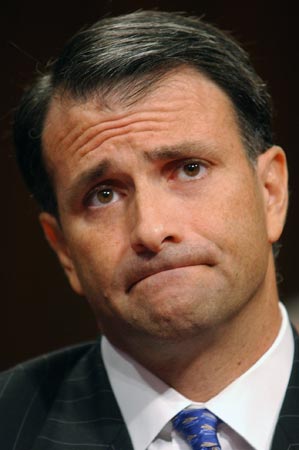
Everybody's favorite lobbyist received his sentence today for the Miami part of his legal troubles.
Jack A. Abramoff, the once-powerful Republican lobbyist at the center of a major corruption scandal, was sentenced in Miami today to five years and 10 months in prison for his role in the fraudulent purchase of a fleet of casino cruise ships. An associate received the same sentence.
U.S. District Judge Paul C. Huck sentenced Abramoff, 47, and his former partner, Adam R. Kidan, 41, after considering their pleas for the shortest possible prison terms. Each laid most of the blame on the other for the scam, in which they faked a $23 million wire transfer to obtain financing for the 2000 purchase of SunCruz Casinos from an owner who was later shot to death in a gangland-style hit...
The judge opted today for the minimum. But Abramoff faces the prospect of at least a few additional years in prison when he is sentenced in a separate case in Washington, D.C.In that second case, Abramoff pleaded guilty in January to federal charges of fraud, tax evasion and conspiracy to bribe public officials. His plea deal with federal prosecutors in that case required him to cooperate with a broad federal investigation of corruption involving members of Congress, congressional staffers, other lobbyists and employees of the Interior Department and other federal agencies.
Among the congressmen whose names have come up in the probe are Rep. Robert W. Ney (R-Ohio), former chairman of the House Administration Committee, and Rep. Tom DeLay (R-Tex.), the former House majority leader.
Colloquy Charade
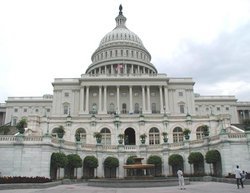
Some Republican Senators have engaged in the legal, but questionable tactic of "colloquy"--inserting a fictional debate into the Congressional Record--and pointing to the charade in order to influence the Supreme Court deliberations in a major case.
According to the official Congressional Record of Dec. 21, 2005, Sens. Lindsey O. Graham (R-S.C.) and Jon Kyl (R-Ariz.) held a long conversation on the Senate floor about an amendment bearing Graham's name that restricts the legal rights of detainees in the military prison at Guantanamo Bay, Cuba.
"I agree entirely," Graham responds to Kyl at one point. "I have just been handed a memorandum on this subject," Kyl says later. Another Republican senator, Sam Brownback of Kansas, interrupts the two with his own commentary.
But those exchanges never occurred. Instead, the debate -- which runs 15 pages and brims with conversational flourishes -- was inserted into the Congressional Record minutes before the Senate gave final approval to the legislation.
In legal briefs to the Supreme Court, which took up the issue yesterday, the Justice Department cites the material as evidence that Congress intended the Detainee Treatment Act to retroactively invalidate pending legal challenges by hundreds of detainees held at Guantanamo Bay. Graham and Kyl submitted a friend-of-the-court brief asserting the same thing...
The briefs filed in support of the government do not make clear that the Graham-Kyl debate was manufactured. In their friend-of-the-court brief, filed in February, Graham and Kyl note that the "Congressional Record is presumed to reflect live debate except when the statements therein are followed by a bullet . . . or are underlined."
The Graham-Kyl exchange is not marked in either way, although a C-SPAN recording and other records make clear that the discussion never happened...
David H. Remes, a Washington lawyer who has helped Hamdan's defense team, called the colloquy "outrageous."
"This colloquy is critical to the government's legislative history argument, and it's entirely manufactured and misrepresented to the court as having occurred live on the Senate floor before a crucial vote," Remes said.
The goopers have gotten away with so much malfeasance so far during their control of the White House and Congress that they think they are exempt from the normal conventions of civilized behavior.
I wonder how they will like it when their precedent for fast and loose behavior are copied by their opponents when the Republicans are again the minority party.
That is, if in the new environment of mandatory electronic voting, the Republicans are ever forced to relinquish power.
Tuesday, March 28, 2006
Senate Judiciary Committee To See Action This Week

The extra-legal NSA warrantless eavesdropping program will be examined today by Sen. Arlen Specter's Senate Judiciary Committee:
Needless to say, not all lawmakers agree that Bush broke the law, and the issue should get a good airing this morning in a separate hearing before Specter's panel. Four federal judges are slated to discuss proposals to bring the eavesdropping program, which is conducted by the National Security Agency, under the auspices of the Foreign Intelligence Surveillance Act...
Some of the judges have served on the FISA court. Also scheduled to testify today are Morton H. Halperin of the Open Society Policy Center and David S. Kris, senior vice president of Time Warner Inc.
Later in the week, things might get interesting:
The Senate Judiciary Committee has scheduled a Friday hearing on Sen. Russell Feingold's resolution to censure President Bush for authorizing warrantless surveillance of Americans' international phone calls and e-mails. The measure has divided Feingold's fellow Democrats, some of whom fear he is helping Republicans shift attention from the GOP's problems in dealing with Iraq, hurricane relief and other matters.
The goopers will be in fine form, I'm sure.
Feingold will no doubt be on the receiving end of some of the most colorful (within Senate decorum) diatribes we have seen in many moons.
That is, if the goopers don't succeed in persuading their man Specter to cancel Friday's hearing first.
"EXCUSE MATRIX" Info-Op Update

The information operation against Russia is showing signs of mismanagement barely four days into the effort. Defense is unable to get all of the uniformed military commands to work from the same playbook.
The U.S. military's Central Command said yesterday it has not opened an investigation into whether sources inside the command leaked details of the 2003 U.S. invasion of Iraq to Russian officials, and distanced itself from captured Iraqi documents that contain the allegations...
A Central Command official said the command takes "all matters of operational security seriously" but was not probing the allegations...
In e-mailed statements in response to questions, Centcom cast doubt upon the validity of the captured Iraqi documents: "It's important to remember that the information came from an Iraqi intelligence report.
"Central command does not vouch for the document's accuracy or authenticity," the statement said...
Such views contrast with those of the authors of the 210-page Iraqi Perspectives Project study released Friday by the U.S. Joint Forces Command in Norfolk. They said they believe the Iraqi documents are authentic. Retired Lt. Col. Kevin M. Woods, the project director, said he had "no reason to doubt the Iraqi documents."...
The Central Command spokesman, said no one in his office knew of the existence of the Iraqi documents before the study's release on Friday, and that it was "highly possible" the military released them without prior vetting by Central Command.
The editorial page of the Washington Post proves today that it is still on board with the anti-Russia propaganda program, itself a sideshow (and liability) to the larger anti-Iran information operation.
"I do think we have to look at the documents and look very carefully," Secretary of State Condoleezza Rice said. "But I don't want of jump out ahead and start making accusations about what the Russians may or may not have known." Fair enough, but a Pentagon study has already been through at least part of that exercise. It found no reason to doubt the documents' authenticity.
The news that Moscow would have helped Saddam Hussein fight U.S. forces might be unwelcome to those administration officials who still try to portray Mr. Putin as a partner of the West and a worthy host for the next summit of the Group of Eight nations. But it shouldn't be surprising. As has been well documented, Russia did its best to weaken and then break the sanctions regime imposed on Iraq, and then to prevent the 2003 invasion. In exchange it reaped lucrative economic concessions from Saddam Hussein, including the payment of large bribes to senior officials and politicians.
Ms. Rice and other Putin apologists ignore all this in part because they believe Russia will be helpful in stopping Iran's nuclear program. But Russia hasn't been helpful. Since its compromise offer to allow Iran to enrich uranium in Russian facilities failed to gain traction, it has dedicated itself to blocking concerted action by the United States and its European allies in the U.N. Security Council. Meanwhile it is discussing the sale to Iran of surface-to-air missiles. As Mr. Putin knows, Iran wants those weapons in the event its drive to obtain nuclear bombs eventually leads to a military confrontation -- with the United States. But the possible consequences of bolstering the defenses of a U.S enemy may not deter him. After all, he has suffered none for Russia's actions in Iraq.
The lack of professionalism in executing the EXCUSE MATRIX info-op comes from ignoring one of the oldest rules in the business.
You never want to have too many cooks in the kitchen.
Monday, March 27, 2006
Skimming From Earmarks For Campaign Contributions
The lobbying reform effort is edging ever so slowly in the direction of the real source of lobbyists' influence, the ability to direct campaign contributions to helpful politicians.
These mutually beneficial transactions are legal under House ethics rules. As long as there is no explicit quid pro quo, lawmakers can channel clients to lobbyists, who help secure home-district pet projects, or "earmarks," and in turn, those lobbyists can send part of their fees back in the form of campaign contributions. But in the wake of the corruption scandals of former representative Randy "Duke" Cunningham (R-Calif.) and former lobbyist Jack Abramoff, congressional reformers want to shine a light on dealings that have even a whiff of impropriety.
Most politicians are lawyers. They are smart enough to engineer any fund raising in a way in which there is no explicit quid pro quo. The Dukestir probably should have gone to law school.
Proposals pending before the House and Senate would force lawmakers to reveal their contacts with lobbyists and disclose their involvement in winning federal spending provisions or earmarks for constituents or special interests. If such disclosures become mandatory, some in Congress hope past practices will shrivel in the light of day. If not, they hope to win passage of provisions that would allow improperly secured earmarks to be struck from bills on the House or Senate floor. The Senate will take up earmark-reform proposals as early as today, when it turns its attention to a broad package of lobbying and ethics rule changes.
The elected politicians know that the average overworked voter doesn't understand the nuts and bolts of
"As the amount of earmarking increases, the amount contributed to campaigns increases. The lawmaker is getting a cut of the money he helped generate," said Scott Lilly, a former chief Democratic aide on the House Appropriations Committee and now a senior fellow at the Center for American Progress.
Do not expect this to change. Nor hold your breath for any crackdown on lobbyist-related campaign contributions.
Treacherous Groups Targeted By FBI

We have known for quite a while now about the FBI's surveillance of anti-war protesters and environmental activists, but today's Los Angeles Times reports on several other shadowy groups that the feds are spying on. One stands out as particularly suspicious.
It is people who feed vegetarian meals to the homeless.
The FBI's encounters with activists are described in hundreds of pages of documents obtained by the American Civil Liberties Union under the Freedom of Information Act after agents visited several activists before the 2004 political conventions. Details have steadily trickled out over the last year, but newly released documents provide a fuller view of some FBI probes...
The list included Food Not Bombs, which mainly serves vegetarian food to homeless people, and, with a question mark next to it, Indymedia, a collective that publishes what it calls radical journalism online.
I hope these agents got hazardous duty pay.
It is interesting that the feds target groups opposed to war. The logic there must be that groups that dislike official violence may embrace non-official violence as psychological compensation. Or something like that.
Denver, where the ACLU fought a lengthy court battle with local police over its spying on political groups, has the most extensive records of encounters between the FBI and activists. Documents obtained by the ACLU there revealed how agents monitored the lumber industry demonstration, an antiwar march and an anarchist group that activists say was never formed...
In June 2002, environmental activists protested the annual meeting of the North American Wholesale Lumber Assn. in Colorado Springs. An FBI memo justified opening an inquiry into the protest because an activist training camp was to be held on "nonviolent methods of forest defense, security culture, street theater and banner making."...
About 30 to 40 people attended the protest; three were arrested for trespassing while hanging a political banner. Colorado Springs police faxed the FBI a three-page list of demonstrators' license plate numbers...
"There's a lot of responsibility on the FBI," said Joe Airey, head of the FBI's Joint Terrorism Task Force in Denver. "We have a real obligation to make sure there are no additional terrorist acts on this soil."
The bottom line is that if and when any future terrorist attacks occur in the U.S., the investigative agencies will have to explain how wasting manpower on crap like this helped to detect the plot that they will have just missed.
Sunday, March 26, 2006
Electronic Voting Machine Skullduggery

A Florida elections official who looked a little too closely at how manipulatable the "tamper proof" electronic voting machines really are is finding that none of the three big companies who make these jewels are willing to do business with him absent an agreement from him not to rigorously test the machines.
The maverick elections supervisor in Leon County, Fla., last year helped show that electronic voting machines from one of the major manufacturers are vulnerable, according to experts, and would allow election workers to alter vote counts without detection.
Now, however, (Ion) Sancho may be paying an unexpected price for his whistle-blowing: None of the state-approved companies here will sell him the voting machines the county needs...
There are three vendors approved to sell voting equipment in Florida, and each has indicated it cannot or will not fill Sancho's order for 160 voting machines for the disabled. Already, he has had to return a $564,000 federal grant to buy the machines because he has been unable to acquire the machines yet...
The trouble began last year when Sancho allowed a Finnish computer scientist to test Leon County's Diebold voting machines, a common type that uses an optical scanner to count votes from ballots that voters have marked. Diebold Election Systems is one of the largest voting machine companies in the United States.While some tests showed that the system is resistant to outside attack, others showed that elections workers could alter the vote tallies by manipulating the removable memory cards in the voting machines, and do so without detection...
last month, California elections officials arranged for experts to perform a similar analysis of the Diebold machines and also found them vulnerable -- noting a wider variety of flaws than Sancho's experts had. They characterized the vulnerabilities as "serious" but "fixable."
"What he [Sancho] discovered was -- oops -- that the conventional wisdom was all wrong," said (David Wagner, a computer scientist at the University of California at Berkeley), a member of the panel that reviewed the Diebold machines. "It was possible to subvert the memory card without detection."
The industry is trying to fight back. If they weren't concerned about rigorous testing, why are they so touchy about selling their product to Sancho?
A spokesman said Diebold will not sell to Sancho without assurances that he will not permit more such tests, which the company considers a reckless use of the machines...
Another company, Sequoia Voting Systems, backed out of discussions with Sancho earlier this year. Spokesman Michelle Shafer said the company lacks the capacity to fill his order.
The third voting machine company, Election Systems & Software Inc., did not respond to three calls for comment directed through their sales representative.
Saturday, March 25, 2006
Patriot Act Signing Statement Skullduggery

President Bush has again utilized the slimy tactic of issuing a dubious "signing statement" to subvert the intentions of the lawmakers who have written and approved a piece of legislation.
This time it was used on the reauthorization of the Patriot Act.
When President Bush signed the reauthorization of the USA Patriot Act this month, he included an addendum saying that he did not feel obliged to obey requirements that he inform Congress about how the FBI was using the act's expanded police powers.
The bill contained several oversight provisions intended to make sure the FBI did not abuse the special terrorism-related powers to search homes and secretly seize papers. The provisions require Justice Department officials to keep closer track of how often the FBI uses the new powers and in what type of situations. Under the law, the administration would have to provide the information to Congress by certain dates...
Bush signed the bill with fanfare at a White House ceremony March 9, calling it ''a piece of legislation that's vital to win the war on terror and to protect the American people." But after the reporters and guests had left, the White House quietly issued a ''signing statement," an official document in which a president lays out his interpretation of a new law.
In the statement, Bush said that he did not consider himself bound to tell Congress how the Patriot Act powers were being used and that, despite the law's requirements, he could withhold the information if he decided that disclosure would ''impair foreign relations, national security, the deliberative process of the executive, or the performance of the executive's constitutional duties."...
Bush wrote: ''The executive branch shall construe the provisions . . . that call for furnishing information to entities outside the executive branch . . . in a manner consistent with the president's constitutional authority to supervise the unitary executive branch and to withhold information... "
(W)hen Congress passed a law forbidding the torture of any detainee in US custody, Bush signed the bill but issued a signing statement declaring that he could bypass the law if he believed using harsh interrogation techniques was necessary to protect national security.
After the torture bill signing statement became public, a wag told me that he is planning to buy a car. The fellow said that at the moment he signs the contract for the car loan, he will issue a signing statement declaring that the terms of the agreement are hereby changed to make the payments optional.
How do you think that will work?
GOP Strategy For Campaign Season

The GOP will be the beneficiary of President Bush's default strategy for trying to keep majorities in both chambers on Capitol Hill.
The plan is to be: All Fearmongering, All The Time.
President Bush on Friday provided a preview of his two-front strategy for protecting the Republican congressional majority in an ominous political climate: hammer Democrats on national security and the economy, and raise millions of dollars for embattled GOP candidates such as Rep. Michael E. Sodrel (Ind.).
At a luncheon fundraiser here, Bush repeatedly called Sodrel an indispensable ally in fighting terrorism, and emphasized his support for the military and a robust U.S. foreign policy. Sodrel, he said, "understands this is a nation at war" against terrorists intent on striking America again. It is imperative that voters elect candidates who know that "there is an enemy which hates those of us who embrace freedom and would like to strike us again."...
Election analysts say Republicans could lose seats, if not their House and Senate majorities, if the public's gloomy view of Bush, Congress and the direction of the country does not brighten this summer.A Democratic majority in the House or the Senate would be likely to launch hearings and investigations into the war and other issues, and would be positioned to stop the Bush agenda in the remaining two years of the Bush presidency. "The Democrats' plan for 2006? Take the House and Senate, and impeach the president," Ken Mehlman, the chairman of the Republican National Committee, warned in a fundraising e-mail sent to party members this week. "With our nation at war, is this the kind of Congress you want?"
I think Mehlman might be surprised to learn that, yes this is the kind of Congress that the people want.
That's why the goopers enacted the electronic voting legislation. Just in case things get worse for them.
Bush realizes, aides say, that he is no longer the political force he was in the days before the 2002 and 2004 elections, when lawmakers lined up for high-profile presidential visits. In fact, some lawmakers in tight races in swing states such as Ohio have passed on chances to appear side by side with Bush at recent events. Santorum, for instance, cited "scheduling conflicts" in skipping a recent Bush speech in his state but has not missed a chance to raise money with the president at private gatherings like the one held Friday night...
The short-term goal is stabilize Bush's low public-approval ratings by talking about the progress and prospects for victory in Iraq. The White House also hopes to minimize intramural GOP feuding with a skeletal domestic agenda.
"A skeletal domestic agenda" to promote sounds an awful lot like the emphasis will be on his patented "you're either with the Republicans, or you are sharing a cave with Osama bin Laden."
Bush knows he cannot allow the Congress fall into hostile hands. He may preface his warnings by appealing to the American people's dislike of losing wars, but political cover for Bush's extra-legal activities may be the bigger impetus for his efforts towards getting his GOP allies returned to Washington this November.
Iran's 164-Centrifuge "Cascade"
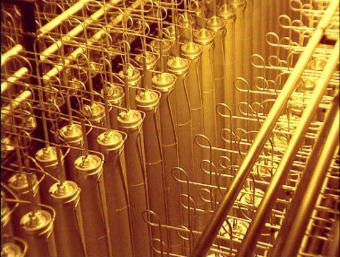
Our regular coverage of the anti-Iran info-op takes us today in the direction of a purported technological breakthrough that is allegedly near at hand by Iran in their efforts at uranium enrichment.
The U.N. nuclear watchdog, the International Atomic Energy Agency, last week briefed diplomats from Britain, France, the United States, China, Russia and Germany, at the request of all six countries, on the progress Iran has made in assembling a 164-centrifuge "cascade" for uranium enrichment. Such a cascade would be far too small to produce enough weapons-grade fuel for a bomb, experts said. But U.S. and British officials expressed concern that it showed Tehran was mastering the enrichment technology as it works toward building an industrial-scale nuclear enrichment program that would run thousands of centrifuges with the capacity to produce fuel for weapons...
Getting multiple centrifuges to operate together in arrays known as cascades is one of the most daunting engineering challenges in the process of developing enriched uranium. Until now, Iran has been trying to get about 20 centrifuges to work in a cascade. The attempt to try 164 suggests that the Iranians have succeeded at the lower number, but IAEA officials cautioned in the briefing that Iran still faces many technical hurdles in operating a larger cascade, according to U.S. and European officials.Britain's ambassador to the United Nations, Emyr Jones Parry, said he is "very concerned" that the latest Iranian advance will provide Iran with the technological expertise needed to enrich uranium on a much larger scale. "If you can do 164, you can probably do many more" centrifuges, Jones Parry said. "That means you have the potential to do full-scale enrichment."
A senior U.S. official said that the Bush administration expressed similar concerns. "The reports that Iran is speeding up its enrichment program at Natanz is alarming to all of us, not just to the United States," the official said.
Is everyone scared enough yet to support a bombing campaign?
No?
Then keep reading these reports as we file them. They will find something to convince you. The info-op is building toward a crescendo.
The Ground Zero Grassy Knoll
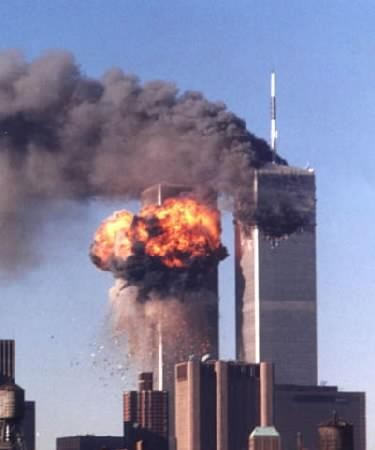
The March 27 issue of New York magazine has an article, The Ground Zero Grassy Knoll, on the current crop of 9-11 conspiracy theories. Aficionados of this genre will find little or nothing new here, but the way the writer, Mark Jacobson, presents his material makes for an interesting read.
Father Frank Morales's conversion was more dramatic. Raised in the Jacob Riis Projects, Morales, who if not for his priest collar could be mistaken for an East Village hipster, is a longtime Lower East Side hero, primarily for his work with local squatter communities. The day after 9/11, the diocese asked if he'd go to ground zero to perform last rites. "They said be prepared, because "we're not talking bodies, Frank, we're talking body parts.""
"I could feel myself getting madder and madder, not the way a priest is supposed to feel," says Morales. Sitting with a fireman, Morales called out, "If I had somebody in this mess, I'd wanna get those motherfuckers." It was then, Morales says, that the fireman whispered, "Hey, that'’s not it. You wanna know something? Bush and bin Laden have the same banker."
Later Jacobson describes his own experiences of that day:
Hours later, I sat down beside another, impossibly weary firefighter. Covered with dust, he was drinking a bottle of Poland Spring water. Half his squad was missing. They'd gone into the South Tower and never come out. Then, almost as a non sequitur, the fireman indicated the building in front of us, maybe 400 yards away.
"That building is coming down," he said with a drained casualness.
"Really?" I asked. At 47 stories, it would be a skyscraper in most cities, centerpiece of the horizon. But in New York, it was nothing but a nondescript box with fire coming out of the windows. "When?"
"Tonight . . . Maybe tomorrow morning."
This was around 5:15 p.m. I know because five minutes later, at 5:20, the building, 7 World Trade Center, crumbled.
LIHOP, MIHOP, and assorted other theories are discussed, and deals briefly with the reason why it will be impossible to decipher the truth of the matter--disinformation intentionally placed in the path of the researcher:
The D-word is nothing to take lightly in conspiracy circles. For, as Thomas Pynchon notes in his "Proverbs for Paranoids," if they can get you asking the wrong questions, they don't have to worry about answers.
Bingo.
There exists many labyrinths and wild goose chases designed to divert anyone who looks seriously at the events of that day.
There are too many grassy knolls this time making for an insurmountable investigative task.
Just the way they want it.
Excuse Matrix Growing

When all the U.S. networks led with this story last night, I knew that something obnoxious was afoot. I was right. The U.S. government is now trying to get the distracted American people to believe that the vile Russians have contributed to our impending defeat in Iraq.
Russian officials collected intelligence on U.S. troop movements and attack plans from inside the American military command leading the 2003 invasion of Iraq and passed that information to Iraqi leader Saddam Hussein, according to a U.S. military study released yesterday.The intelligence reports, which the study said were provided to Hussein through the Russian ambassador in Baghdad at the height of the U.S. assault, warned accurately that American formations intended to bypass Iraqi cities on their thrust toward Baghdad. The reports provided some specific numbers on U.S. troops, units and locations, according to Iraqi documents dated March and April 2003 and later captured by the United States.
"The information that the Russians have collected from their sources inside the American Central Command in Doha is that the United States is convinced that occupying Iraqi cities are impossible, and that they have changed their tactic," said one captured Iraqi document titled "Letter from Russian Official to Presidential Secretary Concerning American Intentions in Iraq" and dated March 25, 2003.
Note the highlighted passage. This document indicates that the U.S. was fully aware before the war of the nightmare inherent in trying to occupy Iraqi cities. And adjusted the war plan accordingly.
This makes the U.S. officials who didn't plan for the troubles we have seen in occupied Iraq (the civilians) look even more derelict in their "short-sightedness" than previously publicly known.
"This is absolutely nonsense," said Maria Zakharova, a spokeswoman for the Russian mission to the United Nations. She said the allegations were never presented to the Russian government before being issued to the news media.
Why would she expect that we would clear propaganda (based on truthful information or not) with the party that we are smearing?
The study gives no indication who the alleged sources inside the U.S. Central Command might have been, or whether American officials believe the Kremlin authorized the transfer of information to Hussein's government.
That's the only really germane issue here. Whether the Russian government per se authorized their man in Baghdad to give the intel to Saddam.
Celeste A. Wallander, director of the Russia and Eurasia program at the Center for Strategic and International Studies, said that although Russia probably had intelligence on U.S. war plans, she is skeptical that the Kremlin would have ordered that it be passed to Hussein's government.
It is more likely that a "freelancing" Russian official such as the ambassador in Baghdad personally shuttled the information, she said.
Lets get real, folks. This is war. If anyone in the U.S. security establishment thought that the Russians were not inclined to engage in such skullduggery--that is inter alia an intel failure.
The reason that we are seeing this information being trumpeted now by the government--the same authorities who are leaving much of a broad range of 50 years worth of diplomatic history classified--is simple.
Friday, March 24, 2006
Iran Accused Of Skullduggery in Iraq
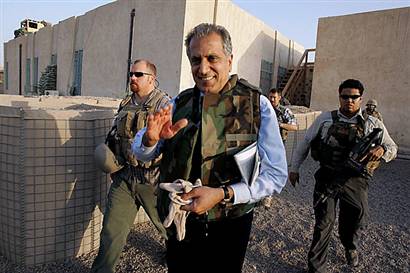
It's been a few days since we covered the anti-Iran information operation. Today brings a message from "Zal", as every jerkoff in Washington refers to U.S. ambassador to Iraq, Zalmay Khalilzad.
Iran is publicly professing its support for Iraq's stalemated political process while its military and intelligence services back outlawed militias and insurgent groups, U.S. Ambassador Zalmay Khalilzad said Thursday.Iranian agents train and arm Shiite Muslim militias such as the Mahdi Army, linked to one of Iraq's most powerful clerics, Khalilzad said, and also work closely with Sunni Arab-led insurgent forces including Ansar al-Sunna, blamed for dozens of deadly attacks on Iraqi and American soldiers and Shiite civilians.
"Our judgment is that training and supplying, direct or indirect, takes place, and that there is also provision of financial resources to people, to militias, and that there is presence of people associated with Revolutionary Guard and with MOIS," the Afghan-born Khalilzad said, referring to Iran's main military force and its Ministry of Intelligence and Security.
The phrase "our judgment is" refers in U.S. intelligence community-speak to the consensus position expressed in a National Intelligence Estimate (NIE).
Someone authorized Khalilzad to allude to the classified NIE. In other words, this is being released for propaganda purposes.
Khalilzad expressed particular concern over Iran's ties to the Mahdi Army, an armed group loyal to the outspoken Shiite cleric Moqtada al-Sadr that the ambassador said was responsible for many of the recent killings, despite Sadr's public pleas for calm...
But Khalilzad said the United States has had no face-to-face contact with the cleric, in his early thirties, whose followers hold more than 30 seats in the new parliament. "No, I don't talk to him, because we don't meet with Moqtada Sadr, but I have sent him messages publicly. . . . We engage him whatever way we can," said Khalilzad, who added that he and other embassy officials did meet with Sadr's political allies. "I think that our people advise me against it because there is an indictment against him."
The denial of any contact between U.S. officials and Sadr is a questionable assertion at best.
An aide to Sadr, one of the most outspoken critics of the U.S. military presence in Iraq, said Thursday that the cleric would not meet with American officials until foreign troops are withdrawn from Iraq.
The previous statement is made in precisely the same spirit as George W. Bush's claims never to have met Jack Abramoff.
Khalilzad ends with a reasonable statement given the situation. Too bad it is untrue:
"I have been reduced -- and I am not complaining -- to an observer, which is a good thing," he said, dismissing the widely held belief that he is still the driving force for unity, cajoling rival groups to negotiate. "I think now I say that they are really politically moving toward a self-reliance."
The reader is well advised to take Khalilzad's "observer" status with a grain of salt.
Blame The War Opponents, Act One
This morning, ace WaPo op-ed man David Ignatius argues that Bush needs to do a better job of convincing the American people that we are, contrary to war critics, doing well in Iraq.
Ignatius says that if Bush fails to succeed in snowing the people, we may be forced--despite impending victory-- to withdraw prematurely from Iraq in failure.
This is an opening salvo of the "blame the war opponents for our eventual loss in Iraq" program, which was discussed here earlier this week.
The polls suggest that Bush is losing the ability to communicate effectively about the issue that matters most to him. He has a better story on Iraq than many people seem to appreciate: Iraqi politicians are in fact coming together toward a government of national unity; Iraqi troops are improving their performance; substantial reductions in the number of U.S. troops are likely this year. But to many Americans, judging by the polls, Bush's assertions sound like a broken record. His optimism comes across as happy talk...
Ask senior military commanders what they think about Bush and they will tell you they love his toughness -- but wish the White House could communicate its Iraq strategy better.
Horse Hockey. If the military commanders could win the war, they already would have. All the domestic propaganda in the world cannot salvage the mission. Only prolong the inevitable.
Bush works hard to disguise it, but one senses the same inner conflict that afflicted Johnson as Vietnam began to go bad. In "The Best and the Brightest," David Halberstam described LBJ's torment: "He was a good enough politician to know what had gone wrong and what he was in for and what it meant to his dreams, but he could not turn back, he could not admit that he had made a mistake. He could not lose and thus he had to plunge forward." But, recalls Halberstam, "instead of leading, he was immobilized, surrounded, seeing critics everywhere."
True enough. Ignatius always tries to sound reasonable when pushing the agenda of the national security state.
Then he is back to it:
It's a dangerous situation. If Bush loses his ability to convince the country that his war aims make sense, America may be forced into a hasty withdrawal that will have devastating repercussions.
Here you have it, folks. Ignatius has been entrusted to start getting opinion, especially among the influential Washington lemmings, behind the new meme.
It has worked for 30 years against the Vietnam War protest movement.
Hence, the Halberstam quote.
Thursday, March 23, 2006
Defamation Suit Against John Kerry
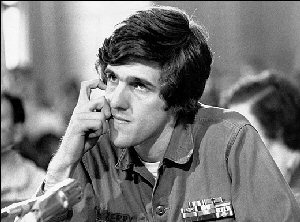
Some fuckwit is suing John Kerry for standing up for himself against allegations that he behaved dishonorably towards fellow Vietnam vets after returning from the War.
The Massachusetts Democrat recently created a defense fund to pay his legal costs in a federal defamation lawsuit filed last fall by a Pennsylvania filmmaker, Carlton Sherwood.
Sherwood alleged that Kerry and a top aide sought to "discredit and silence" him while blocking the broadcast of his anti-Kerry documentary during the final weeks of the race.
The film, "Stolen Honor: Wounds That Never Heal," alleges Kerry's actions as an anti-war activist after he returned home from the Vietnam War harmed American POWs. Kerry lied about atrocities by U.S. soldiers as a leader of Vietnam Veterans Against the War, according to the film.Kerry has denied the charges...
The defamation suit was filed in Philadelphia by Sherwood and the Vietnam Veterans Legacy Foundation. Thomas Manning, a lawyer for Sherwood and the group, declined comment.
Drug-Free School Zones Snare Mostly Minorities

A new study shows that minorities are the ones who are mainly given the mandatory harsh penalties for being caught with contraband in drug-free school zones, which extend in some areas for 27 square miles around each school.
Many entire cities are considered drug-free school zones.
During the crack cocaine epidemic of the 1980s, dozens of states drew wide circles around schools and called them "drug-free zones" to keep dealers away from children. But a national report released yesterday said the zones have failed to achieve that goal.
A report by the Justice Policy Institute, a liberal research organization that advocates for alternatives to incarceration, said the zones have led to a far different result: a disproportionately high number of drug convictions and harsh sentences for black and Latino citizens who live who live near urban schools and other protected areas.
In some cases, entire cities are covered by the zones, leading to mandatory sentences even for first-time offenders caught possessing minuscule amounts of drugs far from any school...
Alabama's zones cover 27 square miles each, almost half the size of one of its largest cities, Tuscaloosa. Convictions within the zones often come with fixed sentences that are added to whatever jail time is imposed for the crime committed...
The New Jersey study included maps of Newark, Jersey City and Camden, dense urban areas dominated by minorities and smothered by drug zones. But the largely white Mansfield Township, suburban and spread out, was marked by three small circles, where more minorities live...
In New Jersey, 96 percent of inmates serving harsher zone sentences are either black or Latino...
In Massachusetts, racial disparities in arrests and convictions were also tied to the zones. Eighty percent of people convicted with enhanced penalties were minorities, according to the Justice Policy Institute report.
Wednesday, March 22, 2006
Bill-Signing Skullduggery
In the last few days, bloggers have been the only people taking note of a blatant case of bill-signing skullduggery.
Now, as proof that real people think something is amiss, the mainstream media is picking up on the story:
(L)ast month...President Bush signed into law a bill that actually never passed the House. The bill -- in this case, a major budget-cutting measure that will affect millions of Americans -- became a law because it was "certified" by the leaders of the House and Senate.
After stewing for weeks, Public Citizen, a legislative watchdog group, sued yesterday to block the budget-cutting law, charging that Bush and Republican leaders of Congress flagrantly violated the Constitution when the president signed it into law knowing that the version that cleared the House was substantively different from the Senate's version.
The issue is bizarre, with even constitutional scholars saying they could not think of any precedent for the journey the budget bill took to becoming a law. Opponents of the budget law point to elementary-school civics lessons to make their case, while Republicans are evoking an obscure Supreme Court ruling from the 1890s to suggest a bill does not actually have to pass both chambers of Congress to become law...
For their part, congressional leaders and administration officials point to an 1892 Supreme Court decision, Field v. Clark , to argue that as long as the speaker of the House and the leader of the Senate certify a bill passed, it is passed. In that case, a bill signed by President Benjamin Harrison and authenticated by the leaders of the House and Senate was different from the version printed in the official journals of Congress, known now as the Congressional Record...
In the 1892 case, the Supreme Court did not rule that the law really was a law but instead said the dispute was not a matter for the courts to decide, said Michael C. Dorf, a professor of constitutional law at Columbia University. The main problem for Public Citizen will not be showing that the budget law is technically not a law, but getting the courts involved, Dorf said, especially with a measure as sweeping as this one...
The issue would be solved if the House voted again, this time on the version that passed the Senate. But that would mark the third time House members would have to cast their votes on a politically difficult bill, containing cuts in many popular programs, and it would be that much closer to the November election.
The bottom line is that the fuckwitted House members are too spineless to vote again on the legislation, and would rather throw this thing to the Court, if need be, to deal with the mess.
There is also some evidence that Bush knew at the time that he was signing a bill that hadn't passed both chambers in identical form.
Tuesday, March 21, 2006
FBI Agent Warned Superiors More Than 70 Times About Moussaoui

A heretofore unknown aspect of the U.S. security blunders surrounding 9-11 emerged yesterday in the death penalty trial of Zacarias Moussaoui.
An FBI agent who interrogated Zacarias Moussaoui before Sept. 11, 2001, warned his supervisors more than 70 times that Moussaoui was a terrorist and spelled out his suspicions that the al-Qaeda operative was plotting to hijack an airplane, according to federal court testimony yesterday.
Agent Harry Samit told jurors at Moussaoui's death penalty trial that his efforts to secure a warrant to search Moussaoui's belongings were frustrated at every turn by FBI officials he accused of "criminal negligence."...
Samit's testimony added striking detail to the voluminous public record on the FBI's bungling of the Moussaoui case. It also could help Moussaoui's defense. Samit is a prosecution witness who had earlier backed the government's central theory of the case: that the FBI would have raised "alarm bells" and could have stopped the Sept. 11 attacks if Moussaoui had not lied to agents. But under cross-examination by the defense yesterday, Samit said that he did raise those alarms -- repeatedly -- but that his bosses impeded his efforts.
Defense attorney Edward B. MacMahon Jr. zeroed in on increasingly urgent warnings Samit issued to his FBI supervisors after he interviewed Moussaoui at a Minnesota jail in mid-August 2001. Moussaoui had raised Samit's suspicions because he was training on a 747 simulator with limited flying experience and could not explain his foreign sources of income.
By Aug. 18, 2001, Samit was telling FBI headquarters that he believed Moussaoui intended to hijack a plane "for the purpose of seizing control of the aircraft." A few days later, he learned from FBI agents in France that Moussaoui had been a recruiter for a Muslim group in Chechnya linked to Osama bin Laden.
But when Samit tried to use the French intelligence in his draft application for a Foreign Intelligence Surveillance Act warrant to search Moussaoui's belongings, he said, Maltbie edited out the connection with bin Laden because it did not show that a foreign government was involved.
"How are you supposed to establish a connection with a foreign power if it's deleted from the document?" MacMahon asked.
"Well, sir, you can't," Samit replied.
Samit said he also sent an e-mail to the FBI's bin Laden unit but did not receive a response before Sept. 11, 2001...
Samit acknowledged that he told the Justice Department's inspector general's office that his supervisors engaged in "criminal negligence" and were trying to "run out the clock" because they wanted to deport Moussaoui rather than prosecute him.
Most portions of the inspector general's report dealing with Moussaoui have never been made public.
"You thought a terrorist attack was coming, and you were being obstructed, right?" MacMahon asked.
"Yes, sir," Samit answered.
One has to wonder why the supervisors were so opposed to investigating Moussaoui. The story about simply wishing to deport him does not fly.
Especially in light of the editing of the French intelligence information out of the FISA affidavit.
And all the other suspicious government actions surrounding the events of that day.
U.S. Officials Claim Iran Is Helping Al-Qaeda
It would be even better to accuse the Iranians of participating in 9-11.
From today's Los Angeles Times:
U.S. intelligence officials, already focused on Iran's potential for building nuclear weapons, are struggling to solve a more immediate mystery: the murky relationship between the new Tehran leadership and the contingent of Al Qaeda leaders residing in the country.
Some officials, citing evidence from highly classified satellite feeds and electronic eavesdropping, believe the Iranian regime is playing host to much of Al Qaeda's remaining brain trust and allowing the senior operatives freedom to communicate and help plan the terrorist network's operations.
And they suggest that recently elected President Mahmoud Ahmadinejad may be forging an alliance with Al Qaeda operatives as a way to expand Iran's influence or, at a minimum, that he is looking the other way as Al Qaeda leaders in his country collaborate with their counterparts elsewhere...
To some U.S. intelligence officials, what worries them most is what they don't know.
"I don't need to exaggerate the difficulty in determining what these people are up to at any given moment," the intelligence official said.
The U.S. counter-terrorism official was more blunt. "We don't have any intelligence going on in Iran. No people on the ground," he said. "It blows me away the lack of intelligence that's out there."
Only by the fucked up standards of 21st century U.S. intelligence analysis (and nowhere else in the world of spookdom) can someone extrapolate from no evidence whatsoever that an "imminent" threat is brewing.
One can prudently consider the worst when you don't have all the facts. That's what footnotes in intelligence analyses are for.
But to plan a military attack or other disruptions of the international system based solely upon masturbatory fantasies about worst case scenarios is a whole other level of incompetence that
we've not proven to be immune to in recent years.
The remainder of the propaganda piece details a rogue's regiment of Al-Qaeda operatives that the U.S. claims are hiding in Iran.
Leaving aside the obvious non sequitur of Shiite Iran giving voluntary sanctuary to shit-disturbing Wahabists, one wonders why--if true--this would amount to a casus belli against Iran.
On the lunatic fringe, there is a blog calling for the United States to spill it's blood so that a bunch of jerk-off Iranian ex-pats can go back home to a "Free-Iran."
Part of their hook is their claim that Osama bin-Laden was sheltered by the Iranian Mullahs before his death.
Does that make anybody want to immediately head off to the recruiting station? I didn't think so.
That's why we see today's piece in the Los Angeles Times.
L.A. being the home of perhaps the loudest bunch of Iranian expatriates in the USA.
Must be one of them "coincidences."
"War Against All Hazards"
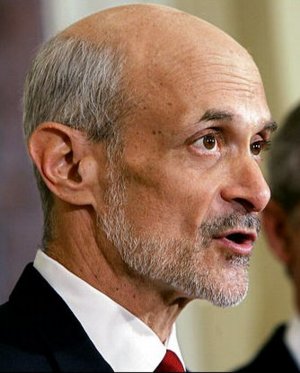
Not long ago, I heard a medical student claim that he had dissected better looking cadavers than Michael Chertoff.
The body, despite a chronic cough that is not convincingly explained away as being from "a cold", is still up and functioning. I'm not so sure about the brain.
A typically witty Dana Milbank column this morning gets into the details. Beginning with your typical local color:
As Homeland Security Secretary Michael Chertoff sat down for lunch yesterday on the seventh floor of the Heritage Foundation, a vivid scene from the post-9/11 world was unfolding outside the conference-room window.Two blocks away at Union Station, a small grease fire had erupted on the grill at McDonald's. The blaze was quickly extinguished, but not before jittery security personnel ordered the terminal evacuated. Hundreds of shoppers, diners and rail passengers, heeding shouted warnings to flee the premises, flowed into the plaza outside, where emergency response vehicles joined the usual duck boats and tourist trolleys.
Chertoff aides watched the mayhem from the Heritage windows, but Chertoff himself missed the hullabaloo; one of his lunch partners explained that his security guards had ordered the blinds drawn.
It's not easy being Mr. Chertoff:
A strikingly thin man with a high-pitched voice, pointy ears and droopy eyelids, Chertoff speaks of "the critical points of triangulation" and calls for a "properly risk-managed approach to critical infrastructure." He talks about the need for "total assets visibility" and favors "an integrated, sensible, systems-based approach." He desires "better information about the constituents of the supply chain." And instead of telling people that he's protecting them, he says that his department has "done a lot to elevate the general baseline of security in this country."
Speaking yesterday to another group, the International Association of Fire Fighters at the Hyatt on Capitol Hill, he tried to put his talent for post 9-11 language abuse to the test.
Pointing to photos of the Sept. 11, 2001, wreckage, Chertoff said: "You are really part of the war on terror, as well as the war against all hazards."
War Against All Hazards: WAAH?
Isn't that the sound that babies make when they want their mommy?
Monday, March 20, 2006
Wade's MZM Skullduggery Revisited
The sordid tale of Mitchell J. Wade, who bribed Randy "Duke" Cunningham in order to obtain government work for his defense contracting company MZM, reads like a pulp novel of the perversely greedy taking advantage of the clueless incompetent.
According to excerpts of e-mails collected by a Pentagon employee and provided to The Washington Post, one contract official inaccurately thought Wade was a former undersecretary of defense. Another wrote that "Mitch Wade is a force to be reckonned (sic) with . . . he has a lot of perceived power that can slow us down . . . maybe even grind us to a halt."
Nice.
Wade first bribed Cunningham on Nov. 16, 2001, according to prosecutors' court papers. That Friday, barely two months after the terrorist attacks on New York and Washington, the contractor bought the congressman $12,000 worth of antiques, and Cunningham told Wade that he would make him "somebody." At the time, the government filings said, MZM had contracts of less than $1 million a year.
Their partnership became apparent early the next year as Wade requested a $15 million earmark for a counterintelligence program. He was also working at the time to get on the General Services Administration's schedule of companies authorized to seek federal business, a prelude to the broader intelligence-related "blanket purchase agreement" he pursued that summer and fall...
The blanket purchase agreement, signed with a Defense Department contracting office in September of 2002, was written so broadly that any agency inside or outside the Pentagon could order a wide variety of help. It seemed crafted for the Bush administration's post-Sept. 11 push for more defense and intelligence spending. It referred to homeland security, law enforcement planning, geospatial integration, document exploitation and what is called MASINT, for measurement and signature intelligence...
To ensure that MZM "could milk that account without interruption or interference" from the Defense Department officials who oversaw the contract, Wade enticed them with personal favors, the government said in court documents filed along with Wade's guilty plea. He hired the son of one Defense Department official at the Army's National Ground Intelligence Center in Charlottesville in early 2002, when MZM was still a subcontractor. In return, the official gave MZM inside information and favorable performance reviews ensuring further work, prosecutors alleged...Two days after the war in Iraq started, MZM won a $1.2 million contract to provide interpreters for "post conflict" work. And in March, Wade's company got a $6.2 million contract, this one with the Pentagon's new Counter Intelligence Field Activity. In fiscal 2003, MZM got a total of $38.6 million in orders through the blanket purchase agreement...
The global war on terror was good for business. There was lots of work at the National Ground Intelligence Center and the Counterintelligence Field Activity. The Pentagon called on MZM to help seek counters to roadside bombs in Iraq. The Special Operations Command in Tampa needed help too. And thanks to an earmark from Rep. Virgil H. Goode Jr. (R-Va.), MZM was picked to run a Foreign Supplier Assessment Center in Martinsville, Va., to check out foreign-based contractors...
Last July, a month after the San Diego Union-Tribune triggered the investigation by disclosing the home sale, the Pentagon was still telling Cunningham's office that money was in the pipeline for his latest MZM earmarks.
Crikey!
I wonder if the Pentagon will keep a better eye on the defense contractors in the future.
I doubt it. Defense contracting companies are the preferred destination of Pentagon officials following retirement from the government.
That arrangement does not inspire too much motivation for government officials to aggressively look to find wrongdoing in contracting.
One wouldn't want to damage one's future career prospects, after all.
Hamas Finding No Outsiders Willing To Join Cabinet

Hamas is having a bit of difficulty getting politicians of other Palestinian parties to become ministers in the first cabinet to be led by the Islamic group widely shunned for using terrorist tactics.
Hamas finalized a proposed cabinet Sunday that would place several key ministries in the hands of senior leaders but not include any other Palestinian faction, precisely the narrowly partisan government that the radical Islamic movement had hoped to avoid.
Ismail Haniyeh, the designated prime minister, submitted the list to Palestinian leader Mahmoud Abbas, whose secular Fatah party declined to join the cabinet. The cabinet's makeup is likely to complicate efforts to persuade international donors to continue funding the government once Hamas, designated a terrorist organization by the United States and European Union, assumes control of the ministries.
"Their task was to have as wide a government as possible with Fatah, other factions and independents," said Ali Jarbawi, a political science professor at Beir Zeit University in the West Bank. "The cabinet they have proposed will be, in effect, all Hamas. They are facing a deep problem."
Their problem in fielding a broad-based government could cost them:
Haniyeh's proposed cabinet, which was due by the end of the month, could change in the weeks ahead. Hamas will probably continue seeking partners to broaden its domestic support and assuage international donors, who supply nearly half of the Palestinian Authority's roughly $2 billion annual budget.
Bush, Cheney Expect Victory in Iraq
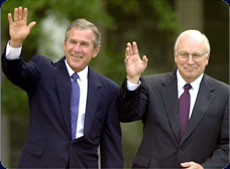
The administration continues, despite evidence to the contrary, to insist that the ill-fated U.S. endeavor in Iraq will result in victory.
It all depends on the meaning of the word "victory."
The glass is looking more than half full to the true believers.
The administration could take heart this weekend from the relatively small antiwar protests around the country, compared with protests held on the previous anniversaries of the invasion. An estimated 7,000 people demonstrated in Chicago on Saturday and smaller protests were held over the weekend in Boston, San Francisco and other cities. In Times Square, the figure was about 1,000.
Now is not the time for Americans to go wobbly on the war, insisted Bush yesterday.
Bush, speaking on the third anniversary of the U.S.-led invasion that toppled Iraqi President Saddam Hussein, assured Americans that his administration is pursuing a strategy "that will lead to victory in Iraq," an outcome about which polls show the public is increasingly skeptical.
The omniscient Vice President Cheney proved that he knows more about the situation on the ground in Iraq than people in that country who are not neo-cons.
Cheney, meanwhile, dismissed assertions made by former Iraqi prime minister Ayad Allawi that the nation is in the throes of civil war. He said Iraq is holding together as a new constitutional democracy even as terrorists are desperately trying to cause its dissolution...
Cheney also dismissed a statement by Sen. Edward M. Kennedy (D-Mass.), who said the war in Iraq should never have been fought: "I would not look to Ted Kennedy for guidance and leadership on how we ought to manage national security. . . . I think what Senator Kennedy reflects is sort of the pre-9/11 mentality about how we ought to deal with the world and that part of the world."
But CBS anchor Bob Schieffer bluntly challenged Cheney on his own string of prognostications, such as his pre-invasion assertion that U.S. troops would be welcomed in Iraq as liberators and, 10 months ago, that the insurgency was in its "last throes."
Cheney replied that those statements were "basically accurate and reflect reality," but that public perceptions of Iraq's progress are being skewed "because what's newsworthy is the car bomb in Baghdad."
Again linking the war in Iraq to the Sept. 11, 2001, attacks, Cheney called the conflict part of "an aggressive, forward-leaning" strategy that has since prevented terrorist incidents in the United States.
Only a psychopath would imagine that we haven't created more rather than less danger for Americans by our war of aggression against Iraq.
While not bothered by the opinions of the American public or Democratic lawmakers, the White House is growing concerned about increasing misgivings about the war on the part of their Republican allies in Washington.
As the administration offered optimistic appraisals of the war's progress, Sen. Chuck Hagel (R-Neb.), a frequent administration critic who is weighing a run for president in 2008, echoed Allawi's assessment, saying that Iraq is already in the midst of a "low-grade civil war."
"I think it's important that we stop this talk about we're not going to leave until we achieve victory," Hagel said on ABC's "This Week." "Well, what is victory? We achieved victory: Saddam's gone, the Iraqis have a constitution, they had an election, it's now up to them."
The semantic challenge of defining down "victory" in Iraq may prove to be one of the most important battles, at least politically, that Republicans will face during the next several election cycles.
Sunday, March 19, 2006
Lobbyists Not Fearing Reform
Though Congress may ultimately vote to eliminate a few of the more visible trappings of special pleading, such as gifts, free meals and luxurious trips, lobbyists say they have already found scores of new ways to buy the attention of lawmakers through fundraising, charitable activities and industry-sponsored seminars. An estimated $10 billion is spent annually to influence legislation and regulations, and that spending is not likely to be diminished by the proposed lobbying changes, these lobbyists contend.
"I wouldn't classify those changes as major," said Dan Danner, executive vice president of the National Federation of Independent Business. "Between charitable events and fundraising events, there will still be lots of ways to get in front of members [of Congress]."...
An emerging Senate bill, which has yet to be completed, would bar lawmakers from accepting meals and gifts such as sports tickets from registered lobbyists. The leading House measure, which has been proposed by GOP leaders, would rely more heavily on additional disclosures but would also impose a temporary ban on privately paid travel...
"If meals are heavily restricted, we're likely to see executives from the home office picking up checks because they're not lobbyists," added J. Steven Hart of Williams & Jensen, a major lobbying firm. "And there are lots of other ways we can still get our cases before members of Congress."Besides, experts said, industries and interest groups have turned to more sophisticated tactics in recent years, and such tactics are generally not addressed in the new bills on Capitol Hill. Lobbyists are increasing their campaign contributions, widening their use of the Internet to stir voter activism.
Directing contributions to campaigns is precisely where lobbyists in Washington derive most of their influence over the decisions of the beneficiaries of the largesse.
In 2004, the most recent full year about which data are available, lobbying was a $10 billion industry, according to estimates by James A. Thurber, a political science scholar at American University. Of the total, $2.1 billion was used to pay the salaries of registered lobbyists, while the rest was spent on more subtle forms of persuasion...
Interest groups also pay to participate in social activities, which double as lobbying venues. State societies, for example, offer lawmakers, congressional aides and lobbyists numerous opportunities for informal encounters...
The most important framework for lobbying clout -- campaign finance laws -- would not be altered in the Senate approach, while House GOP leaders have proposed putting limits on the contributions made to big-money independent groups known as 527s. But without Senate support, the effort to clamp down on the independent groups will fail.
As a result, lobbyists would still be able to contribute to lawmakers' coffers, host and organize major fundraising events, and arrange trips subsidized by their clients to encourage electoral giving -- just as they do now.
Again, we return to the main convincer--campaign contributions directed from corporate clients to lawmakers--that allows lobbyists to have their sway over public officials and policy.
One should not expect that this aspect of governance will be touched in any enacted lobbying reform.
Saturday, March 18, 2006
New Hypothesis About Govt. Lawyer's Possible Motivation
In making this decision, the judge cited the cost to the taxpayers of the trial. Nice.
A federal judge yesterday revived the Justice Department's death penalty case for Sept. 11 conspirator Zacarias Moussaoui, accepting a compromise offered by prosecutors to find new aviation security witnesses not tainted by the misconduct of a government lawyer...
"I'm fully aware of the huge resources that have been expended on this case, the fact that we summoned 850 jurors . . . and I agree it would be unfortunate if this case could not go forward to some final resolution," Brinkema said in a teleconference with case attorneys, according to a transcript...
Although the government will continue its case, legal experts said the week's events still leave prosecutors in a tough spot. Martin had worked on the case since at least 2002 and had contact with aviation security experts throughout the government...
In e-mails to the seven witnesses, Martin was highly critical of the prosecution's argument that aviation officials could have kept the hijackers' knives from getting onto the planes, and defense attorneys might want jurors to hear of her doubts. But experts said it would be difficult for the defense to persuade Brinkema to allow evidence of Martin's conduct or e-mails. "It shouldn't come in, and I don't see how it would," said Carl Tobias, a law professor at the University of Richmond. "It could poison the minds of the jury."...
Martin violated a standing court order by e-mailing trial transcripts to the seven witnesses and coaching them on their testimony. All those witnesses worked for the government and were experts on aviation security. They would have testified about the government's ability to have stopped the terror attacks had Moussaoui not lied to the FBI when he was arrested in August 2001.
After a hearing Tuesday, Brinkema barred the testimony of the seven witnesses and the aviation evidence. That evidence is key, because about half of the prosecution's case consists of showing that airport security would have been dramatically stepped up if Moussaoui had provided the information.
Judge Brinkema is fully aware that much of the aviation evidence will show that airline security could not have detected all the weapons before they made it on to the plane.
Especially since the weapons used in the attack were not merely "box cutters" as the American public has been told, but ceramic knives that were sharper than steel, and which would not show up on the metal detectors.
It was never believed that the ceramic knives information would be presented to the jury. The government does not want this to be widely known.
Martin's violation of federal trial protocol was so brazen that she must have known, if discovered, it would result in the aviation security evidence being thrown out.
This may have been the goal all along.
Keeping the existence of the ceramic knives quiet may be an even more important reason than protecting the airlines from liability to explain the bizarre behavior of Ms. Martin.
Setback For Polluter-Coddling Administration

The Bush administration's coddling of industrial polluters was dealt a blow yesterday when their long-running attempt to allow increased befoulment of the nation's air and water was disallowed by a federal court.
A federal appeals court blocked the Bush administration's four-year effort to loosen emission rules for aging coal-fired power plants, unanimously ruling yesterday that the changes violated the Clean Air Act and that only Congress could authorize such revisions.
A three-judge panel of the U.S. Court of Appeals for the District of Columbia Circuit sided with officials from 14 states, including New York, California and Maryland, who contended that the rule changes -- allowing older power plants, refineries and factories to upgrade their facilities without having to install the most advanced pollution controls -- were illegal and could increase the amount of health-threatening pollution in the atmosphere...
The administration has long argued that the existing standards are too stringent and have discouraged utility plants and other industries from upgrading and expanding their facilities. But opponents have characterized the rule changes as a favor to administration allies in the utility and coal-producing industries that would greatly add to public health problems.
Everybody in the United States already sports a detectable amount of mercury in their bodies from industrial pollution. The enrichment of the corporate buddies of the administration is not worth the harm to the rest of society.
Boehner Loves To Travel

We now know why John Boehner is not pushing for a ban on privately funded travel for lawmakers. He is a world class travel-hound, especially when someone--even someone with business before the House--is paying.
House Majority Leader John A. Boehner (Ohio), who rose to power in the wake of a congressional lobbying scandal, spent the equivalent of nearly six months on privately funded trips over the past six years, according to a new study by a nonpartisan research group.
The Center for Public Integrity said that Boehner accepted 42 privately sponsored trips from January 2000 to December 2005. That put him on the road to other countries and "golfing hotspots," often with his wife, Debbie, for about half a year, "only nine days of which he listed as being 'at personal expense,' " the center said.
Boehner also flew at least 45 times on corporate jets owned by companies "with a financial stake in congressional affairs" from June 2001 through September 2005, the center reported...
Among the places Boehner traveled on privately financed trips were Edinburgh, Scotland; Venice; Brussels; and Barcelona, the center said. Two of his domestic destinations, which the center pointed out are famous for their golf courses, were Boca Raton, Fla., and Scottsdale, Ariz.
The report said Boehner received more than $160,000 in food, lodging, transportation and other expenditures on his privately paid journeys.
Boehner is good to his people.
Boehner's staff has benefited from corporate-paid travel. The congressman approved trips taken by dozens of his aides from his personal office and the staff of the House Committee on Education and the Workforce, which he chaired starting in 2001. Over the past five years, the center said, his staff aides took more than 150 privately paid trips worth more than $200,000 to locations as far-flung as Japan and Europe.
Job applications can be sent to:
Rep. Boehner
House of Representatives
Washington, DC 20515
Friday, March 17, 2006
When The Money's All Gone, We'll Just Spend Some More

It is no longer just your children, but now your grandchildren, who will be forced to pay for the profligate spending of the current Republican-led government.
Congress raised the limit on the federal government's borrowing by $781 billion yesterday, and then lawmakers voted to spend well over $100 billion on the war in Iraq, hurricane relief, education, health care, transportation and heating assistance for the poor without making offsetting budget cuts.
On vote after vote in the House and Senate, lawmakers demonstrated the growing gap between their political promises to rein in spending and their need to respond to emergencies and protect politically popular programs...
The House voted 348 to 71 to approve a $92 billion measure to fund the wars in Iraq and Afghanistan and ongoing hurricane relief, after members rejected calls from conservatives to pay for at least some of that spending with budget cuts. On the other side of the Capitol, senators considering a budget blueprint for fiscal 2007 voted to effectively breach their own firm limits on spending by at least $16 billion to boost programs they said have been starved for funding...
With no brakes on spending and no moves afoot to raise taxes, the federal debt is now raising at an unprecedented clip. The government bumped up against its $8.18 trillion statutory debt ceiling last month, forcing the Treasury to borrow from employee pension funds to keep the government operating. After weeks of pleading from Treasury Secretary John W. Snow, the Senate took the politically unpalatable but economically critical step of raising the ceiling for borrowing to $8.96 trillion. Under House rules, the debt limit was raised last year without a vote when lawmakers approved a budget.
It was the fourth debt-ceiling increase in the past five years, after boosts of $450 billion in 2002, a record $984 billion in 2003 and $800 billion in 2004. The statutory debt limit has now risen by more than $3 trillion since Bush took office.
Most of the House spending package, nearly $68 billion, would pay for military operations in Iraq and Afghanistan. The legislation would push total war costs since Sept. 11, 2001, to nearly $400 billion. Before the Iraq invasion in 2003, administration officials predicted that costs related to the war would total less than $100 billion.
Those were the same "administration officials" who "predicted" that American troops would be greeted with roses by the Iraqi citizenry.
At least things are going well for the U.S. over there and we have a plan for victory.
If not, the American people would have long ago been fed up with the endeavor.
"Congress must stop hiding wasteful spending under the American flag," said Rep. Jeb Hensarling (Tex.), one of several Republicans who voted against the final bill.
He must be one of them "freedom hatin' Texans."
The only Democrat voting for the budget was Mary Landrieu (La.). Republicans voting against the budget were Lincoln D. Chaffee (R.I.), Norm Coleman (Minn.), Susan Collins (Maine), Mike DeWine (Ohio ) and John Ensign (Nev.). Independent James M. Jeffords (Vt.) also voted against the budget.
Landrieu, for someone who was sold down the river by this administration, sure is nice to those folks.
Thursday, March 16, 2006
Republicans Take Aim At '527' Groups

Wealthy Republicans have better things to do with their money than to emulate the prominent Democrats like George Soros and others who give multi-million dollar contributions to political organizations not affiliated with their party per se.
If the moneyed Republicans weren't so tight-fisted, you can bet that the "527" groups wouldn't be in the cross-hairs of the Republicans in the House of Representatives.
House Republican leaders proposed changes in lobbying laws yesterday that would include a crackdown on independent, big-money committees that heavily aided Democrats in the 2004 elections...
(I)n a surprising development yesterday, House GOP leaders decided to try to intervene in a fast-growing sector of campaign finance that has mostly benefited Democratic candidates.
As part of the House GOP proposals, "527" organizations that operate independently of the political parties would no longer be allowed to collect unlimited sums from individuals. Democratic-leaning 527s have accepted tens of millions of dollars from such wealthy backers as investor George Soros and insurance mogul Peter B. Lewis.
Instead, the groups would be governed by federal campaign finance laws that would restrict such giving to a total of $30,000 from individuals per year. By contrast, during the 2004 election cycle, Soros gave $27 million and Lewis gave nearly $24 million to Democratic-oriented 527 groups, according to PoliticalMoneyLine, a nonpartisan research company.
Republicans were excited at the prospect of crippling these groups. "We strongly commend these efforts as an important step towards much-needed reform," said a spokeswoman for the Republican National Committee...
In 2004, Democratic-oriented 527s raised $265 million, compared with the GOP-oriented groups' $154 million. So far in the 2006 election cycle, Republican- and Democratic-leaning 527s have raised roughly the same amount of money -- more than $36 million on each side, PoliticalMoneyLine reported.
The Senate's lobbying bill does not address 527 groups.
The Republicans always love a level playing field.
Their embrace of electronic voting technology notwithstanding.
A New Paradigm For The Moussaoui Trial Skullduggery

Prosecutors in the death penalty trial of the only person to be charged in the U.S. with participating in the 9-11 attacks are realizing that their case for execution of Zacarias Moussaoui has been irrecoverably damaged by the malfeasance of TSA lawyer, former flight attendant, Carla J. Martin.
Federal prosecutors yesterday implored a judge to reverse her decision banning key witnesses from testifying at the death penalty trial of Zacarias Moussaoui, saying the misconduct of a government lawyer they labeled a "lone miscreant" should not imperil the case.
Calling it unprecedented and "grossly punitive," prosecutors said her ruling devastates their argument that Moussaoui should be executed for the Sept. 11, 2001, terrorist attacks. U.S. District Judge Leonie M. Brinkema on Tuesday barred seven witnesses and all aviation security evidence from the trial, saying the actions of Transportation Security Administration lawyer Carla J. Martin had tainted the process beyond repair...
After her ruling Tuesday, prosecutors told Brinkema in a teleconference that she had threatened the sentencing phase of the only person convicted in the United States on charges stemming from the Sept. 11 attacks. Assistant U.S. Attorney Robert A. Spencer told her that resuming the proceedings, which began last week in U.S. District Court in Alexandria and are on hold until Monday, would "waste the jury's time."
"We don't know whether it is worth us proceeding at all, candidly, under the ruling you made today," he told Brinkema, according a transcript obtained yesterday. "Without some relief, frankly, I think that there's no point for us to go forward."...
The government could, legal experts said, take an unusual route by asking the U.S. Court of Appeals for the 4th Circuit to issue what is known as a writ of mandamus, which would order Brinkema to restore all or part of the disputed evidence.
But experts said that even the 4th Circuit, which tends to strongly support the government on national security issues and which overturned an earlier Brinkema ruling in the Moussaoui case, would be hesitant to intervene here. "It's a very high hurdle. They have to show a clear error in the law by Brinkema," McBride said. "I don't think they have an appeal."
Somehow I am doubting that "the clear error in the law" was committed by the trial judge Brinkema.
Meanwhile, more information is coming out about former World Airways flight attendant, and now disgraced TSA lawyer, Carla J. Martin.
The government lawyer who has thrown the death penalty trial of Sept. 11, 2001, conspirator Zacarias Moussaoui into turmoil by improperly contacting witnesses was supposed to be playing a limited role and was never to be involved with legal strategy or litigating the case.
Carla J. Martin, a former flight attendant whose legal career has been devoted to defending aviation security secrets, was a legal go-between -- a conduit, officials said...
Legal specialists said Martin's conduct undermined Moussaoui's fundamental constitutional rights. She violated an order from Brinkema barring most witnesses from attending or following the trial and from reading transcripts. The judge, experts said, was trying to ensure that witnesses did not alter their sworn testimony to conform with what others had said.
"The evil here, the corruption of the system, is that through the intermediation of Ms. Martin, witnesses were able to change their testimony to corroborate other witnesses," said Stephen Gillers, an expert on legal ethics at New York University Law School. "You want the raw experiences of other witnesses, untainted and uninfluenced by the views of others."...
A plausible interpretation of Ms. Martin's motive for her skullduggery is supplied by TalkLeft:
Martin may not have been concerned with getting a conviction against Moussaoui -- but the civil litigation over 9/11 involving the FAA and United and American Airlines. It appears to me her "partners", for lack of a better word, were not the prosecutors, but the civil lawyers representing United and American Airlines in the civil litigation, and she was trying to prevent the Moussaoui witnesses from saying something that could result in a judgment against the Government and the airlines in the civil litigation...
It appears that Ms. Martin did not get the Moussaoui opening arguments transcripts of March 6 from the prosecutors or the court reporter, but from civil aviation lawyer Jeffrey Ellis, who got them from Christopher J. Christensen of the law firm Condon & Forsyth.
The prosecutors' cover letter to Court regarding the e-mails states Martin was representing some of the Moussaoui witnesses who are or were FAA employees. It also states that in the e-mails, she was giving her opinions about on-going litigation "prepared as part of her preparation for the litigation."
I take that to mean she is representing those who were employees of the FAA on 9/11. It was the responsibility of the FAA to provide airline security on 9/11. Among the issues in the civil litigation is whether the FAA, American Airlines or United Airlines were responsible for the security breaches that allowed the hijackers to crash the planes into the World Trade Center and the Pentagon...
So, it appears to me Ms. Martin was trying to coach and influence the witness' testimony not to convict Moussaoui, but to prevent the FAA from found to be at fault in the civil litigation over 9/11. American and United are hoping for the same result -- hence her collaboration with their lawyers.
I had been assuming that Ms. Martin had received her marching orders from higher-ups in the administration.
The new paradigm posits that she was carrying out the wishes of the real people who are in control of the United States--corporations.
Wednesday, March 15, 2006
Wimpy Dems Hide From Censure Resolution

The squeamish Democrats are afraid to associate themselves with the not-terribly fearsome censure resolution against President Bush being sponsored by Sen. Russ Feingold.
Nice work, folks.
Many Democrats...(are) wary of polls showing that a majority of Americans side with the president on wiretapping tactics.
Feingold's resolution, formally introduced Monday, would censure Bush for approving an "illegal program to spy on American citizens on American soil." The senator's intention was to refer the matter to the Judiciary Committee for hearings and a vote before consideration by the full Senate. Majority Leader Bill Frist (R-Tenn.) tried to force an immediate vote, to put the Democrats on the spot, but Democratic leaders objected, and for now the censure measure appears to be stalled...
Republicans seized on Feingold's presidential ambitions as the motivation behind his bid. Feingold "should be ashamed of this political ploy," said Frist, who also has presidential ambitions.
I would be ashamed to look into the mirror if I were Bill Frist.
The fearful Dems are not much more vigilant of Americans' rights than the goopers are on this issue:
"I haven't read it," demurred Barack Obama (Ill.).
"I just don't have enough information," protested Ben Nelson (Neb.). "I really can't right now," John Kerry (Mass.) said as he hurried past a knot of reporters -- an excuse that fell apart when Kerry was forced into an awkward wait as Capitol Police stopped an aide at the magnetometer.
Schumer is shown here as being no better than your typical New York whiney CYA pol.
So nonplused were Democrats that even Sen. Charles Schumer (N.Y.), known for his near-daily news conferences, made history by declaring, "I'm not going to comment." Would he have a comment later? "I dunno," the suddenly shy senator said.
Schumer's lack of cojones reminds me of the Edward Abbey truism: "New Yorkers like to say that if 'you can make it there, you can make it anywhere.' But if you can make it anywhere, why in hell would you want to live in New York?"
"Most of us feel at best it's premature," announced Sen. Christopher Dodd (Conn.). "I don't think anyone can say with any certainty at this juncture that what happened is illegal."Dodd must not have checked with Sen. Tom Harkin (Iowa). "The president broke the law and he needs to be held accountable," he said. "Talk about high crimes and misdemeanors!" Harkin said he'll vote for the Feingold resolution -- if it comes up.
That gives Feingold two solid votes, including his own. The rest: avowedly undecided.
Today's mainstream Democrats: Leading their party into oblivion.
More On Gooper Love-In

Al Kamen's In The Loop column today in the Washington Post includes an item about an extra-curricular political task on behalf of one of the most odious politicians in town.
Some GOP eyebrows raised last week when Emily J. Reynolds , the secretary of the Senate, showed up at the Southern Republican Leadership Conference in Memphis and seemed to be working to ensure a good showing for her boss, Senate Majority Leader Bill "Dr. Video" Frist (Tenn.), in a presidential straw poll.
The grumbling was that Reynolds, Frist's former deputy campaign manager and finance chairman in his 1994 Senate run and campaign chief in 2000, is now an officer of the entire Senate, a bipartisan job -- though obviously the majority leader and the majority party dictate. This was not even a Senate event, and she was favoring one senator over other likely candidates...
Reynolds said she was not "directing Frist's operation" -- which included busing in all those supporters from Nashville and, with the help of contributors, paying the $150 registration fee so they could vote and ensure Frist would win the straw poll. "I helped out on odds and ends," she said, "for the event and for him."
Of course, some other members of the Senate -- presidential hopefuls John McCain (Ariz.), George Allen (Va.) and Sam Brownback (Kan.) -- probably could have used more of her help.
She is claiming that she performed her favor for Frist on her own time, and that makes it okay.
It is however, the kind of thing that the other Senators will always remember when dealing with her.
That may not work to her benefit over time.
Tuesday, March 14, 2006
Vanity Fair Says Bradlee Named Armitage as Woodward's Source

Vanity Fair is getting credited with a scoop that I maintain must have been caused by their reporter mishearing the New England accent of Ben Bradlee.
Vanity Fair is reporting that former Washington Post executive editor Ben Bradlee says it is reasonable to assume former State Department official Richard L. Armitage is likely the source who revealed CIA operative Valerie Plame's name to Post Assistant Managing Editor Bob Woodward.In an article to be published in the magazine today, Bradlee is quoted as saying: "That Armitage is the likely source is a fair assumption." Armitage was deputy secretary of state in President Bush's first term.
What Bradlee probably said was "That Armitage is a likely source is a fair assumption."
In an interview yesterday, Bradlee said he does know the identity of Woodward's source and does not recall making that precise statement to a Vanity Fair reporter. He said he has no interest in unmasking the official who first told Woodward about Plame in June 2003.
"I don't think I said it," Bradlee said. "I know who his source is, and I don't want to get into it. . . . I have not told a soul who it is."...
The identity of Woodward's source emerged as one of the big mysteries of the CIA case after he disclosed last year that a government official with no ax to grind had told him about Plame, an undercover operative, a month before her name was revealed by columnist Robert D. Novak. Since then, guessing Woodward's source has been a Washington parlor game.
TSA Lawyer Coached Witnesses in Moussaoui Trial

This is pretty effing outrageous. I am detecting pressure from above in this matter.
A federal judge halted the trial of Zacarias Moussaoui yesterday and threatened to remove the death penalty as a possible sentence for the Sept. 11 conspirator after a veteran government aviation lawyer improperly shared testimony and communicated with witnesses.Ms. Martin didn't "get it wrong." Attorneys know the rules. This is like a cop going out and robbing a bank, "it's usually not something cops get wrong."U.S. District Judge Leonie M. Brinkema, clearly exasperated by the new problems in the oft-delayed case, called the conduct of Carla J. Martin, a Transportation Security Administration lawyer, "the most egregious violation of the court's rules on witnesses" she had seen "in all the years I've been on the bench."...
Martin violated a court order by e-mailing trial transcripts to seven witnesses -- all current and former federal aviation employees -- and coaching them on their upcoming testimony, court papers say. She also shared the e-mails among the witnesses...
The judge ordered a hearing today to find out how the incident happened. To sanction the government for the error, she could remove the death penalty, forbid the witnesses from testifying or declare a mistrial. The government could appeal either of the first two sanctions.
Further embarrassing the government, Martin's e-mails sharply criticized prosecutors' case, saying, among other things, that their opening statement "has created a credibility gap that the defense can drive a truck through."...
Assistant U.S. Attorney David J. Novak said in court yesterday that the testimony of the contacted witnesses constituted "half the evidence in this case."...
"This is the only opportunity for the government to make a Sept. 11 case. This is it. There isn't another," said Juliette Kayyem, a terrorism expert at Harvard University. "The government has to cross every t and dot every i to ensure that the Sept. 11 families finally have their day in court. If it gets messed up over a technicality . . . there is no excuse."
Duke University law professor Robert P. Mosteller said ethical restrictions against speaking with witnesses are drilled into every attorney. "Lawyers don't do things like this," he said. "The federal rule on witnesses is elegant in its simplicity, and it's usually not something people get wrong."
In this high-profile case, there would naturally be the incentive for the government to do everything within their power to secure the death penalty. Nonetheless, I seriously doubt whether this woman dreamed up the witness tampering scheme on her own volition.
She will doubtlessly get the sole blame, but there are likely other high ranking (maybe very high ranking) officials who green-lighted her malfeasance.
Nobody expected that one of her contactees, a trusted government type, would bring this bogey to the officers of the court who have a legal responsibility to report it to the judge.
Notice that none of the other contactees came forward.
They knew better.
Monday, March 13, 2006
Rigorous Intuition on Milosevic' Death
Excerpt:
Milosevic sought the testimony of Bill Clinton, and he would have seized the moment to expose the deep politics that saw al Qaeda operate as an overt strategic ally of American interests in the Balkans war. Bin Laden himself visited Albania in 1994 and sent units to fight in Kosovo alongside the KLA. The convergence of interest in the Balkans for al Qaeda and the United States was only superficially religious and political. It was narco-criminal.
(...)
In the opening statement of his trial, Milosevic said:
In 1998 when Holbrooke visited us in Belgrade, we told him the information we had at our disposal, that in Northern Albania the KLA is being aided by Osama bin Laden, that he was arming, training, and preparing the members of this terrorist organization in Albania. However, they decided to cooperate with the KLA and indirectly, therefore, with bin Laden, although before that he had bombed the embassies in Kenya and Tanzania [and] had already declared war.
See: Leprosy Treatment
Feingold Proposes Censure Over NSA Warrantless Spying

Sen. Russ Feingold (D-Wis.) is proposing censuring President Bush for authorizing the extra-legal NSA warrantless eavesdropping program.
What, if any, good such a move would be is unclear.
The five-page resolution to be introduced on Monday contends that Bush violated the law when, on his own, he set up the eavesdropping program within the National Security Agency in the months following the attacks of Sept. 11, 2001...
The resolution says the president "repeatedly misled the public" before the disclosure of the NSA program last December when he indicated the administration was relying on court orders to wiretap terror suspects inside the U.S...
Senate Majority Leader Bill Frist, R-Tenn., called the proposal "a crazy political move" that would weaken the U.S. during wartime...
Frist, appearing on ABC's "This Week," said that he hoped al-Qaida and other enemies of the U.S. were not listening to the infighting.
"The signal that it sends, that there is in any way a lack of support for our commander in chief who is leading us with a bold vision in a way that is making our homeland safer, is wrong," Frist said.Sen. John Warner, R-Va., said on CNN's "Late Edition" that Feingold's announcement on a Sunday talk show was "political grandstanding. And it tends to weaken our president."
I wonder how strenuously these administration apologists would be defending the exact same illegal actions if conducted by a Democrat.
Would Bill Clinton been given the same deference to blatant disregard of the constitution?
U.S. Campaign Against Iran Gets Media Attention

The American government machinations against Iran, which we have been discussing here since late last year, are beginning to be portrayed in the mainstream media as a coordinated program aiming to overthrow the Iranian regime.
Of course, the reports leave out the existence of the anti-Muslim information operation, a covert action by the CIA, that is helping to prepare world opinion for the punitive steps that will be needed to deal with the freedom hatin' Iranians.
As the dispute over its nuclear program arrives at the U.N. Security Council today, Iran has vaulted to the front of the U.S. national security agenda amid Bush administration plans for a sustained campaign against the ayatollahs of Tehran.President Bush and his team have been huddling in closed-door meetings on Iran, summoning scholars for advice, investing in opposition activities, creating an Iran office in Washington and opening listening posts abroad dedicated to the efforts against Tehran.
The internal administration debate that raged in the first term between those who advocated more engagement with Iran and those who preferred more confrontation appears in the second term to be largely settled in favor of the latter...
In the past week, the State Department created an Iran desk. Last year, only two people in the department worked full time on Iran; now there will be 10. The department is launching more training in the Farsi language and is planning an Iranian career track, which has been difficult without an embassy there.
Undersecretary of State R. Nicholas Burns said in an interview that the department will also add staff in Dubai, which is part of the United Arab Emirates, as well as at other embassies in the vicinity of Iran, all assigned to watch Tehran. He called the new Dubai outpost the "21st century equivalent" of the Riga station in Latvia that monitored the Soviet Union in the 1930s when the United States had no embassy in Moscow.
The administration also has launched a $75 million program to advance democracy in Iran by expanding broadcasting into the country, funding nongovernmental organizations and promoting cultural exchanges. Voice of America broadcasts one hour a day into Iran; by April, that will grow to four hours a day, and the administration plans to go to 24 hours a day...
Now that the nuclear issue is at the Security Council, the U.S. strategy is to escalate gradually rather than force an immediate climax. The first step would be a statement by the council president declaring Iran in violation of nuclear treaty obligations and demanding it suspend uranium enrichment. If that fails, the council could be asked to impose economic sanctions or pass a resolution allowing military force to enforce compliance. Russia and China, which have veto power, seem unlikely to support either move...
Many military specialists doubt a strike would be effective because Iran's nuclear facilities are scattered in dozens of locations, and would require hundreds of sorties first to disrupt Iranian air defenses. Such an attack, they say, could inflame the Muslim world and alienate reformers within Iran...
Some Republicans, though, say a military attack may be required if only to set back Iran's nuclear program a few years.
These unnamed Republicans must have oil company connections.
That would be the only sane excuse for trumpeting a military solution that would result in oil prices reaching stratospheric levels, at least for an uncomfortable enough period of time to create negative economic conditions for everyone except the petroleum interests.
The disconnect between the administration and the rest of the civilized world on this issue (and others) is illustrated by a brief rude awakening experienced by our distinguished chief diplomat:
During her first trip to Europe as secretary of state, in February 2005, Rice was surprised that most questions from European officials concerned Iran, not Iraq, and was sobered by the realization that they viewed Washington as the problem, not Tehran.
I have been assured that her momentary discomfort has long been forgotten.
Sunday, March 12, 2006
Gooper Love-In

The Republicans gathered in Memphis this weekend to ritually service the avatar of their moral (mal)development, President Bush.
The (Southern Republican Leadership Conference) delegates -- many party leaders in their home states and overwhelmingly backers of the president -- were in no mood for Bush-bashing, despite the battering the president has taken in the polls, in the media and from some within his own party. "I want Congress to stick with the president and Republicans to stick with the president," said Judy Batson of Madison, Miss. "We need to stick with the president."
When Senate Majority Whip Mitch McConnell (Ky.) called Bush "one of the great presidents in the history of the United States," the audience rose to applaud and cheer. Former Texas Republican Party chairman Fred Meyer made clear that anyone running for president in 2008 should forget about running against Bush. "Not supporting the president on the high percentage of issues would be a mistake, because people value loyalty."
The other prospective candidates generally followed that script throughout the weekend, finding ways to praise Bush on his judicial appointments or on his steadfast commitment to defeating the terrorist threat...
Sen. John McCain was full-throated in his support for Bush on Iraq, Iran and even the now-defunct Dubai seaports deal. In doing so, he continued to establish his bona fides as the Republican most likely to defend and extend the president's controversial foreign policy record...
(McCain) was matter-of-fact about his steadfast support for the president. "We elected him, we need him, he needs to do well and the country needs him," McCain said in an interview. "With all the challenges, all of these things that are going on, including slow progress in Iraq, we need to show our support...
In addition to McCain and Frist, four other potential presidential candidates spoke: Govs. Mitt Romney of Massachusetts and Mike Huckabee of Arkansas and Sens. George Allen (Va.) and Sam Brownback (Kan.). New York Gov. George E. Pataki, former New York mayor Rudolph W. Giuliani, former House speaker Newt Gingrich (Ga.) and Sen. Chuck Hagel (Neb.), all said to be mulling runs in 2008, did not attend. Rep. Tom Tancredo (R-Colo.), who might use the 2008 primaries and caucuses to promote his anti-immigration agenda, was not invited.
Even for a meaningless straw poll one of the most odious goopers had to utilize skullduggery:
Most of the nearly 2,000 delegates from the South and Midwest this weekend came for 2008 window-shopping -- with the exception perhaps of legions of home-state loyalists bused in by Senate Majority Leader Bill Frist (Tenn.), who was determined to win a nonbinding straw poll sponsored by the Hotline politics newsletter and avoid embarrassment on his home turf...
Frist won the Hotline straw poll with 37 percent of the 1,427 votes cast, thanks to the fact that more than half of all the votes cast came from Tennesseeans. Romney finished second with 14 percent, while Allen and Bush, who was not on the ballot, tied for third with 10 percent. McCain was fifth with 5 percent.
On Friday, McCain urged his supporters to write in the name of the president, saying that early straw polls are a distraction.
Write in President Bush for the Republican nomination for president in 2008?
A symbolic gesture of support for their embattled leader?
Or, perhaps, symbolic of Republican unthinking disregard for the Constitution.
Saturday, March 11, 2006
Interesting Angle on the Claude Allen Case
Cannon thinks that Allen may have an idea about where the bodies are buried in terms of Bush administration skullduggery.
See A hidden side of the "Klepto Klaude" Allen scandal (updated)
Bush To Try To Polish The Proverbial Turd

President Bush is heading back out on the road to attempt to sell the American public on a concept that is questionable at best, and ludicrous in actuality.
He wants people to think that the U.S. is succeeding in Iraq.
The president hopes to give "better depth, understanding and context for how the strategy in Iraq is unfolding," a senior White House official said of the planned speeches. Vice President Cheney, Secretary of State Condoleezza Rice and other Cabinet members will be making speeches on Iraq in advance of the anniversary of the U.S. invasion...
The initiative is modeled on a similar effort the White House rolled out in November and December, when Bush gave four speeches, acknowledging setbacks, pointing out how the military had adapted its strategy and highlighting the administration's plans for victory...
Bush's planned speeches on Iraq come as that nation's fledgling democracy is struggling to put together a unity government against a backdrop of intense sectarian violence...
"There are some who are trying to, obviously, sow the seeds of sectarian strife," Bush said, during remarks to a group of community newspaper publishers yesterday. "They fear the advancement of a democracy. They blow up shrines in order to cause this Iraqi democracy that is emerging to go backwards, to not emerge."
Bush praised Iraqis for so far not escalating the ongoing crisis into a full-fledged civil war. "As I said earlier, there was -- no question there was violence and killing, the society took a step back from the abyss," Bush said. "And people took a sober reflection about what a civil war would mean."
Bush is trying to polish a turd, or put lipstick on the pig, or whatever aphorism one prefers to describe a futile attempt to make a bad situation seem less loathsome.
It is also insulting to the people he is trying to con.
As he did during his last round of speeches, Bush will attempt to focus on specific elements of his Iraq strategy in hopes of rallying public support for the war. His speech Monday will focus on the efforts being made by Iraqi security forces to tamp down the ongoing violence. Another address will focus on the military's evolving strategy for detecting and defusing roadside bombs. A third address is likely to be a case study of an Iraqi city or town, which the White House hopes will illustrate its plans for clearing insurgents from parts of Iraq, installing Iraqi security forces then rebuilding.The idea is to bring the view "from 30,000 feet down to eye level," the senior White House official said.
A risky strategy at best.
It is easier to see bullshit from "eye level" than from the comfortable distance of 30,000 feet.
The Best Democracy That Money Can Buy

The predominance of money being the defining characteristic of American democracy is a fact well enshrined in the political culture of this country.
Every decision made in Washington has, at it's basis, the (covert or overt) motive of making someone money.
No wonder then, that the amounts of money required to run for president has ballooned dramatically in recent years.
"There is a growing sense that there is going to be a $100 million entry fee at the end of 2007 to be considered a serious candidate (for president)," Michael E. Toner, the chairman of the Federal Election Commission said in a recent interview...
Many political operatives are expecting that the gradual breakdown of the public funding system -- federal funds in exchange for spending limits -- that has taken place in recent years will become complete in 2008. The result would be candidates in both parties racing far past old spending records, and facing new pressure to begin raising money far in advance of the election year.
Not all political finance experts and campaign operatives agree with Toner that raising $100 million over the next 22 months is the price of admission for candidates who want to establish credibility and compete on an equal footing. The $100 million is nearly three times the previous threshold for being regarded in national political circles as a first-tier candidate. But it is plain that a number of factors have converged that will render obsolete old assumptions about what it costs to run for president.
First among those factors is the 2004 precedent. President Bush and Democratic nominee John F. Kerry decided then to do without public matching funds in the nominating phase of the campaign -- money that came with a requirement to limit spending to just $44.7 million each. They went on to raise $274.7 million and $253 million, respectively, before accepting public funding for the general election campaign in the fall. Their success established what many strategists believe will be a new norm in presidential politics.
What's more, many analysts believe that 2008 will be a clash of such titanic intensity that the nominees will reject public funding -- and the spending limits that govern it -- even for the fall campaign. If so, most bets are that each major-party candidate would need to raise in excess of $400 million by the Nov. 4, 2008, election...
Steve Elmendorf, the deputy manager for Kerry's general election campaign against Bush, predicted that accepting matching funds is a "thing of the past in the primary and the general." Public funding of presidential campaigns was started in 1976 in the wake of the Watergate scandal.
With this kind of money being thrown around, little wonder then that contributors often want to get something tangible in return for their expenditures.
We truly have the best democracy that money can buy.
Democrats Want To Position Party To The Right Of Republicans On Security

In a political blunder befitting their opinion-poll obsessed party, the Democrats--on the heels of their "victory" on the Dubai ports issue--are planning to try to sell themselves as being more eager about keeping the nation "safe" than the "security party", the GOP.
Flush from what they see as a victory, members of Congress appear determined to insert themselves into matters of national security that they had previously left exclusively to the president. But their aggressive response has left administration officials -- and even some colleagues -- concerned that the longer the controversy drags out, the more likely it will alienate foreign allies, dampen investment in the United States and even slow the economy...
House leaders have decided to push ahead next week with a full House vote on legislation to kill the port deal. The House Appropriations Committee had approved the measure 62 to 2 on Wednesday, but rank-and-file members outside the committee have asked to go on record with their opposition.
Democrats demanded that the White House release all documents related to DP World's acquisition of London-based Peninsular and Oriental Steam Navigation Co., including the administration's review of the deal and documents pertaining to a Coast Guard memo that said investigators could not say whether the transaction would heighten terrorist threats.
Despite the assurances of congressional Republicans and the president, some Democrats also questioned whether DP World really committed to shedding its U.S. port assets Thursday when it pledged to "transfer" them to a U.S. entity. Bush himself said the Dubai-owned firm has "made the difficult decision to hand over port operations that they had purchased from another company."
But company spokesman Mark Dennis again refused to elaborate yesterday on the company's official statement, leaving it unclear whether a transfer of assets meant a loss of ownership or just management responsibilities, and Democrats remain skeptical. Even one knowledgeable House Republican aide suggested that the language could mean the company might maintain ownership if a buyer could not be found at the right price. "The port deal's not dead," said Rep. Dennis J. Kucinich (D-Ohio).
Privately, Democrats are saying that they have found a winning issue.
I have been counseling them that the nation is sick of the excesses brought on by the "war on terror."
If the Democrats continue to believe that "security" is a good issue for them, the goopers will not even need to resort to electronic voting skullduggery to maintain their majority status in Washington.
Friday, March 10, 2006
Cover Up In Progress

The Sen. Pat Roberts orchestrated cover-up of the administration's extra-legal NSA warrantless eavesdropping program got officially underway yesterday.
The new seven-senator intelligence subcommittee created to review the Bush administration's domestic surveillance program had its first White House briefing yesterday and is scheduled to visit the National Security Agency's headquarters Monday to gather additional information, according to congressional and administration officials.
You know the shit is being layered on thick when even the Senator with the most integrity among the seven feels compelled to add the following:
"It's too . . . sensitive to talk about" was the only message from the panel's vice chairman, Sen. John D. Rockefeller IV (D-W.Va.), as passed on by his press secretary...This is just pathetic.Both House and Senate panels have been negotiating with the White House over what kind of inquiry Congress will be able to make into the controversial program, and what rules will govern it.
Members of the Senate subcommittee -- which, along with Roberts and Rockefeller, includes Republicans Mike DeWine (Ohio), Orrin G. Hatch (Utah) and Christopher S. Bond (Mo.) and Democrats Carl M. Levin (Mich.) and Dianne Feinstein (Calif.) -- will not be able to share what they learn with the other eight members of the intelligence panel, according to rules the White House has proposed.
However, according to some people in Washington, the administration's worries about legal liability for their extra-legal actions have not been completely extinguished.
There may further nasty legal developments to follow.
Port Deal Scuttled

President Bush's buddies in the oil business will not be happy about this (see yesterday's explanation of the real motivation for the Dubai Port deal).
A United Arab Emirates-based maritime company at the center of a furious controversy over port security bowed to pressure from Congress yesterday and announced that it will sell off its U.S. operations to an American owner.The announcement, issued by Dubai Ports World Chief Operating Officer Edward H. Bilkey, came hours after House and Senate GOP leaders bluntly told President Bush that Congress would kill the U.S. portions of the company's $6.8 billion acquisition of London-based Peninsular and Oriental Steam Navigation Co. (P&O), which has operations at six major U.S. ports, including New York and Baltimore...
It is not clear which American company is willing to buy DP World's U.S. operations. About 75 percent of containers that enter U.S. ports go through terminals that are operated by foreign-owned firms.
The United States and United Arab Emirate have postponed free trade talks set for next week, the U.S. Trade Representative's office said on Friday...
"The U.S. and UAE are strongly committed to making progress on our FTA negotiations. In order to get an agreement that both sides can successfully implement, we need additional time to prepare for the next round of negotiations," Neena Moorjani, a spokeswoman for the U.S. Trade Representative's office, said.
Bush was placed in office to make the trains run on time for big oil.
I wonder now how soon it will be until we see the real owners of the United States come up with a new scandal to help usher their--now marginalized--lackey away from the levers of power so that a more effective figurehead can get back to doing their bidding.
Thursday, March 09, 2006
Dubai Threatens Economic Retaliation If Port Deal Blocked

The nation of Dubai, hailed as a partner of the United States, is threatening to retaliate economically if the deal to takeover port operations in this country is cancelled.
As the House Appropriations Committee yesterday marked up legislation to kill Dubai Ports World's acquisition of Britain'’s Peninsular and Oriental Steam Navigation (P&O), the emirate let it be known that it is preparing to hit back hard if necessary.A source close to the deal said members of Dubai's royal family are furious at the hostility both Republicans and Democrats on Capitol Hill have shown toward the deal.
"They're saying, 'All we've done for you guys, all our purchases, we'll stop it, we'll just yank it,'" the source said.
Retaliation from the emirate could come against lucrative deals with aircraft maker Boeing and by curtailing the docking of hundreds of American ships, including U.S. Navy ships, each year at its port in the United Arab Emirates (UAE), the source added...
Any repercussion to Boeing could put House Speaker Dennis Hastert (R-Ill.) in a delicate position. Boeing's decision to move its headquarters to Chicago has been seen as calculated to facilitate a close relationship with Hastert. He is against the ports deal, and his office did not return calls by press time...
The United States and the UAE are meeting next week for a fourth round of talks to sign a free-trade agreement. The American Business Group of Abu Dhabi, which has no affiliation with the U.S. government, said that Arabs may hesitate to invest into the United States, according to a report by Reuters.
One of the most savvy international business types I know has previously indicated that the free-trade agreement with the UAE, especially as it would allow majority ownership by American companies of oil projects there, is the real motivation for the Bush administration to strongly back the port deal.
Santorum Back To Old Habits

Sen. Rick Santorum loves the company of lobbyists. He can't get enough of it. Even after he publicly announces he will stop his regularly scheduled meetings with them. He just doesn't know how to quit them.
After saying in January that he would end his regular meetings with lobbyists, Sen. Rick Santorum (Pa.), the third-ranking GOP leader in the Senate, has continued to meet with many of the same lobbyists at the same time and on the same day of the week.
Santorum, whose ties to Washington lobbyists have been criticized by his Democratic challenger, suspended his biweekly encounters on Jan. 30. His decision came as Democrats named him as their top target in November's Senate races, and after the guilty plea of former lobbyist Jack Abramoff to charges of conspiring to corrupt public officials...
Democrats had lambasted Santorum's Capitol meetings in large part because, at the end of most of them, a representative of the Republican National Committee distributed lists of Washington-based lobbying job openings, and participants often discussed which GOP congressional aides and former lawmakers might be best suited for those jobs...
Santorum is considered the Senate Republicans' most vulnerable incumbent. Democrats recruited Pennsylvania Treasurer Robert P. Casey Jr., the son of a former governor, to challenge him this fall, and recent polls show Casey ahead.
Senate Republicans, eager to help Santorum, put him in charge of the party's efforts on lobbying changes, although he was soon overshadowed by Sen. John McCain (R-Ariz.) and the actions of two Senate committees. Democrats note that Santorum's campaign has received more money from lobbyists than any other congressional candidacy thus far in the 2006 election cycle...
Foes question Santorum's use of his leadership PAC, America's Foundation, which has paid for at least 160 small purchases at coffee shops near Santorum's Leesburg home, as well as for fast-food meals and purchases at hardware stores and bookstores.
It is so expensive to live in the Washington that most people have to dip into their PACs to pay for day to day expenses. Nothing to see here, folks.
Legal Case For NSA Program Weak, Ex-Justice Dept. Official Says

A specialist in national security law who was formerly a Justice Department official early in the Bush administration is weighing in on the extra-legal NSA warrantless eavesdropping program.
A former senior national security lawyer at the Justice Department is highly critical of some of the Bush administration's key legal justifications for warrantless spying, saying that many of the government's arguments are weak and unlikely to be endorsed by the courts, according to documents released yesterday.
David S. Kris, a former associate deputy attorney general who now works at Time Warner Inc., concludes that a National Security Agency domestic spying program is clearly covered by a 1978 law governing clandestine surveillance, according to a legal analysis and e-mails sent to current Justice officials.
Kris, who oversaw national security issues at Justice from 2000 until he left the department in 2003, also wrote that the Bush administration's contention that Congress had authorized the NSA program by approving the use of force against al-Qaeda was a "weak justification" unlikely to be supported by the courts...
Kris's views are contained both in a 23-page legal analysis that he provided yesterday to journalists and in a series of e-mails that he sent in December to Courtney Elwood, an associate counsel to Attorney General Alberto R. Gonzales. The e-mails were released yesterday by the Electronic Privacy Information Center, which obtained them as part of ongoing Freedom of Information Act litigation...
"In sum, I do not believe the statutory law will bear the government's weight," Kris wrote in his paper, dated Jan. 25. ". . . I do not think Congress can be said to have authorized the NSA surveillance."
Even when the authorities try to keep to the letter of the FISA law, problems do arise, according to a new FBI IG report:
The FBI reported more than 100 possible violations to an intelligence oversight board over the past two years, including cases in which agents tapped the wrong telephone, intercepted the wrong e-mails or continued to listen to conversations after a warrant had expired, according to a report issued yesterday.
In one case, the FBI obtained the contents of 181 telephone calls rather than just the billing records to which it was entitled. In another, a communication was monitored for more than a year after eavesdropping should have ended -- although investigators blamed a third-party provider for the mix-up...
Rep. John Conyers Jr. (Mich.), ranking Democrat on the House Judiciary Committee, said Fine's report "is yet another vindication for those of us who have raised concerns about the administration's policies in the war on terror."
"Despite the Bush administration's attempt to demonize critics of its anti-terrorism policies as advancing phantom or trivial concerns, the report demonstrates that the independent Office of Inspector General has found that many of these policies indeed warrant full investigations," Conyers said.
It's breathtakingly cynical. Faced with a president who is almost certainly breaking the law, the Senate sets up a panel to watch him do it and calls that control. This new Senate plan is being presented as a way to increase the supervision of intelligence gathering while giving the spies needed flexibility. But it does no such thing.One would hope that the concerned citizens of the United States are fed up enough with all the Republican malfeasance to vote them out in this year's mid-terms.
The actions of Republican politicians, from the president on down, tell me that I may be mistaken.
The Republicans are acting like they already have future elections "in the bag", by hook or by crook.
Wednesday, March 08, 2006
Republicans On Senate Intelligence Committee Join Cover-Up

Haven't these Senators learned the old Washington maxim: "It's not the crime, it's the cover-up"?
The Senate Select Committee on Intelligence voted along party lines yesterday to reject a Democratic proposal to investigate the Bush administration's domestic surveillance program and instead approved establishing, with White House approval, a seven-member panel to oversee the effort.
Chairman Pat Roberts (R-Kan.) told reporters after the closed session that he had asked the committee "to reject confrontation in favor of accommodation" and that the new subcommittee, which he described as "an accommodation with the White House," would "conduct oversight of the terrorist surveillance program."...
The panel's vice chairman, Sen. John D. Rockefeller IV (D-W.Va.), (said about) yesterday's outcome. "The committee is, to put it bluntly, basically under the control of the White House through its chairman," he told reporters. "At the direction of the White House, the Republican majority has voted down my motion to have a careful and fact-based review of the National Security Agency's surveillance eavesdropping activities inside the United States."...
Also yesterday, legislation sponsored by Sen. Mike DeWine (R-Ohio), a member of the intelligence committee ... would permit warrantless surveillance of calls between the United States and another country involving "a designated terrorist organization" for 45 days, after which the government can stop the eavesdropping, seek a warrant, or explain to Congress why it wants to continue without a warrant.
The bill would also create a subcommittee that would carry out monitoring of all aspects of the program, "on a case-by-case" basis, DeWine told reporters. Roberts told reporters that DeWine had consulted with him and the White House and "in concept it is a very good proposal." At the White House, press secretary Scott McClellan described the DeWine proposal as interesting but reiterated the position that Bush already has the power to institute the program.
The language calling for "a subcommittee that would carry out monitoring of all aspects of the program, "on a case-by-case" basis" will not be found in the final bill, if it gets enacted.
This is because the Intelligence Community won't stand for it. They already have major problems with the statutory requirement to notify the Intelligence Committees of the existence of every Covert Action undertaken by the CIA.
The Senate Judiciary Committee looks, as of now, to be the final place that the administration may be called to account over the extra-legal warrantless NSA eavesdropping program.
The NSA issue was brought up at a Senate Appropriations Committee hearing by Sen. Arlen Specter (R-Pa.), chairman of the Judiciary Committee, who is drafting his own bill. Specter warned that he will try to reduce the administration's funding unless Attorney General Alberto R. Gonzales agrees to answer more of his committee's questions.
"We're having quite a time in getting responses to questions as to what has happened with the electronic surveillance program," Specter said. "I want to put the administration on notice and this committee on notice that I may be looking for an amendment to limit funding as to the electronic surveillance program -- which is the power of the purse -- if we can't get an answer in any other way."
It is really bad when the final hope of the American citizens to reach the truth about an important matter rests upon the actions of Sen. Arlen "Magic Bullet" Specter.
More Dubai Port Skullduggery

It looks like the nation's lawmakers, and the public, have ignored the real motive behind the Dubai Ports deal, even though the evidence has been in plain sight in the public record.
An agreement has been struck whereby Bush, et al, deliver port management deals and the UAE reciprocates by allowing (currently prohibited) majority stake ownership in oil projects for US energy firms.
So we are faced with a Kabuki dance in which the clueless lawmakers are falling all over each other to prove their security mettle. I would have expected more from the naturally well-connected Republicans.
Efforts by the White House to hold off legislation challenging a Dubai-owned company's acquisition of operations at six major U.S. ports collapsed yesterday when House Republican leaders agreed to allow a vote next week that could kill the deal.
Appropriations Committee Chairman Jerry Lewis (R-Calif.) will attach legislation to block the deal today to a must-pass emergency spending bill funding the wars in Iraq and Afghanistan. A House vote on the measure next week will set up a direct confrontation with President Bush...
Since the Dubai port issue exploded last month, the Bush administration, GOP leaders and DP World officials have tried to defuse the situation and to buy time to let the issue fade.
In a deal brokered by Senate Majority Leader Bill Frist (R-Tenn.), DP World resubmitted its acquisition this week to the administration for a 45-day national security investigation. Frist has said he will hold off any legislation in the Senate until that inquiry is completed, a vow meant to give the administration and the company a chance to present their case.
That agreement appears to have quieted calls in the Senate for immediate action against the deal.
Something tells me that the administration has let Frist in on the oil project ownership angle.
The House is still boiling. Armed Services Committee Chairman Duncan Hunter (R-Calif.), with bipartisan support, introduced legislation yesterday that would scuttle the deal; mandate that the owners of "critical infrastructure" in the United States, including ports, highways and power plants, be American; and demand that cargo entering U.S. ports be screened within six months of passage.
Kudos to M1 at Swedish Meatballs Confidential for digging up the details of the real story behind the story.
Congress Has No Guts, Patriot Act Renewed

In yet another mindless display of obsequious devotion to the Bush administration, the congress passed legislation making permanent almost all provisions of the vile USA Patriot Act.
The House voted 280 to 138 to approve a Senate-passed measure that would make several changes to the Patriot Act, which was enacted shortly after the 2001 terrorist attacks. Both chambers earlier approved another bill to extend the act's provisions that are scheduled to expire, and Bush is expected to sign the measures as a package...
One change involves National Security Letters, which are subpoenas for financial and electronic records that do not require a judge's approval. Libraries functioning in their "traditional capacity" would no longer be subject to such letters. Also modified are "Section 215 subpoenas," which are granted by the Foreign Intelligence Surveillance Act Court. Recipients would have the explicit right to challenge the subpoenas' nondisclosure or "gag order" requirements.
The reauthorization would make permanent all but two of the Patriot Act's provisions. The Senate, in which four Republicans joined most Democrats in pushing for greater safeguards, insisted on four-year sunsets of the FBI's authority to conduct "roving wiretaps" of targets with multiple phones or e-mail devices, and of the government's powers to seize business records with the FISA court's approval.
There is also new legislation in the works:
Senate Judiciary Committee Chairman Arlen Specter (R-Pa.) has introduced a bill that, among other things, would allow federal officials seven days to act on a "delayed-notice search warrant" before informing its target. The revised measure would allow 30 days...
Under the general category WTF we find:
The reauthorized Patriot Act includes new tools to combat the manufacture and distribution of methamphetamine. It will require retailers to place cold medicines with pseudoephedrine -- a key ingredient of the illegal drug -- behind counters, and would set limits on each person's monthly and daily purchases. Buyers would have to identify themselves and sign for their purchases.
That provision should work wonders against any meth-head terrorist groups.
I feel safer already.
Texas Republicans Ignore Obvious, Select DeLay

Apparently, charges of malfeasance by an elected official do not have an impact upon the actions of Texas Republicans, even at the polls.
Rep. Tom DeLay, facing an unusual four-way Republican primary, won the party's nomination Tuesday, calling his victory a rejection by voters of "the politics of personal destruction."...
With 86 percent of the 216 precincts reporting in congressional District 22, which includes all of Fort Bend County and part of three other Houston-area counties, DeLay had 62 percent of the votes, allowing him to win the GOP nomination outright without a runoff. His closest GOP opponent, Tom Campbell, had 30 percent, followed by Mike Fjetland with 4.7 percent and Pat Baig with 3.3 percent..."I'm honored . . . to defend this district from the funding and activism of America's most radical Democrats," he said. "Liberal activists like Barbra Streisand, George Soros and Nancy Pelosi all have a dog in this fight, and his name is Nick Lampson."
DeLay and Lampson begin the battle for the November general election virtually tied for cash on hand. According to campaign finance reports filed in mid-February, DeLay had $1.3 million in the bank to Lampson's $1.4 million. According to a Houston Chronicle poll taken in early January, Lampson also had a lead over DeLay of eight percentage points.
Tuesday, March 07, 2006
Democrats' Dilemma

The Democrats are trying to figure out whether to base their Fall election strategy upon a new version of their traditionally bland policy platform or to run with the gift horse that President Bush's disastrous governance provides as a vehicle for attacking Republicans across the board.
As could be expected, the Democrats can't decide which to go with.
Some Democrats fear that the hesitant handling is symbolic of larger problems facing the party in trying to seize control of the House and Senate after more than a decade of almost unbroken minority status. Lawmakers and strategists have complained about erratic or uncertain leadership and repeated delays in resolving important issues.
The conflict goes well beyond Capitol Hill. The failure of congressional leaders to deliver a clear message has left some Democratic governors deeply frustrated and at odds with Washington Democrats over strategy.
Party leaders, for example, have yet to decide whether Democrats should focus on a sharply negative campaign against President Bush and the Republicans, by jumping on debacles such as the administration's handling of the Dubai port deal -- or stress their own priorities and values.
There is no agreement on whether to try to nationalize the congressional campaign with a blueprint or "contract" with voters, as the Republicans did successfully in 1994, or to keep the races more local in tone. And the party is still divided over the war in Iraq: Some Democrats, including Pelosi, call for a phased withdrawal; many others back a longer-term military and economic commitment.
The leadership roster for positive versus negative campaigning goes basically as follows:
The Democratic leaders in Congress -- Pelosi and Sen. Harry M. Reid (Nev.) -- are the party's chief strategists and architects of the (positive) agenda, which they view as a way to market party ideas on energy, health care, education and other issues. They have held countless meetings to construct the right list, consulting with governors, mayors and just about every Democratic adviser in town...
Others, including Sen. Charles E. Schumer (N.Y.) and Rep. Rahm Emanuel (Ill.) -- who head the Senate and House campaign efforts -- believe the November election will turn mainly on how voters view Republicans. Schumer is leading the Democratic attack on the port deal, excoriating the administration for jeopardizing national security -- a realm in which Republicans have held the advantage with voters.He and Emanuel have sought to delay the agenda's release to allow Democratic attacks to hold the stage with minimum distraction. "When you're in the opposition, you both propose and oppose," Emanuel said. "But fundamentally, this is going to be a referendum on [Republican] stewardship."...
Even the party's five-word 2006 motto has preoccupied congressional Democrats for months. "We had meetings where senators offered suggestions," Reid said. "We had focus groups. We worked hard on that. . . . It's a long, slow, arduous process."
That slogan -- "Together, America Can Do Better" -- was revived from the 2004 presidential campaign of Sen. John F. Kerry. It was the last line of Virginia Gov. Timothy M. Kaine's response to President Bush's State of the Union address, and Reid, Pelosi and Democratic National Committee Chairman Howard Dean have used it in speeches. But there is an effort afoot to drop the word "together." It tests well in focus groups and audiences, Democratic sources said, but it makes the syntax incorrect.
I think the Democrats have bigger problems than trying to keep their syntax correct.
E. J. Dionne has an op-ed today in the Post about the Democrats' dilemma.
It is now an ingrained journalistic habit: After a period of bad news for President Bush, media outlets invariably devote time and space to "balancing" stories that all say more or less: "Yes, the Republicans are in trouble, but the Democrats have no alternatives, no plans," etc...
The stories about the Democrats are by no means flatly false -- Democrats don't yet have a fully worked-out alternative program -- but they are based on a false premise, and they underestimate what I'll call the positive power of negative thinking.
The Democrats' real problem is that they have failed to show how their critique of the Republican status quo is the essential first step toward the alternative program they will owe the voters in the presidential year of 2008.
This failure has made it easier for Republicans to cast anti-Bush feeling (aka, "Bush hatred") as a psychological disorder. The GOP shrewdly makes the president's critics look crazed and suggests that opposition to Bush is of no more significance than, say, the loathing that many watchers of "American Idol" love to express toward Simon Cowell, the meanest of the show's judges...
Thus the shortcoming of Democratic leaders is not that they don't have a program but that they have not yet convinced opinion makers that fighting bad policies is actually constructive -- and that, between presidential elections, keeping matters from getting worse is sometimes the most positive alternative on offer.
The Democrats who are arguing for attacking the Republicans have the winning strategy.
Many Americans are ashamed at what the Republicans have done to this country under the Bush administration.
The traditional Democratic programs, as good as they may be, won't bring their voters to the polls like Bush's malfeasence will.
Ways and Means Chairman Stepping Down

Prime pissant Rep. Bill Thomas (R-Calif.) will be stepping down as the powerful leader of the House Ways and Means Committee.
House Republican term limits would have forced Thomas, 64, to give up his perch on the powerful committee before the next Congress, a prospect that pushed the 14-term lawmaker toward his decision. His is the highest-profile in a string of retirement announcements that brings the total of seats being vacated to 26, 16 of them by Republicans...
Thomas will leave an impressive record of legislative accomplishment that includes passage of six tax cuts in the past five years, a Medicare prescription drug benefit that was the most significant expansion of the program since its inception, and a slew of hard-fought free trade agreements. Still within reach is a major restructuring of the nation's private pension system...
But Thomas's reputation as a shrewd legislative tactician has a dark side: He has shown himself willing to bully friends and adversaries alike if his arguments do not prove persuasive.
Democrats may have a hard time forgiving him for the imperial way he ran his committee. Thomas held only a few perfunctory hearings, keeping even Republicans largely in the dark as he drafted legislation, then giving committee members just hours to digest complex, voluminous bills before slamming them through on party-line votes, said Rep. Charles B. Rangel (N.Y.), the Ways and Means Committee's ranking Democrat."I really think the methods he used to accomplish his goals have done severe damage to the legislative process . . . and really damaged relations between the parties," Rangel said.
The outcome of the battle to succeed Thomas is not very clear at this early stage of the game.
Mr. Thomas's successor as committee chairman will be chosen by the House Republican steering committee, which is dominated by the leadership, and then ratified by the full Republican conference. The maneuvering for the job quickly intensified. Representative E. Clay Shaw Jr. of Florida is next in line by virtue of seniority, and quickly signaled his interest. But House Republicans do not always follow strict seniority rules.
Representative Jim McCrery of Louisiana, who ranks below Mr. Shaw, is also considered a leading candidate. And Representative Nancy L. Johnson of Connecticut, who ranks between them, indicated Monday that she would defer to Mr. Shaw, but that "if it becomes an open race," she would jump in.
Part-Time Congress

In an op-ed published in today's Washington Post, Norman Ornstein, delves into the phenomenon of the "part-time Congress"--the rather short work week of most lawmakers in Washington.
When I came to Washington in 1969, I became familiar with what was called the "Tuesday-to-Thursday Club," the band of members, mostly from the Northeast and regions near Washington, who would try to limit their time in the capital to three days a week. They would leave late Thursday evening or early Friday morning to go home and return here late Monday night or early Tuesday. Those club members were in the minority; most legislators spent the full workweek in Washington and were here two or three weekends a month as well when Congress was in session.Today the "Tuesday-to-Thursday Club" includes nearly all members, with one distinction from the earlier era: They get back into Washington late Tuesday night, or even early Wednesday, and head out again early Thursday afternoon, having spent just one full day and parts of two others on Capitol Hill.
Why the change? One reason is that most lawmakers now leave their families back in the district instead of having them live in Washington...
But there are other, more important reasons. One is the drive for members to get out and raise money, both for their own campaigns and for those of their current and prospective party colleagues. Many members now have "leadership PACs," which are required for those who want to become subcommittee or committee chairmen or to move up in party leadership...
Mention the part-time nature of this Congress to many people, and the reaction is, "Good, the less time they're in session, the less the danger to the country." Wrong. Congress does not do less -- it has its full impact on society -- it just does things in a shoddier way.
Nice.
Monday, March 06, 2006
Threats From Both Sides Over Iran Nuke Issue

The threats are flying fast and furious between Iran and the United States over the stated intentions of the Islamic Republic to proceed with a nuclear program that could have military applications.
Iran and the United States on Sunday heralded a crucial week of decision-making at the International Atomic Energy Agency by exchanging thinly veiled threats about the consequences of a vote to send the issue of Iran's nuclear program to the U.N. Security Council.
Iran's chief negotiator renewed a threat to interrupt petroleum exports if the IAEA board of governors followed through on its vote last month to report Iran to the Security Council...
"If we are referred to the Security Council, problems might occur for others as well as us," Ali Larijani said at a news conference. "We would not like to use our oil as a weapon. We would not like to make other countries suffer."...
"If Iran is referred to the Security Council, Iran will start enrichment, so there's no need to have another country do enrichment for us," he said...
He repeatedly warned, however, that Iran would not tolerate the issue of its program being sent to the Security Council, given the humiliations neighboring Iraq endured during forced inspections through the 1990s."But we're not willing to be like Iraq, to let them come into the country whenever they want and look in any corner they want," he said.
Our distinguished ambassador to the U.N., never a shrinking violet when it comes to the Iranians, got in a few sharp jabs of his own:
"The Iran regime must be made aware that if it continues down the path of international isolation, there will be tangible and painful consequences," Bolton said at the convention of a pro-Israel lobby, the American Israel Public Affairs Committee, the Reuters news agency reported. He said the United States was prepared to "use all the tools at our disposal to stop the threat." President Bush has repeatedly said the possibility of military strikes remains "on the table" even as Washington endorsed an intense international diplomatic effort.
A speech to AIPAC. Nice.
More work needs to be done.
Nearly five years ago, immediately after the Sept.11, 2001, attacks, Republican strategists identified what they hoped would be a powerful new engine of support. "September 12 Republicans" were Jewish Democrats and independents who would switch their allegiance because of their concern over national security and their appreciation of President Bush's stalwart support of Israel.
It is such people that Vice President Cheney will be courting tomorrow, when he speaks to the closing plenary session of the influential American Israel Public Affairs Committee's policy conference. But the much-trumpeted effort by the Bush White House to make deep inroads on the Democrats' historic claims on Jewish voters -- and, even more important politically, the campaign contributions of Jewish donors -- has not materialized in any convincing fashion, according to poll data, fundraisers and campaign finance reports.
In 2004, Bush improved his 2000 performance among Jewish voters, jumping from 19 percent to 25 percent, according to exit polls. But this gain was disappointing to many Bush supporters -- and was substantially below the 35 percent level Republican presidential candidates averaged through the five elections of the 1970s and 1980s...
Bush's level of support -- 25 percent -- among Jewish voters in November 2004 was far less than that received by Richard M. Nixon and Ronald Reagan, and by George H.W. Bush in the 1988 election...
The 1992 election marked a low point for Jewish support of a Republican presidential candidate, when George H.W. Bush won just 11 percent of that vote.
The senior Bush lost ground when, upset about Israeli settlement policies, he tried to delay $10 billion in loan guarantees to Israel. He then complained about the strength of Jewish lobbyists, charging that they had "a thousand lobbyists on the Hill. . . . We've got one lonely little guy down here doing it."
The goopers' embrace of the Jews fits well with the apocalyptic "Late, Great, Planet Earth" goal for the Middle-East that is so in fashion among the Christian fundamentalists these days.
Poll: Most Americans Think Iraq Civil War Coming

The American people sometimes display such a native shrewdness that even the perfidious Bush administration cannot reliably fool them all the time.
Case in point, the insistence by the administration that things are improving on the ground in Iraq.
An overwhelming majority of the public believe fighting between Sunni and Shiite Muslims in Iraq will lead to civil war and half say the U.S. should begin withdrawing its forces from that violence-torn country, according to the latest Washington Post-ABC News poll.
The survey found that 80 percent believed that recent sectarian violence made civil war in Iraq likely, and more than a third said such a conflict was "very likely" to occur. Expectations for an all-out sectarian war in Iraq extended beyond party lines. More than seven in 10 Republicans and eight in 10 Democrats and political independents believe civil war was likely...
The new survey reflected a sharp decline in optimism sparked by the sectarian violence that flared in Iraq since the bombings of a revered Shiite mosque two weeks ago. Since then, deadly confrontations have occurred between Shiites and Sunni, who are a minority in Iraq but were favored under the regime of Saddam Hussein.
Over the last few days, the White House has sent people such as the Chairman of the Joint Chiefs Gen. Peter Pace out to the talk show circuit to assure people that things in Iraq are continuing to go splendidly.
This administration will continue to deny the facts of a civil war long after it becomes accepted wisdom throughout the rest of the world.
Corporate Propaganda Working In Schools

No wonder the United States is turning out a generation of passive, conformist kids.
This whole concept is pathetic.
Students remember more of the advertising than they do the news stories shown on Channel One, the daily public affairs program shown in 12,000 U.S. schools, a study has found.Students reported buying _ or having their parents buy _ teen-oriented products advertised on the show, including fast food and video games, researchers said.
Schools that agree to show Channel One on 90 percent of school days receive free televisions and satellite dishes, a deal critics say turns students into a captive audience for advertisers. Nearly 8 million students see the program, according to Channel One's parent company, Primedia.
Corporate propaganda in the schools.
Makes you yearn for the good ol' days of dozin' (or dosin') and droolin'.
Sunday, March 05, 2006
Crackdown on Media Leaks Reported By MSM

In a development which readers of this blog have previously been made aware of (see last week's Is There More Here?), the White House has ordered surveillance of government employees with certain security clearances and the journalists that they are in contact with.
Today's Washington Post has an article about this that omits the really sensitive part of the story, that there apparently exists a classified USSID (United States Signals Intelligence Directive) permitting the NSA to eavesdrop upon a large number of people who are in a position to leak or receive classified information that is embarrassing to the administration.
This is the program that AG Alberto Gonzales was dancing around to avoid acknowledging in his Senate Judiciary Committee testimony of Feb. 6.
From today's Post article:
The Bush administration, seeking to limit leaks of classified information, has launched initiatives targeting journalists and their possible government sources. The efforts include several FBI probes, a polygraph investigation inside the CIA and a warning from the Justice Department that reporters could be prosecuted under espionage laws.In recent weeks, dozens of employees at the CIA, the National Security Agency and other intelligence agencies have been interviewed by agents from the FBI's Washington field office, who are investigating possible leaks that led to reports about secret CIA prisons and the NSA's warrantless domestic surveillance program, according to law enforcement and intelligence officials familiar with the two cases.
Numerous employees at the CIA, FBI, Justice Department and other agencies also have received letters from Justice prohibiting them from discussing even unclassified issues related to the NSA program, according to sources familiar with the notices. Some GOP lawmakers are also considering whether to approve tougher penalties for leaking...
Some media watchers, lawyers and editors say that, taken together, the incidents represent perhaps the most extensive and overt campaign against leaks in a generation, and that they have worsened the already-tense relationship between mainstream news organizations and the White House...
Disclosing classified information without authorization has long been against the law, yet such leaks are one of the realities of life in Washington -- accounting for much of the back-channel conversation that goes on daily among journalists, policy intellectuals, and current and former government officials.
You heard it here first, folks.
Texas Primary A Test For Delay

On Tuesday, Rep. Tom DeLay gets the first indication of how badly he has screwed the pooch with his approach to leadership ethics when he competes in the Republican primary for the 22nd district in Texas.
(E)mboldened by DeLay's legal and ethical troubles, three Republicans have stepped up to oppose his renomination.
If DeLay emerges as the party's candidate, the road to reelection will not get any smoother. Former representative Nick Lampson, who has no opponent in the Democratic primary, has been running since last year and, with $1.4 million, has slightly more cash on hand than DeLay, according to the latest campaign finance report. A Houston Chronicle poll in January showed Lampson with a lead over DeLay of eight percentage points...
In that same Chronicle poll, 68 percent of respondents said they were undecided on a candidate in the Republican primary, a potentially worrisome sign for DeLay, who enjoys near universal name recognition in the district. DeLay must secure more than 50 percent of the vote Tuesday to avoid an April 11 runoff with the next highest Republican vote-getter.
Pranksters have an opportunity to make mischief on Tuesday:
There is no party registration in Texas, which means that Democrats can vote in the Republican primary and vice versa.
DeLay does have some natural political instincts:
DeLay has put on a low-profile primary campaign, choosing to focus on reaching the most dedicated primary voters through direct-mail pitches and phone calls. DeLay has not run any radio or television ads so far, reflecting the campaign's belief that they would heighten the profile of the GOP primary and bring out anti-DeLay voters. The decision also allows him to husband resources for the general election campaign. As of Feb. 15, DeLay had $1.3 million in the bank.
I wonder what will become of the money if he loses the primary.
Democrats are hoping DeLay is the GOP nominee because they believe he is politically damaged enough for them to defeat in November. Without DeLay, Democrats would be hard-pressed to win in a district that gave President Bush 64 percent of the vote in 2004.
We'll be watching on Tuesday.
New Pat Tillman Probe

The propaganda effort immediately following the "friendly fire" death in Afghanistan of former NFL star Pat Tillman showed a revealing glimpse of American ethics.
"Tell any lie necessary to further the interests of the national security state" is the mantra of our heroes, the people who keep us safe from "terror."
The Army is opening a criminal investigation into the "friendly fire" death of former NFL player Pat Tillman to examine whether negligent homicide charges should be brought against members of his Ranger unit who killed him in Afghanistan nearly two years ago, according to defense officials.Reflexively lying about Tillman's death was stupid in this case. The truth was bound to come out sooner or later, with the predictable result of loss of face for the military.
Pentagon officials notified Tillman's family on Friday that a review of the case by the Defense Department's inspector general has determined that there is enough evidence to warrant a fresh look, after initial investigations that were characterized by secrecy, mishandling of evidence, and delays in reporting crucial facts about what had happened.
The inspector general's review was launched in August after bitter and public complaints by the Tillman family that the Pentagon had failed to hold anyone accountable for the April 22, 2004, shooting or to fully explain its circumstances. Mary Tillman has expressed deep frustration about what she calls a succession of "lies" she has been told about her son's death.
The Army originally reported that Tillman was killed in a firefight with enemy forces in the rugged mountains of Afghanistan near the Pakistani border, and officials heralded his heroism with a tale of how he was charging a hill against the enemy when he was shot.
Iran's Khatami Understands West's Plan

The former president of Iran is pointing an accusatory finger at the propagandists of the West whose raison d'etre is to build up the Islamic world as the necessary bogeyman to facilitate the modern national security state.
Former Iranian president Mohammad Khatami, whose foreign policy was defined by a quest for what he called a "dialogue between civilizations," warned Saturday that tensions between the Islamic world and the West are taking the shape of a new Cold War.
Khatami... said the West was largely responsible. Islam was being cast as the "enemy of humanity" by governments reverting to the polarized worldview that divided the planet for 50 years after World War II, he said.
The West "needs an enemy, and this time it is Islam," Khatami said. "And Islamophobia becomes a part of all policies of the great powers, of hegemonic powers.
Khatami takes a dim view of one of the main attractions of the recent information operation, the cartoon depictions of the Prophet Mohammed intended to stir up the Muslim "street."
"The affront to the prophet was an act, not an idea," he said. "The tragedy is that this inhumane act is justified in the name of freedom.""Defilement is an action, not an idea, and therefore it is not freedom of expression. It does treachery to freedom of expression," Khatami said. "Secondly, it is a part of a trend that enrages Islamism around the world. Therefore it has to be interpreted in this context."
Khatami suggested that the bombing of a Shiite shrine in Samarra, Iraq, last month was an extension of the trend. "If we go behind the idea," he said, "it leads to the destruction of holy shrines and killing of human beings."
The Bush administration should stop pretending Russia is a genuine strategic partner and adopt a new policy of "selective cooperation" and "selective opposition" to the authoritarian government of President Vladimir Putin, a bipartisan task force has concluded.
In a grim assessment of the recent "downward trajectory" under Putin, the Council on Foreign Relations reports that in Russia democracy is in retreat, corruption on the rise and the Kremlin an increasing obstacle to U.S. interests. The goodwill that developed between President Bush and Putin, particularly after the attacks of Sept. 11, 2001, has eroded.
"U.S.-Russian relations are clearly headed in the wrong direction," the task force wrote. "Contention is crowding out consensus. The very idea of 'strategic partnership' no longer seems realistic."
The Council on Foreign Relations?
Saturday, March 04, 2006
Time For "Dukestir" To Pay The Piper

In a day that the "Dukestir" had doubtlessly hoped would never come, a trial judge pronounced his fate.
Former congressman Randy "Duke" Cunningham, a decorated fighter pilot in Vietnam who admitted taking $2.4 million in bribes from two defense contractors, was sentenced Friday to eight years and four months in federal prison for selling his office.U.S. District Judge Larry A. Burns imposed the sentence after prosecutors argued for the maximum 10 years and defense attorneys suggested that six years was enough because Cunningham, 64, is suffering from various physical ailments, as well as depression. The California Republican resigned from Congress after pleading guilty to tax evasion and conspiracy to commit bribery in November.
A thoroughly modern politician:
Cunningham's greed was unparalleled, according to prosecutors, who detailed in two pre-sentencing memos what they would have presented at trial.
One included a detailed list -- with pictures -- of the house, boat, cars, antiques, rugs and other bribes he took over the past five years. It contained a copy of a "bribe menu" on Cunningham's personal note card that signified he would trade $1 million of federal funding for $50,000, and then offer a discount of $25,000 per million once he had collected $200,000.
In return, Cunningham admitting using his seats on the appropriations and intelligence committees to earmark funding for programs intended for the companies of Mitchell J. Wade and (Brent Wilkes, one of the contractors identified as having made payments to Cunningham). He then "bullied and hectored" Pentagon officials to ensure their firms, MZM Inc. and ADCS Inc., were awarded federal contracts, the government said...
Thomas E. Mann, an expert on Congress at the Brookings Institution, said Friday that "we haven't seen anything like" the magnitude and duration of Cunningham's corruption since the Teapot Dome scandal of the 1920s...
When the GOP took over the House in 1995, (Cunningham) used his committee seats to earmark funds for Wade and Wilkes. Wilkes's company collected at least $80 million in federal contracts, and Wade's was awarded more than $150 million in the past three years.
Cunningham's downfall began last June when the San Diego Union-Tribune reported that Wade had bought the lawmaker's home near San Diego for $1.675 million and sold it months later at a $700,000 loss. Cunningham used the profits -- after Wade sent him a $115,100 check to pay the capital gains tax -- to buy a $2.55 million mansion in nearby Rancho Santa Fe. That was followed by a disclosure that Cunningham was living rent-free while in Washington on Wade's yacht, the Duke-Stir.
There is a bright side to Cunningham's ordeal:
Despite the conviction, Cunningham will get a congressional pension. Peter Sepp, spokesman for the National Taxpayers Union, estimated that Cunningham's 15 years in the House will make him eligible for about $36,000 a year.
The Odious Rep. Katherine Harris

The former Florida Secretary of State, now congresswoman, Katherine Harris--so indispensable to the Bush brothers--is back in the news today.
Rep. Katherine Harris (R-Fla.) has acknowledged that she requested last year that $10 million in federal funds be set aside for a Navy intelligence program in her district at the request of Washington contractor Mitchell J. Wade, who pleaded guilty last week to bribing another House member.
Harris, who gained notoriety as secretary of state in Florida during the contested Bush-Gore presidential race in 2000, is running for the Senate this year. News media in her home state have been focusing on her dealings with Wade since prosecutors disclosed last week that she was the unwitting recipient of $32,000 in illegal campaign donations from Wade in 2004...
Last year, she first requested five defense projects totaling $15.8 million. A month later, she wrote another letter to Reps. C.W. Bill Young (R-Fla.) and John P. Murtha (D-Pa.), the senior members of the (House appropriations subcommittee) panel, adding the Wade project. It was for Naval Criminal Investigative Service airborne capability, which she placed third on her list of funding priorities. She said it was "to support counterintelligence and combating terrorism missions."
No wonder the goopers are so big on the "war on terrorism", the appropriations process can be used as a huge slush fund without the taxpayers even batting an eye. Also known as the "Dukestir" business model.
And it makes the politician look "tough" on the freedom hatin' Muslims--a real vote getter in the red states.
Administration Tries To Discredit Daschle To Avoid Consequences of NSA Scandal

The habitually mendacious Bush administration is having to employ their well-honed skills to discredit a serious flaw in the White House argument that the extra-legal NSA warrantless eavesdropping program was authorized by the Authorization for Use of Military Force (AUMF) passed by Congress in the wake of the 9-11 attacks.
(F)ormer senator Tom Daschle (D-S.D.), majority leader at the time of the vote, argued in a Dec. 23 opinion article in The Washington Post that Congress could not have implied such power because it refused a more direct request.
See Congress Removed Domestic Military Authorization From Sept. 2001 War Resolution.
"Literally minutes before the Senate cast its vote" on Sept. 14, 2001, Daschle wrote, the White House asked to insert the words "in the United States" into the use-of-force resolution. "I could see no justification for Congress to accede to this extraordinary request for additional authority," Daschle added. "I refused."
Assistant Attorney General William Moschella, responding yesterday to questions from Sen. Dianne Feinstein (D-Calif.), wrote that "we do not recall such a discussion with former Senator Daschle and are not aware of any record reflecting such a conversation."
The old "we do not recall" excuse. This excuse has kept many people in Washington from the clutches of the legal system over the past 25-30 years. You can expect to hear a near symphony of the faulty memory excuse over the next year with Plamegate, NSA, and all the other scandals reaching critical mass.
Daschle, in a telephone interview yesterday, stood by his account. "They can deny it, but it happened," Daschle said, "and there's no question in my mind that the reason" is that Bush advisers "feared that they didn't have the authority" to exercise war powers domestically without the inserted language.
Denis McDonough, who was then Daschle's foreign policy aide, said in a separate interview that David Crane, his counterpart in the office of then-Senate Minority Leader Trent Lott (R-Miss.), was the person who brought the White House request to Daschle...
Reached by telephone last night, Crane said he has "absolutely no recollection of that ever having occurred." Though he took part in negotiations over the use-of-force resolution, Crane said, he had been reassigned to another task before the resolution reached the Senate floor.
The fact that language expressly approving the domestic warrantless eavesdropping was not permitted to be included in the AUMF doesn't really square with administration claims that the AUMF is the controlling legislation for the NSA program.
That is why the White House is portraying Daschle as being the liar. They have no choice. If the program is found to be illegal, the Haldemann/Ehrlichmann scenario could come into play.
All the president's men could then find themselves wondering why they catered to Bush and Cheney's abuses of power.
Friday, March 03, 2006
Washington Post Returned Document Revealing NSA Program in 2004

The Washington Post claims not to have realized what they had, but it turns out that a Post reporter had in his hands in 2004 a classified Treasury Department document that included information derived from the extra-legal NSA warrantless eavesdropping program.
And they returned it to the government when threatened with prosecution.
A classified document that an Islamic charity says is evidence of illegal government eavesdropping on its phone calls and e-mails was provided in 2004 to a Washington Post reporter, who returned it when the FBI demanded it back a few months later.According to a source familiar with the case, the document indicated that the National Security Agency intercepted telephone conversations in the spring of 2004 between a director of the al-Haramain Islamic Foundation and lawyers for the foundation in the District...
Treasury Department officials inadvertently provided the classified document, which was marked "top secret" and dated May 24, 2004, to al-Haramain lawyers that same month, according to FBI correspondence with The Post. Treasury was investigating the foundation for possible links to terrorists and soon designated the group a terrorist organization.
At the same time, an attorney for al-Haramain, Wendell Belew, provided a copy of the document to Post reporter David B. Ottaway. Ottaway was researching Islamic groups and individuals who had been designated terrorists by the U.S. government and were attempting to prove their innocence.
In November 2004, FBI agents approached Belew, and soon thereafter Ottaway, saying that the government had mistakenly released the document. They demanded all copies back and warned that anyone who revealed its contents could be prosecuted...
"The FBI said that . . . it contained highly sensitive national security information," Ottaway said yesterday in a statement. "I returned it after consulting with Washington Post editors and lawyers, and concluding that it was not relevant to what I was working on at the time."
Leonard Downie Jr., executive editor of The Post, also declined to discuss the document but said it did not directly aid Ottaway's reporting.
"At the time we had this document, it was before we had any knowledge of the eavesdropping program. Without that knowledge, the document provided no useful information," Downie said. "At the time, all we knew was that this document was not relevant to David's reporting."
To give the Post the benefit of the doubt, they may have assumed that the NSA had a FISA warrant to intercept the conversations.
Treasury had, after all, provided the documents to the charity's defense team.
The best stories sometimes slip by without you knowing what you have.
However, anyone schooled with the dictum "there are no such things as coincidences" might have a hard time swallowing the Post's excuse.
More Horsehockey on Lobbying Reform

The media is playing this up as if it matters. When dealing with any legislation sponsored by Joe Lieberman, one has to approach facts that, on the face of them, mean something other than advertised.
A Senate committee yesterday rejected a bipartisan proposal to establish an independent office to oversee the enforcement of congressional ethics and lobbying laws, signaling a reluctance in Congress to beef up the enforcement of its rules on lobbying.
"Bipartisan" ordinarily would indicate Republican and Democratic Parties acting together. In this case, the term is used incorrectly. Joe Lieberman, a Republican in the guise of a Democrat, was partnering here with a fellow Republican, Susan Collins of Maine.
The vote was described by government watchdog groups and several lawmakers as the latest example of Congress's waning interest in stringent lobbying reform. After starting the year with bold talk about banning privately paid meals and travel, lawmakers are moving toward producing a bill that would ban few of their activities and would rely mostly on stepped-up disclosure and reporting requirements as their lobbying changes."Lobbying reform is going more the enforcement route," said Melanie Sloan, executive director of Citizens for Responsibility and Ethics in Washington. "What's that going to do? Nothing much."...
Watchdog groups reacted angrily. "The cutting out of the office of public integrity really undermines this whole effort," said Joan Claybrook, president of the liberal group Public Citizen. Lieberman said he will try to get the integrity office approved next week when lobbying legislation is scheduled for action on the Senate floor. He said that he will be joined by other senators in a variety of efforts to get the lobbying bill back in the direction it was headed at the beginning of the year.
This is much ado about nothing. No one is talking about doing the only effective thing--restricting campaign contributions from lobbyists and their victims.
Until campaign contributions are targeted, no real lobbying reform is going to happen.
Fitzgerald Responds To Defense Requests

Plamegate prosecutor Patrick Fitzgerald has given a response to the continuing efforts by I. Lewis "Scooter" Libby's defense team to demand information that is clearly not material to the case at bar.
Special Counsel Patrick J. Fitzgerald said in a court affidavit released yesterday that indicted former White House official I. Lewis "Scooter" Libby is not entitled to know everything that government investigators learned about other leaks to reporters regarding Valerie Plame's employment as a covert CIA operative.The affidavit, released by the U.S. District Court in Washington with lengthy redactions on 16 of its 19 pages, asserts that Libby's defense team has already been told what it needs to know about other Bush administration contacts with reporters and that granting its request for more information would compromise "innocent accuseds," breach confidences and delve into irrelevant matters...
Fitzgerald says he has said more than he has to about his investigation; Libby's lawyers say they cannot prepare an adequate defense without learning everything the prosecution knows about what other Bush administration officials told reporters.
Libby's lawyers are rightfully doing all they can to keep their client free, but this probably won't fly. Fitzgerald purposely limited his indictment of Libby to actions (perjury) that can be proved in the absence of the type of sensitive details that could be requested by the defense in an Espionage Act case.
It doesn't matter to Libby's case what other officials told reporters. That may well be the subject of other criminal cases, but it is Libby who is currently facing the music.
CIFA: A Money Pit

The controversial Counterintelligence Field Activity (CIFA) seems willing to bend over backwards to accommodate the whims of corrupt politicians, as well as being a money pit in general.
Federal investigators are looking into contracts awarded by the Pentagon's newest and fastest-growing intelligence agency, the Counterintelligence Field Activity, which has spent more than $1 billion, mostly for outsourced services, since its establishment in late 2002, according to administration and congressional sources...
In pre-sentencing documents filed this week, prosecutors said that in fiscal 2003 legislation, Cunningham set aside, or earmarked, $6.3 million for work to be done "to benefit" CIFA shortly after the agency was created. The contract went to MZM Inc., a company run by Mitchell J. Wade, who recently pleaded guilty to conspiring to bribe Cunningham...
In late 2002, Cunningham made the contract for Wade's company, MZM, one of "his top priorities" in the defense appropriations bill, according to the prosecutors' pre-sentencing filing. After Congress approved the money, Wade told unnamed Defense Department officials they had to "work something up" that would provide a "real benefit to CIFA," according to the prosecutors' documents.The resultant program saw more than $6 million spent for a mass data storage system supposedly for CIFA that, according to the prosecutorial document, included almost $5.4 million in profit for MZM and a subcontractor. "Adding insult to injury," the prosecutors wrote, "the final system sold to the government was never installed (as it was incompatible with CIFA's network system) and remains in storage in Arlington, Va."...
CIFA, whose exact size and budget remain secret, was established in September 2002 to coordinate policy and oversee the counterintelligence activities of units within the military services and Pentagon agencies. In the past three years, it has grown to become an analytic and operational organization with nine directorates and widening authority focused primarily on protecting defense facilities and personnel from terrorist attacks. The agency was criticized after it was revealed in December that a database it managed held information on Americans who were peacefully protesting the war in Iraq at defense facilities and recruiting offices.
Thursday, March 02, 2006
Legal Bribery "Reform" Negotiations

The season of half-hearted attempts at
A Senate committee will meet today to draft legislation that would increase the amount of information that lobbyists must provide the government about their contacts with senators and establish a new enforcement regimen for those disclosures.
The plan would require lobbyists to file quarterly rather than the current biannual reports about their activities as well as a new, once-a-year disclosure that would detail their donations to federal candidates, officeholders and political parties.The measure would also expand the types of lobbying groups that must report to include large coalitions, which now operate mostly under the radar but are major vehicles for lobbying in Washington...
It would double to two years the time lawmakers and senior executive branch officials would be prohibited from lobbying their former colleagues after they leave government service.
Some real reforms, especially vis-a-vis campaign contributions from lobbyists (as opposed to lunches, vacations, etc.) could conceivably be of some benefit to the American citizens. That's why you will not see restrictions on campaign contributions in any passed legislation.
Prosecutors have asked a travel agency to turn over records on a trip to Britain that Rep. Tom DeLay (R-Tex.), then the House majority leader, took in 2000 with lobbyist Jack Abramoff.
A subpoena issued Wednesday seeks documents on travel services bought by the now-disgraced Abramoff for himself, DeLay, DeLay's wife, a DeLay aide-turned-lobbyist and two others.
The subpoena includes statements from Abramoff's credit card showing that he paid the travel agency nearly $40,000 for the group's airfare for the trip to England and Scotland. It is against House rules for a lobbyist to put a congressman's expenses on his credit card.
There are a bunch of people on K St. and the Hill who wish that Jack Abramoff hadn't been so blatant about his "lobbying."
Talk about killing the goose who laid the golden egg.
Cunningham Acted Like Real Pissant

Government prosecutors have filed memoranda with the federal court portraying disgraced former Rep. Randy "Duke" Cunningham as having been even more of a pissant than previously suspected.
Former congressman Randy "Duke" Cunningham (R-Calif.) "bullied and hectored" Defense Department officials to ensure that two contractors who were bribing him "received their pound of gold" and profits of up to 850 percent, federal prosecutors contend in a new court filing that urges a federal judge to give Cunningham a maximum 10 years in prison when he is sentenced tomorrow...
In arguing for the maximum prison term, prosecutors in San Diego filed e-mails, memorandums and grand jury testimony late Tuesday to demonstrate that Cunningham's crimes cost the government millions of dollars because the contractors overcharged for equipment and services.
The filing included copies of Cunningham's earmark requests for increased funding for programs two contractors worked on, and e-mails from his staff members expressing his anger when some of his requests were cut. "I am under my desk ducking and covering," one once wrote to another...
The prosecutors also cited several instances in which Cunningham and his staff pressured Pentagon officials to release earmarked money to the contractors' companies. A Defense Department official said he told Cunningham in 2000 that $750,000 in bills from Wilkes's company appeared fraudulent. The congressman cut the phone call short but later repeatedly phoned the official's supervisor to complain about how the contractor was being treated, according to the document.
According to a psychiatrist hired by the defense, Cunningham "now manifests evidence of a Major Depressive Disorder with suicidal ideation."
Cunningham "came to the job of Congressman with the outsized sense of ego and a mantel of invulnerability. . . . The process of rationalizing his behavior blinded him to the corruption it entailed, and led him to behave in ways totally antithetical to his life history," the psychiatrist concluded.
The defense is now in "the process of rationalizing his behavior."
The Dukestir had better hope that the judge tomorrow is in a good mood.
Or else all the rationalization of Cunningham's corruption will not make a damn bit of difference.
Wednesday, March 01, 2006
Is There More Here?

An inductive reading of Attorney General Abu Gonzales' testimony to Sen. Specter's Senate Judiciary Committee a few weeks ago led many observers to believe that there is more than one extra-legal warrantless surveillance program currently in operation.
See Feb. 7: What Other Illegalities Are They Hiding?
Gonzales is still acting suspiciously evasive on the matter.
Attorney General Alberto R. Gonzales appeared to suggest yesterday that the Bush administration's warrantless domestic surveillance operations may extend beyond the outlines that the president acknowledged in mid-December.In a letter yesterday to senators in which he asked to clarify his Feb. 6 testimony to the Senate Judiciary Committee, Gonzales also seemed to imply that the administration's original legal justification for the program was not as clear-cut as he indicated three weeks ago.
At that appearance, Gonzales confined his comments to the National Security Agency's warrantless wiretapping program, saying that President Bush had authorized it "and that is all that he has authorized."
But in yesterday's letter, Gonzales, citing that quote, wrote: "I did not and could not address . . . any other classified intelligence activities." Using the administration's term for the recently disclosed operation, he continued, "I was confining my remarks to the Terrorist Surveillance Program as described by the President, the legality of which was the subject" of the Feb. 6 hearing.
At least one constitutional scholar who testified before the committee yesterday said in an interview that Gonzales appeared to be hinting that the operation disclosed by the New York Times in mid-December is not the full extent of eavesdropping on U.S. residents conducted without court warrants.
"It seems to me he is conceding that there are other NSA surveillance programs ongoing that the president hasn't told anyone about," said Bruce Fein, a government lawyer in the Nixon, Carter and Reagan administrations.
I have been told that there is a good chance that one of these as yet undisclosed programs has been authorized by a USSID (United States Signals Intelligence Directive), and targets government employees with certain security clearances and the journalists that they are in contact with.
That, if true, would be a political hot potato fresh from the oven.
Goopers Getting Uneasy With Bush

The "Security Party" may be getting cold feet about going into the election season trying to keep the ship afloat in the wake of their leader's disastrous governance.
The signs of GOP discontent have been building in the past few months. Dissident Republicans in Congress forced Bush to sign a measure banning torture of detainees despite his initial veto threat, blocked renewal of the USA Patriot Act until their civil liberties concerns were addressed and pressured the White House into accepting legislation on its secret eavesdropping program. By the time the port deal came to light, the uprising was no longer limited to dissidents...
The breakdown of the Republican consensus on national security both reflects and exacerbates Bush's political weakness heading toward the midterm elections, according to party strategists. Even as Republicans abandoned him last year on domestic issues such as Social Security, Hurricane Katrina relief and Harriet Miers's Supreme Court nomination, they had largely stuck by him on terrorism and other security issues.Karl Rove, the president's political guru and deputy chief of staff, has already signaled that he intends to use national security as the defining issue for the fall congressional campaigns, just as he did to great effect in 2002 and 2004. But with Bush's numbers still falling, the Republicans who will be on the ballot have decided to define the security issue in their own way rather than defer to the president's interpretation.
The release of a new CBS News poll showing Bush's approval rating dropping to 34 percent, a low for him in that survey, sent tremors through Republican circles in Washington. Scott Reed, who managed Robert J. Dole's presidential campaign in 1996, called the results "pretty shattering." Most distressing to GOP strategists was that Bush's support among Republicans fell from 83 percent to 72 percent.
"The repetition of the news coming out of Iraq is wearing folks down," Reed said. "It started with women and it's spreading. It's just bad news after bad news after bad news, without any light at the end of the tunnel."
To paraphrase a "Security Party" eminence grise, you have to seek re-election with the Party leader you have, not the Party leader you would like to have at some other time.
Jeb Bush Involved In Katrina Cruise Ship Deal

Florida Gov. Jeb Bush referred the Carnival cruise ship company, a big Republican donor, to then-FEMA director Michael Brown who subsequently entered into a questionable Hurricane Katrina contract with the well-placed firm.
A top House Democrat released e-mails Tuesday detailing Florida Gov. Jeb Bush's role in pushing a $236 million federal contract for Carnival Cruise Lines to house Hurricane Katrina victims.In a letter, Rep. Henry Waxman of California called on Bush to explain his role in the award of the "lucrative contract," which was given to the Florida-based company without a full competitive bid process. The e-mails Waxman released were provided to Congress by Michael Brown, former director of the Federal Emergency Management Agency...
The Sept. 3 deal with Carnival for three full-service cruise ships--which sat half-empty for weeks in the Gulf Coast--has been criticized by lawmakers of both parties as a prime example of wasted spending in Hurricane Katrina-related contracts...
According to Waxman, Bush forwarded to Brown, then the FEMA director, an e-mail from a Carnival advertising executive proposing that the company's ships be used for housing two days after the Aug. 29 storm.
The Carnival official, Ric Cooper, has been a major political donor to the Florida and national Republican parties, including $65,000 to the state GOP in 2002, and $50,000 to the RNC in 2004, Waxman said.
Less than three hours later, Brown replied to Cooper, saying he thought it was a "great idea."
"One of my HQ folks working the housing issue is going to contact you directly," Brown wrote. "If you haven't heard from them by close of business tomorrow, please call me on my cell phone ...Thanks. MDB"
On Sept. 1, Cooper then appealed to Brown and Brad Gair, FEMA's housing area command director, to speed along its consideration of Carnival's bid, saying the company needed to make plans accordingly.
After Gair replied that he had done all he could and the matter was now in the hands of FEMA contracting, Brown expressed impatience. "Why? Why isn't this red tape being cut?" he wrote, two days before the deal was finally handed to Carnival.
Waxman, the top Democrat on the House Government Reform Committee, called on Bush to provide a timeline of his contacts with Carnival and Brown as well as other documents relating to the Carnival proposal.
I find it amusing that ex-FEMA head Brown is diming out the administration after being painted as the sole scapegoat for the incompetent federal response to Katrina.
U.S. Officials Meddle With Cuban Delegation Hotel Reservations in Mexico City

Mexico City officials moved Tuesday to shut down a U.S.-owned hotel after it kicked out a Cuban delegation under pressure from Washington.
The expulsion of 16 Cuban oil industry officials on Feb. 2 prompted local officials to launch an intensive investigation of the hotel, located alongside the U.S. Embassy, seeking violations of local ordinances.They accused it of several minor violations and of having built part of the structure without a building license.
Federal officials, meanwhile, filed a complaint seeking to fine the hotel for allegedly violating Mexican investment and trade laws that are aimed at blocking application of U.S. laws inside Mexico.
The hotel's expulsion of the Cubans, who were attending a meeting with American energy executives to discuss possible investment opportunities in Cuba's oil industry, caused a national uproar in Mexico, which is heading into a presidential election campaign.
Politicians competed to denounce the expulsion as a violation of Mexican sovereignty. Mexico City is governed by the left-leaning Democratic Revolution Party, which alleges that the conservative government of President Vicente Fox has been too compliant with U.S. policy.
Officials at the U.S. Treasury Department later said if the hotel had not expelled the Cubans, it would have been in violation of a long-standing embargo against the communist-ruled island.
The negotiations with the American energy executives must have been going badly for the U.S. side, or else the expulsion of the Cubans would never have happened.
Update: 3/2/06: The Mexico City government has changed it's mind about shuttering the hotel.
MEXICO CITY -- City officials dropped threats to immediately close a U.S.-owned hotel that had expelled Cuban guests, easing federal government concerns that a shutdown would hurt investment and cost hundreds of jobs.
Iraq Morgue Skullduggery

Pressure is being applied by various parties in order to minimize the number of extra-legal deaths in Iraq, and the numbers game has been going on for some time prior to the Samarra mosque bombing of last week.
Officials overseeing Baghdad's morgue have come under pressure not to investigate the soaring number of apparent cases of execution and torture in the country, the former U.N. human rights chief for Iraq said Tuesday.John Pace, who left his post this month, spoke as Iraqi and U.S. officials offered widely varying numbers for the toll so far in the explosion of sectarian violence that followed last Wednesday's bombing of a Shiite shrine in Samarra.
Pace said the pressure had come from "both sides," but declined to give further details. The statement seemed to refer to both the Shiite-led government and the Sunni insurgency fighting it.
I would reckon that a more forthcoming assessment by the U.N. official Pace would name the U.S. and the Shiites as "both sides", since the party most aggrieved by death squad activities over the last few months--the Sunnis--would have no motive to downplay the body count.
Prime Minister Ibrahim al-Jafari said Tuesday that the death toll provided to The Washington Post by morgue workers -- more than 1,300 dead since last Wednesday -- was "inaccurate and exaggerated." Jafari said the toll was 379. Gen. Ali Shamarri of the Interior Ministry's statistics department put the toll at 1,077.
The Washington Post has been catching grief from the wingnuts for yesterday's count of 1300 post-mosque bombing deaths, and found it necessary to contact the former U.N. official in Iraq to set the record straight about the habitual undercounting at the Baghdad morgue.
Pace, speaking by phone from his home in Sydney, said some of the officials connected with the morgue had been put "under a lot of these pressures" and had been threatened in the past and told not to investigate the killings of those brought to the morgue "precisely because it was considered a way of attributing responsibility for such crimes."
The pressure would be to underreport the numbers "or to ignore them," Pace said. "I think the pressure would be not to take into account the totality of cases.
"The ultimate objective is not to count the bodies" in political killings, Pace said. "The objective is to use that data in order to take measures to prevent its recurrence, and to take measures to identify the perpetrators and bring them to justice."
This is not the first instance of underreporting casualties in the Iraq war.
The U.S. has long followed a policy of "not counting civilian dead."
What that really means is that they are counted, one way or another, but the number is withheld from the public for public relations purposes.


