Tuesday, February 28, 2006
Goopers Attempt To Seek Cover for President in NSA Scandal
The Republicans--not usually known as soft on crime--are scrambling to pull the administration's fat from the frying pan by trying to retroactively legalize the extra-legal NSA warrantless eavesdropping program.
All the usual suspects make an appearance.
At 5 p.m. today, several Senate Republicans will huddle with Majority Leader Bill Frist (Tenn.) in hopes of loosening one of Congress's toughest knots: how to provide oversight of the Bush administration's domestic surveillance operations without impairing the ability to spy on possible terrorists.Frist wants to keep his caucus from fracturing over the issue now that Judiciary Committee Chairman Arlen Specter (Pa.) is proposing a bill that many fellow Republicans oppose. The White House, meanwhile, has signaled that it wants as little congressional meddling as possible.
The Specter bill is a pathetically weak cover-up attempt as it is, and these apologists are trying to make mockery of even that.
Specter is circulating language that would require the FISA judges to rule on the NSA program's constitutionality. Should it pass that test, it would operate under FISA guidelines. Specter's committee will hold a hearing on the program's constitutionality today.
Sen. Mike DeWine (R-Ohio) is pushing a rival plan that would keep the NSA program separate from FISA and provide a mechanism for oversight by a bipartisan band of House and Senate members.
"Keep the NSA program separate from FISA?"
The program is only separate from FISA in that the administration says so. A careful reading of law instructs otherwise. DeWine means to legalize what is currently illegal.
Some Republicans consider Specter's plan too restrictive and DeWine's too lenient. Frist's gathering of Republicans from the judiciary and intelligence committees today will seek a possible compromise, several sources said.
One idea, Sen. Lindsey O. Graham (R-S.C.) said yesterday, "would include statutory blessing of the current surveillance program, a limited but meaningful role for the FISA court and a warrant requirement" if there is reason to believe "an American citizen is collaborating with the enemy." The plan, which some call "DeWine plus," would not allow the FISA court to rule the NSA program unconstitutional, said Graham, a Judiciary Committee member.
That is having your cake and eating it too. Graham wishes to retroactively legalize the lawbreaking, and prevent the courts from declaring the program illegal.
Sheesh.
Intelligence committee member Olympia J. Snowe (R-Maine) hopes "there will be a way that aspects of Senator Specter's and Senator DeWine's legislation can be married," her spokeswoman, Antonia Ferrier, said.
Even if the Senate finds a middle path, it is unclear the House would follow. Intelligence committee Chairman Peter Hoekstra (R-Mich.) "has been pretty strong that the program does not need to fall under FISA, that the authority lies elsewhere," said his spokesman, Jamal Ware.
The voters in Hoekstra's district need to be "pretty strong" so that the administration's co-conspirator does not win re-election in the fall.
Taiwan Pushes Independence From China

After a recent thaw in China/Taiwan relations, Taiwan President Chen Shui-bian has decided now is the time to toy with the sensitive issue of pressing for full legal independence from the Communist China.
The Reds don't have much of a sense of humor about the Straits issue.
Defying warnings from China and the United States, Taiwan eliminated its National Unification Council on Monday and said that only the Taiwanese people can decide whether they want to rejoin the mainland...
China's government and Communist Party Taiwan affairs offices jointly condemned Chen's move as an incitement to tension. "Chen Shui-bian persists in pushing the radical route of Taiwanese independence and provoking confrontation and conflict within Taiwanese society and across the Taiwan Strait," they said in a statement Tuesday. "This will only bring disaster to Taiwanese society."
Even the Bush administration can see a potential foreign policy crisis here (not of it's own making this time).
The White House 10 days ago dispatched Dennis Wilder, an Asia specialist on the National Security Council staff, and Clifford Hart, who handles Taiwan affairs at the State Department, to Taipei for an unannounced meeting with Chen to press the U.S. case.Chen rejected the appeals, press reports said. He followed up last week by telling a visiting U.S. congressman, Rob Simmons (R-Conn.), that the council and guidelines were "absurd products of an absurd era."
Bush's family is well-known to be close to, and sensitive to the wishes of, Red China. President Bush's father, the first President Bush, was U.S. ambassador to China in the 1970's.
Monday, February 27, 2006
Will Mookie "Do The Right Thing"?

At least one influential Iraqi figure is doing nothing to calm fears that Iraq will decend further into civil war.
The sectarian crisis further raised the political and military prominence of Moqtada al-Sadr, the anti-American Shiite cleric whose black-clad Mahdi Army militiamen rolled out after Wednesday's mosque bombing.Sadr, who had been abroad meeting with Middle Eastern leaders, returned to Iraq Sunday and called on his followers to keep up the protests.
In stops in three cities, the black-turbaned cleric called for joint Shiite and Sunni demonstrations in Baghdad to demand the withdrawal of U.S. forces and to condemn attacks on mosques and all other "terrorist actions" in Iraq.
"No, no occupation," Sadr chanted before a crowd in Basra.
"You should unite and love each other," he said in remarks directed at Sunnis and Shiites, "so that Iraq will be safe away from the occupation."
Venezuela Threatens Oil Cutoff To USA

Tensions between Venezuela and the United States are continuing with a threat by the Venezuelan Oil Minister to halt shipments of oil to the U.S.
President Hugo Chavez's government has recently stepped up threats to cut off oil exports to the United States and sell Venezuelan-owned refineries there amid rising tensions with President George W. Bush's administration.
"If our country, our process, our constitution are attacked by the Bush administration, we are not going to send any more oil," Oil Minister Rafael Ramirez told the Ultimas Noticias daily in an interview. "We'll see then which of the two governments is able to manage this type of a situation better."
Venezuela exports about half its production of 3.2 million barrels a day to the United States, much of that refined and sold by the Venezuela-owned Citgo Petroleum Corp. Venezuela supplied 10 percent of U.S. oil imports in November, the latest month for which U.S. figures are available.
There are quality problems with the high-sulfur crude produced in Venezuela requiring special refineries which are mostly located in the United States.
The distance issue involved in shipping Venezuelan crude to Asia (the biggest prospective market) would be have to be an additional consideration before any such punitive action is taken by Chavez.
Sunday, February 26, 2006
More Specter Dumbshittery
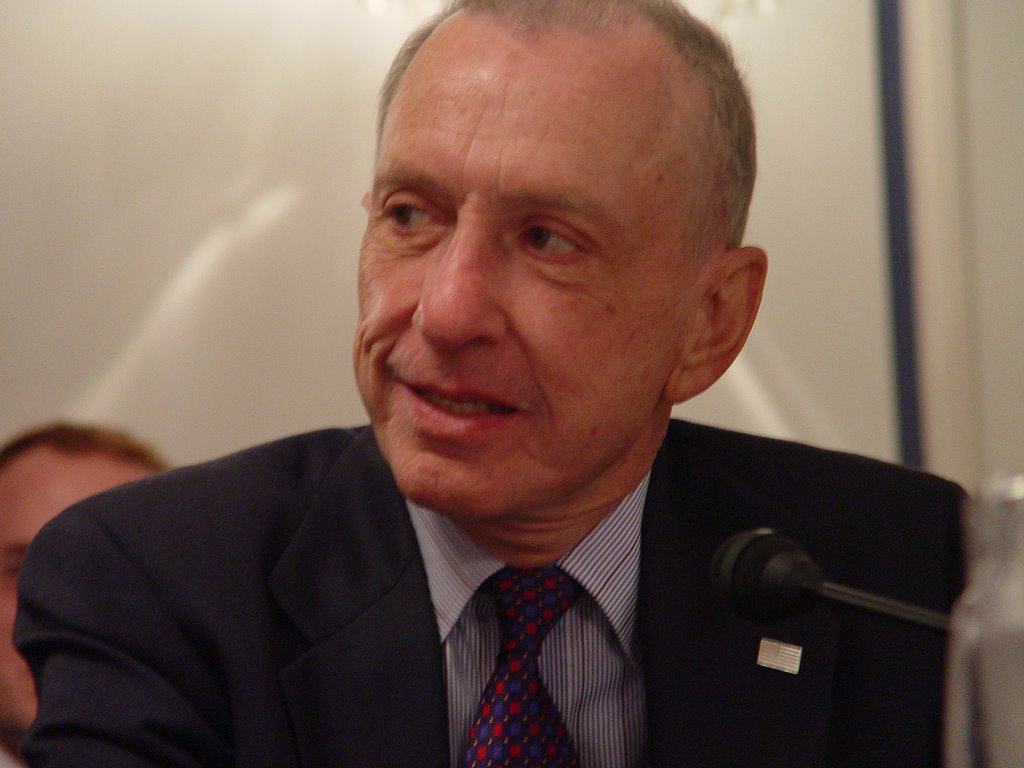
Sen Arlen "Magic Bullet" Specter has come up with a novel idea: Let's write a law that brings Bush's extra-legal NSA warrantless eavesdropping under the FISA act.
That's kinda like writing legislation to bring exceeding the speed limit on the highways under the traffic laws.
Specter's proposal would bring the four-year-old NSA program under the authority of the court created by the 1978 Foreign Intelligence Surveillance Act. The act created a mechanism for obtaining warrants to wiretap domestic suspects. But President Bush, shortly after the 2001 terrorist attacks, authorized the NSA to eavesdrop on communications without such warrants. The program was revealed in news reports two months ago.
I bet he will want to make the provisions retroactive to spare Bush any legal consequences for having evaded FISA for the last few years.
There looks to be a problem or two with Sen. Specter's legislation:
The draft version of Specter's bill, which is circulating in intelligence and legal circles, would require the attorney general to seek the FISA court's approval for each planned NSA intercept under the program...
Specter's bill would require the attorney general to give the secret court "a statement of the facts and circumstances" causing the Justice Department to believe "that at least one of the participants in the communications to be intercepted . . . will be the foreign power or agent of a foreign power specified in [the law], or a person who has had communication with the foreign power or agent." The attorney general would have to provide "a detailed description of the nature of the information sought" and "an estimate of the number of communications to be intercepted . . . during the requested authorization period."
Even published information about the secret program has pointed out that the NSA is casting a hugely wide net. It will be impossible individually to truthfully provide "a statement of the facts and circumstances" for each suspect, not to mention provide a description of the information that they are trying to intercept.
Nobody must have told Specter. He certainly is not among the eight lawmakers who have been briefed on the program.
Kate Martin, director of the Center for National Security Studies, a civil rights group, said the bill's language is alarmingly broad. "It's not limited to al-Qaeda or even terrorism," she said. Those who communicate with "foreign powers" could include a vast array of innocent people, Martin said.
Specter must think that by eliminating "probable cause" from the requirements of FISA, he is helping to keep the nation safe.
I wonder how he will feel when the administration can't meet even his looser restrictions and continues the program sub rosa.
Saturday, February 25, 2006
GOP Leaders Back on the Bush Team
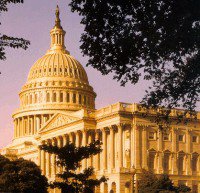
After a testy few days off the reservation, major Republicans are returning to support "our leader" on the Dubai ports deal.
A Dubai company's offer to delay taking control of terminal operations at six U.S. ports, combined with aggressive White House lobbying, has tempered a rush by congressional GOP leaders for quick action next week to block the $6.8 billion transaction, which has triggered a political furor.Speaker J. Dennis Hastert (R-Ill.) will meet with House GOP leaders Tuesday to discuss the chamber's next move, while aides to Senate Majority Leader Bill Frist (R-Tenn.) said he will wait to be briefed by the company before taking a stand. Both Hastert and Frist had issued strong statements earlier raising concerns about national security in the wake of Dubai Ports World's acquisition of the London-based Peninsular and Oriental Steam Navigation Co. and its terminal operations at six major U.S. ports, including those in New York and Baltimore.
But a bipartisan group of senators, who dismissed the Arab maritime company's offer late Thursday as meaningless, said yesterday that they will try to force a vote early next week on legislation that would require a 45-day national security investigation of the deal.
Senators from across the political spectrum -- including Charles E. Schumer (D-N.Y.), Norm Coleman (R-Minn.), Robert Menendez (D-N.J.), Olympia J. Snowe (R-Maine), Hillary Rodham Clinton (D-N.Y.), Tom Coburn (R-Okla.), Susan Collins (R-Maine) and Jack Reed (D-R.I.) -- said they will push for a fast vote on legislation that would block the takeover of port operations while the administration conducts a national security review of the transaction's implications.
The administration wishes any reticent lawmakers to view the report which immediately follows the one you are reading.
Any qualms about the national security ramifications of the deal will evaporate.
Or, at least, the administration hopes they will.
Intelligence Community Says UAE is a Team Player

In the most reassuring thing I've heard in awhile, Walter Pincus tells us that the U.S. Intelligence Community has confidence that the Dubai Port deal will not endanger national security.
The Community's BFF Pincus has been told that since the UAE has been so helpful in the "war on terror", that they are now part of the club.
Reviews by U.S. intelligence agencies supported Dubai Ports World's purchase of the British company running terminals at six American seaports, and the assessments were made available to the Treasury Department-run interagency committee that approved the deal, according to senior administration officials.The intelligence studies were coordinated by the Intelligence Community Acquisition Risk Center, a new organization under the office of the Director of National Intelligence John D. Negroponte, said one official. The center normally does broad threat analyses of foreign commercial entities that seek to do business with U.S. intelligence agencies.
Pincus is saying that a small office that does cursory checks of IC databases on the backgrounds of foreign companies gives the plan the thumbs up.
While contents of the intelligence assessments remain classified, current and former intelligence officials yesterday spoke highly of the level of counterterrorism cooperation provided after Sept. 11, 2001, by Dubai and several of the other states that make up the United Arab Emirates.
A former senior CIA official recalled that, although money transfers from Dubai were used by the Sept. 11 hijackers, Dubai's security services "were one of the best in the UAE to work with" after the attacks. He said that once the agency moved against Pakistani nuclear scientist Abdul Qadeer Khan and his black-market sales of nuclear technology, "they helped facilitate the CIA's penetration of Khan's network."
What are the odds that the UAE will be glad to see that revelation in a major newspaper, even if untrue? (Which is likely.)
Dubai also assisted in the capture of al-Qaeda terrorists.Nice one. The proof:
An al-Qaeda statement released in Arabic in spring 2002 refers to UAE officials as wanting to "appease the Americans' wishes" including detaining "a number of Mujahideen," according to captured documents made available last week by the Combating Terrorism Center at West Point. The al-Qaeda statement threatened the UAE, saying that "you are an easier target than them; your homeland is exposed to us."
Anyone with a passing familiarity with al-Qaeda statements knows that most, if not all, of the Middle-Eastern nations collaborating with the U.S. in the "war on terror" have received the same type of boilerplate threats.
One intelligence official pointed out that when the U.S. Navy no longer made regular use of Yemen after the USS Cole was attacked in 2000, it moved its port calls for supplies and repairs to Dubai.
Marine Corps Gen. Peter Pace, chairman of the Joint Chiefs of Staff, on Tuesday praised the "superb" military-to-military relationship with the UAE, saying, "In everything that we have asked and work with them on, they have proven to be very, very solid partners."
This just tells us that if you play ball with the U.S. security regime, you will receive a payoff.
If Hugo Chavez entered the bidding for the British port management company P&O, beating out Dubai to buy the port operations, there is no way that he--with no ties to Muslim terrorists at all--would be the approved buyer.
The real issue anyway is the continued health of the U.S. dollar.
If the Arabs, who hold a huge portion of U.S. debt, get the idea that their dollar holdings don't have the buying power of everybody else's--they will unload their U.S. bond holdings--spelling doom for the dollar.
Update: My illustrious colleague at Swedish Meatballs Confidential, M1, has received information about the true motivation of the Bush administration in the Dubai Ports deal.
It involves allowing control of port management in the U.S. to be sold to a state-owned company in Dubai in exchange for U.S. oil companies being permitted to increase their stake in some UAE oil operations to majority ownership status.
See Swedish Meatballs Confidential
Friday, February 24, 2006
Former Senator Robert Dole Lobbies For Dubai Ports
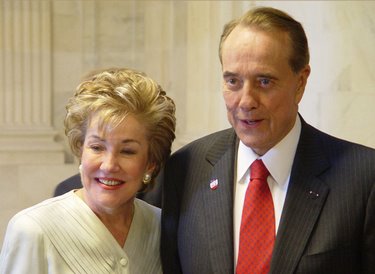
Former Viagra spokesman Robert Dole has gotten himself a new gig.
The lobbying of former Senate majority leader Robert J. Dole on behalf of the Dubai-owned company set to take over management of terminals at six major U.S. seaports is creating a political problem for his wife, Sen. Elizabeth Dole (R-N.C.).Any possible influence Dole has would most likely be on the Congress.The chairman of the North Carolina Democratic Party, Jerry Meek, yesterday called on Sen. Dole to remove herself from "any congressional oversight" of the Dubai port deal. "The fact that Dubai is paying her husband to help pass the deal presents both a financial and ethical conflict of interest for Senator Dole," Meek said...
Dole's statement said he will confine his lobbying to the Bush administration. "I have not nor will I 'lobby' Members of Congress on this issue, not even at home," he wrote. "I have not discussed the port issue with any Senator or member of Congress or anyone working for the Congress, nor will I do so in the months to come."
The controversy confronting the Doles is an increasingly common one in Washington. According to Public Citizen's Congress Watch, at least three dozen members of Congress have relatives who are professional lobbyists.
Congress Watch and other watchdog groups have loudly criticized the growing trend. "What better way to buy access to a lawmaker than to hire the lawmaker's son, daughter or spouse as their lobbyist on a lucrative retainer?" said Craig Holman, a lobbyist for Congress Watch.
Since he will not be lobbying Congress, methinks that Dubai Ports may not be getting their money's worth.
Yoo Style Creative Lawyering
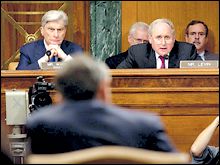
There was some seriously creative lawyering on display yesterday at the meeting of the Senate Armed Services Committee.
Yesterday, it emerged in the committee hearing that the administration may have skirted the law by not granting a 45-day review of the Dubai ports deal. The law says such a review is mandatory if a sale to a state-owned company "could affect the national security of the United States" -- a standard the administration seemed to acknowledge the deal met because it required special safeguards.Sen. Robert Byrd (D-W.Va.), who wrote the 1992 law, demanded to know "why that investigation was not carried out."
Warner asked Deputy Treasury Secretary Robert Kimmitt to "clarify."
"Senator," Kimmitt told Byrd, "we have a difference of opinion on the interpretation of your amendment." The administration, he said, views it "as being discretionary."
Sen. Hillary Rodham Clinton (D-N.Y.), reading the statute to Kimmitt, said the law "requires -- requires -- an investigation."
"We do not see it as mandatory," Kimmitt repeated.
Sen. Carl Levin (D-Mich.) grew irritated. "If you want the law changed," he told Kimmitt, "come to Congress and change it. But don't ignore it."
"We didn't ignore the law," Kimmitt again maintained. "We might interpret it differently."
Even Warner, though initially defending the administration, grew tired of this explanation. "I must say, as a lawyer myself, reading this, on the face, my colleagues raise a legitimate question," the chairman warned.
John Yoo's style of questionable interpretation of law seems to be felt all over Washington these days.
MZM's Wade Plans Guilty Plea in Cunningham Case
The Randy "Duke" Cunningham bribery scandal is claiming another scalp:
Washington defense contractor Mitchell J. Wade is expected to enter a guilty plea in federal court here this morning for his role in the bribery-related case involving former Rep. Randall "Duke" Cunningham (R-Calif.), according to sources familiar with the investigation.Wade, who founded District-based MZM Inc., started cooperating months ago in the inquiry of Cunningham's alleged trading of "earmarks" in congressional appropriations for $2.4 million in cash, furniture, boats and house payments, sources said. The probe began last June after the San Diego Union-Tribune reported that Wade bought Cunningham's San Diego home and then resold it months later for a $700,000 loss. A short time later, another newspaper reported that the congressman also was living rent-free on Wade's 42-foot yacht while in Washington...
Wade is also expected to acknowledge that he attempted to improperly influence a Defense Department contracting and procurement official with inducements and gifts, including offers to hire members of his family, the sources said.
The plea agreement will note also how Wade and his employees gave tens of thousands of dollars in campaign contributions to two other House members. There is no indication that the House members face any liability.
No liability?
That means Wade didn't get his money's worth from the two other House members.
Smart guys.
Thursday, February 23, 2006
The Odious Opinions of John Yoo

If John Yoo is so enamored with police state governance, he is welcome to emigrate to North Korea and work for the government there.
However, the North Korean dictatorship may be reluctant to embrace Yoo's theories of law. Kim Jong-Il may be the object of a "personality cult", but Yoo's interpretation of "supreme leadership" would even make Kim uneasy.
For generations, civics students have learned that the Constitution gives Congress the power to declare war. Yesterday, the man who built the legal underpinnings of the Bush administration's terrorism strategy revised the curriculum.John Yoo, the former Justice Department official whose writings justified the administration's treatment of military prisoners and the National Security Agency eavesdropping program, announced that Congress's warmaking powers are just a figment of the "popular imagination."
"Almost all the prominent scholars who believe that Congress should play a prominent role in foreign policy look to the 'declare war' clause as the source of Congress's power," Yoo said, 10 minutes into his talk at the Heritage Foundation. "They appeal to a very common-sense reading of the declare-war clause," he continued, and "I think in the popular imagination, declaring war does seem to equate with making war or starting war."
That is, indeed, the prevailing view. But it is not Yoo's. "I don't think if you look at the constitutional text carefully that it carries that expansive reach," he asserted. "Note that the declare-war clause uses the word 'declare.' It doesn't use the word 'begin,' 'make,' 'authorize,' 'wage' or 'commence' war."
Thus did Yoo reduce Congress's warmaking authority to a ceremonial role, much like its authority to declare a national Boy Scout recognition month...
Yoo has not mellowed in his view that presidential powers are near absolute in wartime. Twice yesterday, he said the president has a "choice" about whether to follow the 1978 Foreign Intelligence Surveillance Act -- the law that, critics say, President Bush evaded by allowing warrantless wiretaps. FISA "says, 'Look, you have a choice,' " Yoo said. "If you work through FISA, then you can use the fruits of those searches in criminal prosecution." By contrast, if a president "doesn't follow FISA and still collects the information, it's doubtful it will be admitted. That's a choice presidents have to make."
When a defendant gets dodgy legal advice, it doesn't mean that he escapes the legal consequences of his actions.
In a less fanciful country, the administration would have to face the fact that they should have hired less obsequious counsel.
Chickens Come Home To Roost For "Security" Party

The Republican insistence on identifying itself as the "security" party is paying unwelcome dividends to President Bush on the port management controversy.
The chickens are coming home to roost now with the constituents of Republican lawmakers making their fears known in Washington.
Faced with an unprecedented Republican revolt over national security, the White House disclosed yesterday that President Bush was unaware of a Middle Eastern company's planned takeover of operations at six U.S. seaports until recent days and promised to brief members of Congress more fully on the pending deal.But congressional Republicans renewed their vow to prevent the sale from being finalized next month and warned Bush, sometimes in taunting terms, that an overwhelming majority of lawmakers will oppose the sale on national security grounds. "Dear Mr President: In regards to selling American ports to the United Arab Emirates, not just NO but HELL NO!" Rep. Sue Myrick (R-N.C.) wrote to Bush in a one-sentence letter.
The unknown wingnuts in Congress are not alone in their objections.
Senate Majority Leader Bill Frist (R-Tenn.) and House Speaker J. Dennis Hastert (R-Ill.) rejected Bush's call to allow the sale to go through early next month and they remain committed to delaying it, their spokesmen said yesterday.
Republican lawmakers have been flooded with phone calls and letters from constituents encouraging them to fight Bush over the port deal, even at the expense of GOP unity on combating terrorism -- possibly their best political issue. As a result, Bush and Republicans are divided over a national security issue as never before and bracing for a possible showdown that could force Bush to either delay the sale or veto a Republican bill against it, according to congressional and White House officials.
I don't envy the congressional staffers getting an earful on the telephone from terrified red-staters.
House Homeland Security Committee Chairman Peter T. King (R-N.Y.) said political pressure from constituents is driving the debate. Lawmakers, he said, are "responding to incredible local political pressure."
The administration does have their apologists, note the following info:
At the Treasury Department, the Committee on Foreign Investments in the United States (CFIUS), which includes Cabinet officials and White House aides, examines sales with potential national security risks and usually attracts little attention.
Administration officials did not consider the sale of port terminal management to a Middle Eastern company dangerous or potentially controversial, White House aides said. Foreign-owned companies including a Chinese operation have controlled terminals at various U.S. ports for years -- and lawmakers have rarely complained. The White House said intelligence officials reviewed the sale and raised no concerns.
This seems to be all about money.
The rich in the U.S. have always had more in common with their wealthy foreign counterparts than they have with the average American citizen.
U.S. Wants India's Cooperation, While Offending Indian Scientific Community
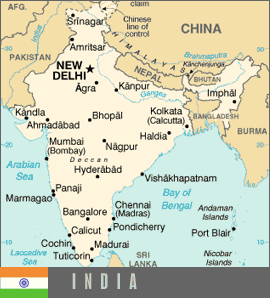
In a diplomatic effort, the U.S. is attempting to get India to separate their military and civilian nuclear programs--to reduce the possibility of the diversion of U.S. made technology from energy programs to weapons programs.
Days before he leaves for South Asia, President Bush publicly urged India yesterday to separate its civilian and military nuclear programs to pave the way for a new strategic alliance between Washington and New Delhi.Bush agreed in July to give India access, for the first time, to civilian nuclear assistance, breaking with decades of U.S. nuclear policies. For the Bush administration, the deal was part of a long-term Asian strategy designed to accelerate India's rise as a global power and as a counterweight to China. The White House had hoped to finalize the accord next week when Bush becomes the first U.S. president to visit India and Pakistan since the two South Asian rivals conducted nuclear tests in 1998...
U.S. law forbids exporting nuclear materials to sites or facilities that are used for bombmaking. For Congress, the military-civilian separation plan is seen as a key indicator of whether New Delhi intends to use the deal to help its weapons production, or its energy sector.
The Indian military is not so keen about the U.S. idea:
In December, Indian negotiators surprised their U.S. colleagues when they proposed keeping a majority of the facilities under military control. In particular, the Indians suggested to senior U.S. officials, including Undersecretary of State R. Nicholas Burns, the chief negotiator, that they wanted military control over fast-breeder reactors, at least until 2010. The reactors are in the experimental phase but will be able to produce enormous quantities of weapons-grade plutonium when fully operational...
At a meeting last week of nuclear weapons experts, David Albright, president of the Institute for Science and International Security, suggested that India's plans for the breeder reactor were evidence of "a greedy effort to try to have as much of a plutonium production capability for nuclear weapons as possible."
"India has to choose," Albright said. "Does it want nuclear weapons capabilities, or does it want international cooperation?"
A decision two weeks ago by a U.S. consulate in India to refuse a visa to a prominent Indian scientist has triggered heated protests in that country and set off a major diplomatic flap on the eve of President Bush's first visit to India.
The incident has also caused embarrassment at the highest reaches of the American scientific establishment, which has worked to get the State Department to issue a visa to Goverdhan Mehta, who said the U.S. consulate in the south Indian city of Chennai told him that his expertise in chemistry was deemed a threat...
Mehta's case has especially angered Indians because he was a director of the Indian Institute of Science and is a science adviser to India's prime minister. He has visited the United States "dozens of times," he said, and the University of Florida in Gainesville had invited him to lecture at an international conference.
Are we worried now about Hindu terrorism?
Libby's Lawyers Using "Busy Official" Defense

Lawyers for I. Lewis "Scooter" Libby are using greymail tactics, requesting mountains of sensitive documents, to try to prove that their client had simply too much on his plate, and could have easily misremembered important details of the Valerie Plame affair.
Attorneys for I. Lewis "Scooter" Libby insist they need hundreds of pages of classified daily briefings prepared for President Bush to show that Libby did not intentionally lie about discussing Plame with reporters, as prosecutors allege. They contend that he was preoccupied with more serious matters when the conversations took place and when investigators questioned him months later.
"One of the central themes of Mr. Libby's defense at trial will be that any misstatements he made during his FBI interviews or grand jury testimony were not intentional, but rather the result of confusion, mistake or faulty memory," the lawyers wrote in a court document filed late Tuesday. "Given the urgent national security issues that commanded Mr. Libby's attention, it is understandable that he may have forgotten or misremembered relatively less significant events [such as] alleged snippets of conversations about Valerie Plame Wilson's employment status."...
Special Counsel Patrick J. Fitzgerald argued in court filings last week that Libby's attorneys were attempting to derail the prosecution with a "breathtaking" request for nearly a year's worth of Presidential Daily Briefs, the closely guarded document that summarizes threats to the United States and is almost never released.
There is at least one big problem with Libby's defense. Simple faulty memory cannot reasonably account for an elaborate story, the entirely ficticious account of being originally told of Plame's identity by Tim Russert.
Regular jurors will be able to tell the difference. The court will not look kindly on this either.
Wednesday, February 22, 2006
Libby Defense Fund Brims With Big Names

Looks like a bunch of influential Republicans may not want I. Lewis "Scooter" Libby to spill the beans on Vice-President Dick Cheney.
A Who's Who of Republican heavy hitters and Bush administration supporters are lending their names to help raise $5 million for the defense of Vice President Cheney's former top aide in his criminal trial.Led by Florida real estate magnate and former ambassador Mel Sembler, the group seeking to help I. Lewis "Scooter" Libby avoid jail time includes 26 notable names, many of whom could also be described as "Friends of George and Dick."
Sembler, a longtime party fundraiser, backed Cheney as a presidential candidate in 1996 until he dropped out of the race, and described himself as vindicated and thrilled when George W. Bush chose Cheney as a running mate in 2000...
Among Cheney's longtime friends on the committee are former senator Alan K. Simpson (Wyo.); GOP donor Frederic V. Malek of McLean, chairman of Thayer Capital Partners who served in the Nixon White House at the same time as Cheney; and top communications aide Mary Matalin. Former Bush energy secretary Spencer Abraham and former CIA director R. James Woolsey are also lending a hand...
The committee boasts academics, such as Bernard Lewis, Princeton history professor, and Francis Fukuyama of the School of Advanced International Studies at Johns Hopkins University, who has written critically of the administration's Iraq policy.
It must be nice to have such loyal friends.
FDA Carbon Monoxide Skullduggery

The FDA is resisting a push to ban the use of carbon monoxide to maintain the look of freshness in packaged meat.
A Food and Drug Administration official indicated yesterday that she was unaware of any scientific studies showing that the color of a piece of meat is central to a shopper's decision to buy it or not -- even though a petition recently filed with the agency describes several such studies.In a telephone news conference yesterday, Laura Tarantino, director of the FDA's Office of Food Additive Safety, sought to allay consumer concerns about the safety and freshness of the nation's meat supply after revelations in The Washington Post that a growing proportion of prepackaged meats in the United States are spiked with carbon monoxide -- a gas that keeps even rotten meat looking red and fresh.
The agency has been asked to ban the practice, but Tarantino defended the FDA's decision to classify it as "generally recognized as safe," which allowed the meatpacking industry to use the gas without seeking formal FDA approval.
Carbon monoxide "does not reduce the safety of meat," Tarantino said, referring to meat-company-sponsored studies indicating that treated meat is not more likely to harbor harmful bacteria than conventionally packaged meat.That aspect of safety is essentially undisputed. But Tarantino appeared unacquainted with a significant body of data -- some of it generated by the meat industry -- indicating that red color is a central cue used by shoppers to determine the freshness of meats, which are increasingly sold in sealed, "modified atmosphere" packages.
The issue is not just about buying preference here.
If the meat still looks good well after the consumer has purchased it, some people might go ahead and serve it up to their families, regardless of smell or slime considerations.
Not everyone in the U.S. is an Einstein.
BLM Diverting Biologists From Wildlife Studies

This really shows the influence of big energy upon the priorities of the Bush administration.
The Bureau of Land Management, caretaker of more land and wildlife than any federal agency, routinely restricts the ability of its own biologists to monitor wildlife damage caused by surging energy drilling on federal land, according to BLM officials and bureau documents.The officials and documents say that by keeping many wildlife biologists out of the field doing paperwork on new drilling permits and that by diverting agency money intended for wildlife conservation to energy programs, the BLM has compromised its ability to deal with the environmental consequences of the drilling boom it is encouraging on public lands.
Nice.
Tuesday, February 21, 2006
Good Work If You Can Get It

In the "it's good work if you can get it" department, today we present the business model of Brent Wilkes.
(T)he president of a small San Diego manufacturing company, showed a new acoustics technology he was developing to his neighbor, defense contractor Brent Wilkes. Wilkes soon came back with an unusual proposition.Wilkes said that Congress had set aside or "earmarked" $25 million in the military budget for the Navy to develop an acoustical system. He promised he could win the government contract to develop the system for Beck's Horizon Sports Technologies, according to allegations in a lawsuit. In return, Wilkes wanted $1.5 million up front to cover his lobbying expenses and a 51 percent interest in a new company they would set up to collect the government cash...
Although it is common for lobbying firms to charge clients large fees to pursue earmarks, Wilkes's demand for a majority interest in the resulting contract is highly unusual, experts said. "It has a strong, bad odor about it," said Kenneth A. Gross, a Washington lawyer who specializes in ethics law. He said many states, including California, have banned such contingency, or success, fees, though there is no federal prohibition.
"My client did nothing inappropriate or illegal in trying to obtain funding for his clients' projects," said Wilkes's attorney, Michael Lipman of San Diego.
Wilkes was an obscure California contractor and lobbyist until his name surfaced last year as one of two defense contractors alleged to have given Cunningham $2.4 million in cash and other benefits in return for Cunningham's steering government business their way. One of Wilkes's companies received more than $80 million in Pentagon contracts over the past decade that stemmed from earmarks that Cunningham slipped into spending bills.
Outstanding return on investment (ROI).
(Wilkes) expanded his business by setting up his own lobbying firm, Group W Advisors, in the Washington suburbs, to pursue earmarks.
State Dept. Punishing Dissenting Employees

The State Department has been valued by policymakers for well over 200 years for providing as independent advice as you will find in this heavily politicized town.
That's what makes the following so egregious:
A State Department reorganization of analysts involved in preventing the spread of deadly weapons has spawned internal turmoil, with more than half a dozen career employees alleging in interviews that political appointees sought to punish long-term employees whose views they considered suspect...
"There are a number of disgruntled employees who feel they have been shoved aside for political purposes. That's true," said one of these (senior departmental) officials. "But there was rank insubordination on the part of these officers."
Rank insubordination? These officials didn't publicly call BS on the phony WMDs. I would call that loyalty.
About a dozen top experts on nonproliferation have left the department in recent months, with many citing the reorganization as a reason...
Some State Department officials privately acknowledge that they used to be thrilled by the department's reputation as a renegade in President Bush's first term, but they say the message has become clear in the past year that such attitudes are no longer acceptable...
The employees who say that they have been targeted once had a back channel to then-Secretary of State Colin L. Powell and his deputy, Richard L. Armitage, who they said would on occasion ask them to bypass their superior, John R. Bolton, now the ambassador to the United Nations. Bolton, with backing from allies in the Pentagon and the vice president's office, frequently battled the rest of the State Department on policy issues.
But (Robert Joseph, the undersecretary of state for arms control, who oversaw the reorganization), who worked for Rice at the White House, is an ideological soul mate of Bolton's and retained much of Bolton's staff -- and now officials say the policy disputes that characterized Powell's State Department have largely faded under Rice's tenure. The back channel that these employees used to alert senior management to their problems with Bolton no longer exists, the career officials said.
By many accounts, the decision to merge two key bureaus focusing on nonproliferation and arms control was necessary. The merger was originally approved by Powell, in his waning days as secretary, after the department's inspector general recommended combining the bureaus on the grounds of efficiency and workload. The IG said the nonproliferation bureau -- which seeks to deter the spread of weapons of mass destruction -- was overworked, and the arms-control bureau -- which negotiates and implements arms-control agreements -- was underworked. The IG also recommended that a third bureau, verification and compliance, be downsized.But once a panel of Joseph's top aides began implementing the plan, some of the IG's recommendations were set aside -- the verification bureau was expanded, not downsized, while officials in the arms-control bureau appeared to attain more authority. Both bureaus had appeared more in sync with the administration's views, officials said.
The dominant meme lately is that State is much more in the loop with the rest of the administration, and that they have a much greater say in U.S. policy under Rice than Powell.
Now we know why.
Intelligence Agencies Reclassifying Old Papers at National Archives
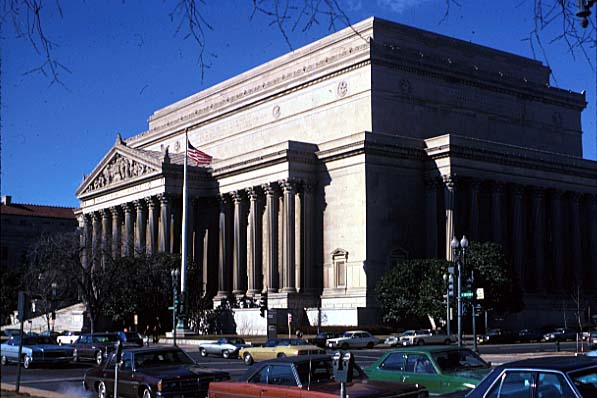
In what can be described as charitably as possible as trying to put the genie back in the bottle:
(I)ntelligence agencies have been removing from public access thousands of historical documents that were available for years, including some already published by the State Department and others photocopied years ago by private historians.
The restoration of classified status to more than 55,000 previously declassified pages began in 1999, when the Central Intelligence Agency and five other agencies objected to what they saw as a hasty release of sensitive information after a 1995 declassification order signed by President Bill Clinton. It accelerated after the Bush administration took office and especially after the 2001 terrorist attacks, according to archives records.
Most of this stuff is ancient:
But because the reclassification program is itself shrouded in secrecy, — governed by a still-classified memorandum that prohibits the National Archives even from saying which agencies are involved, — it continued virtually without outside notice until December. That was when an intelligence historian, Matthew M. Aid, noticed that dozens of documents he had copied years ago had been withdrawn from the archives' open shelves.Mr. Aid was struck by what seemed to him the innocuous contents of the documents, mostly decades-old State Department reports from the Korean War and the early cold war. He found that eight reclassified documents had been previously published in the State Department's history series, "Foreign Relations of the United States."
"The stuff they pulled should never have been removed," he said. "Some of it is mundane, and some of it is outright ridiculous."...
Among the 50 withdrawn documents that Mr. Aid found in his own files is a 1948 memorandum on a C.I.A. scheme to float balloons over countries behind the Iron Curtain and drop propaganda leaflets. It was reclassified in 2001 even though it had been published by the State Department in 1996.
Another historian, William Burr, found a dozen documents he had copied years ago whose reclassification he considers "silly," including a 1962 telegram from George F. Kennan, then ambassador to Yugoslavia, containing an English translation of a Belgrade newspaper article on China's nuclear weapons program.
Under existing guidelines, government documents are supposed to be declassified after 25 years unless there is particular reason to keep them secret. While some of the choices made by the security reviewers at the archives are baffling, others seem guided by an old bureaucratic reflex: to cover up embarrassments, even if they occurred a half-century ago.One reclassified document in Mr. Aid's files, for instance, gives the C.I.A.'s assessment on Oct. 12, 1950, that Chinese intervention in the Korean War was "not probable in 1950." Just two weeks later, on Oct. 27, some 300,000 Chinese troops crossed into Korea.
I find it impossible to imagine that the CIA's Security Operations Center, the office that investigates security violations, would have had any objection at this late date to having those fossilized documents in the open at the National Archives.
Monday, February 20, 2006
Administration Scrambles To Avoid Investigations
The Bush administration is doing everything it can to avoid being called to account for the extra-legal NSA warrantless eavesdropping program.
After two months of insisting that President Bush did not need court approval to authorize the wiretapping of calls between the United States and suspected terrorists abroad, the administration is trying to resist pressure for judicial review while pushing for retroactive Congressional approval of the program...
According to lawmakers involved in the discussions, a number of senior officials, including Harriet E. Miers, the White House counsel, and Andrew H. Card Jr., the chief of staff, began contacting members of the Senate to determine what it would take to derail the investigation.The White House has refused to discuss those talks. Trent Duffy, a deputy press secretary, said the administration "does not want to negotiate in the media."
The White House does not want to be held accountable for anything anywhere at any time.
Sunday, February 19, 2006
The Flight 93 Shoot Down
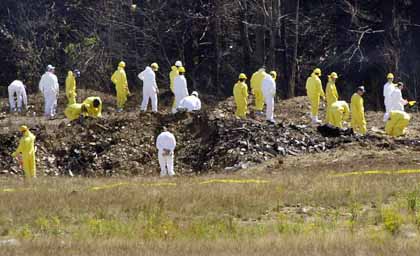
Vice-President Dick Cheney, who admitted having issued a "shoot-down" order for any hijacked planes coming toward the nation's capital on the morning of September 11, 2001, has long claimed that he was merely relaying the express authorization given to him by President Bush.
The new issue of Newsweek, online this morning, has a revealing bit of information buried six pages into a story about Cheney.
We now know why the government concocted the "lets roll" myth of the brave passengers forcing down Flight 93 over Pennsylvania.
People who were with the Vice-President on that morning say that, despite Cheney's testimony to the contrary to the 9-11 commission, he never got the required okay from President Bush to shoot down airliners.
Around 9:35 on the morning of 9/11, Cheney was lifted off his feet by the Secret Service and hustled into the White House bunker. Cheney testified to the 9/11 Commission that he spoke with President Bush before giving an order to shoot down a hijacked civilian airliner that appeared headed toward Washington. (The plane was United Flight 93, which crashed in a Pennsylvania field after a brave revolt by the passengers.) (sic) But a source close to the commission, who declined to be identified revealing sensitive information, says that none of the staffers who worked on this aspect of the investigation believed Cheney's version of events.
A draft of the report conveyed their skepticism. But when top White House officials, including chief of staff Andy Card and the then White House counsel Alberto Gonzales, reviewed the draft, they became extremely agitated. After a prolonged battle, the report was toned down. The factual narrative, closely read, offers no evidence that Cheney sought initial authorization from the president. The point is not a small one. Legally, Cheney was required to get permission from his commander in chief, who was traveling (but reachable) at the time. If the public ever found out that Cheney gave the order on his own, it would have strongly fed the view that he was the real power behind the throne.
It was worse than that, Newsweek is covering for the administration's real problem. It was not concern about "the real power behind the throne" that bothered the White House.
The big problem was that an Air National Guard unit shot down Flight 93 without the statutorily required authorization from the President. This is a scandal of monumental proportion.
This helps to explain why Bush and Cheney initially refused to establish a 9-11 commission, and when pressured to do so, why they insisted upon testifying together and without swearing an oath.
It also explains Defense Secretary Rumsfeld's "slip of the tongue" when he referred to "the people who shot down Flight 93 over Pennsylvania."
Saturday, February 18, 2006
Rumsfeld Hearts Info-Ops

In "the lady doth protest too much, methinks" department we find Defense Secretary Donald Rumsfeld whining about mainstream media coverage of defense issues and calling for better DOD information operations.
Defense Secretary Donald H. Rumsfeld yesterday called for the military and other government agencies to mount a far more aggressive, swift and nontraditional information campaign to counter the messages of extremist and terrorist groups in the world media.Rumsfeld criticized the absence of a "strategic communications framework" for fighting terrorism. He also lashed out at the U.S. media, which he blamed for effectively halting recent U.S. military initiatives in the information realm -- such as paying to place articles in Iraqi newspapers -- through an "explosion of critical press stories."
The speech follows a top-level review of Pentagon strategy and resources released earlier this month that concluded: "Victory in the long war ultimately depends on strategic communication." The Quadrennial Defense Review called for closing gaps in U.S. capabilities in what the Pentagon describes as "information operations," an area being reorganized in the Pentagon, according to current and former defense officials...
He also called for creating 24-hour media operations centers and "multifaceted media campaigns" using the Internet, blogs and satellite television that "will result in much less reliance on the traditional print press."
As if the "traditional print press" wasn't already fully compromised by their obsequious attitude towards power. The electronic corporate media is even closer, ask "Bomb" Woodruff.
Protests sparked by newspaper cartoons of the prophet Muhammad continued across (Pakistan) Friday, as a cleric announced a $1 million bounty for the killing of any of the Danish cartoonists responsible for the caricatures and Denmark temporarily closed its embassy.
Hundreds of protesters gathered in the capital, Islamabad, after midday prayers. Rallying at a downtown intersection, some chanted, "Bush is a dog!" and others carried banners reading, "Death sentence for the cartoonists." Police in riot gear watched from the sidelines. Similar demonstrations were reported in other cities across the country...
In the conservative northwestern city of Peshawar, Mohammed Yousaf Qureshi announced after Friday prayers at the historic Mohabat Khan mosque that the mosque and an affiliated religious school would give $25,000 and a car to anyone who killed one of the artists responsible for the cartoons, news agencies reported from the city.
The cleric also said a local jewelers' association had offered a $1 million bounty.
"If the West can place a bounty on Osama bin Laden" and his top deputy, Ayman Zawahiri, "we can also announce a reward for killing the man who has caused this sacrilege of the holy prophet," Qureshi told the Reuters news agency...
Political leaders from moderate as well as hard-line religious parties have vowed to continue the demonstrations, which have expanded beyond the cartoon controversy into a broader attack on Gen. Pervez Musharraf, Pakistan's president, and his Western backers, especially the United States.
Religious parties have announced plans for a large rally in the capital on Sunday as part of a series of demonstrations intended to peak when President Bush arrives on a visit in early March.
"They are pursuing a larger agenda against this regime under the cover of the cartoons," said Hasan Rizvi, a political analyst and author. "They want a confrontation now."
They aren't the only ones who "want a confrontation now."
Iran's foreign minister demanded the immediate withdrawal of British forces in Basra, saying that they had destabilized the southern Iraqi city near the Iranian border.
Basra is about 22 miles from a southern Iranian province that witnessed riots and bombings last year allegedly connected to Iran's Arab minority. Iran has blamed British intelligence for some of the bombings, a charge that Britain denies.
"The Islamic Republic of Iran demands an immediate withdrawal of British forces from Basra," Mottaki told reporters after talks with his Lebanese counterpart.
Mottaki's allegations seemed to be spurred by the recent publicity given to a video of what appeared to be British soldiers assaulting Iraqi boys after a street confrontation in January 2004 in the southern Iraqi city of Amarah, about 100 miles north of Basra. The British Army has launched an investigation and arrested two people.
And to think, Rumsfeld would like you to believe that the United States doesn't do information operations well.
Update: Indonesian Muslims are reacting according to plan.
Hundreds of Muslims protesting caricatures of the Prophet Muhammad tried to storm the U.S. Embassy on Sunday, smashing the windows of a guard post but failing to push through the gates. Several people were injured.
Abramoff Still Cooperating With Prosecutors

This blog's favorite lobbyist, Jack Abramoff, is still cooperating with prosecutors looking into the corrupt Republican machine.
The Justice Department and defense lawyers asked a federal judge Friday to delay the March sentencing of lobbyist Jack Abramoff in a Florida fraud case to allow him more time to cooperate in a broader government corruption investigation.Abbe Lowell, Abramoff's lawyer in Washington, said in a telephone conference with U.S. District Judge Paul C. Huck that if sentencing went forward as scheduled on March 16, it would be "upsetting to what's happening behind the scenes."
"It's based solely on the sensitivities of cooperation," Lowell said of the request.
I think that Abramoff should be allowed to take all the time he needs to implicate as many wrongdoers as possible.
Churchgoers Targeted By GOP

The Republican Party assumes that just because someone goes to church, they are likely to be dumb enough to vote for the GOP.
The North Carolina Republican Party asked its members this week to send their church directories to the party, drawing furious protests from local and national religious leaders."Such a request is completely beyond the pale of what is acceptable," said the Rev. Richard Land, head of the Ethics and Religious Liberty Commission of the Southern Baptist Convention.
During the 2004 presidential race, the Bush-Cheney campaign sent a similar request to Republican activists across the country. It asked churchgoers not only to furnish church directories to the campaign, but also to use their churches as a base for political organizing...
Officials of the Republican National Committee maintained that the tactic did not violate federal tax laws that prohibit churches from endorsing or opposing candidates for office, and they never formally renounced it. But Land said he thought the GOP had backed down.
Think again, Rev. Land.
Your good book talks a lot about sin and sinners.
They hadn't even heard of Republicans.
Cunningham Pre-Sentencing Memo Brings Bad News
Prosecutors are demanding that the book be thrown at disgraced former congressman Randy "Duke" Cunningham.
Convicted former representative Randy "Duke" Cunningham (R-Calif.) should be sentenced to the maximum 10 years in prison because of "unparalleled corruption" that included a "bribe menu" on congressional letterhead telling a defense contractor what payments were required for different levels of federal funding, federal prosecutors said in court papers yesterday.Cunningham pleaded guilty in November to bribery-related and tax-evasion charges of accepting $2.4 million from two contractors and two other men in return for steering defense work to them. The pre-sentencing memo filed by prosecutors in San Diego yesterday offered new details on the extent of his crimes and efforts he made to cover them up...
The 35-page memo detailed several other incidents, including several in which the government said Cunningham attempted to tamper with witnesses when he feared that his actions would be discovered...
Cunningham attempted to fabricate evidence and tamper with witnesses to his corruption, the government said, including persuading a real estate agent to write a letter justifying the lower price Wade resold his home for, and a phony letter in which Cunningham expressed his surprise at the low price and promised to pay Wade the difference.
He did not pay, the filing said.
Looks like the "Dukestir" is gonna pay now.
Friday, February 17, 2006
Whittington Leaves Hospital, Clearly Heavily Medicated

Vice President Dick Cheney's victim of last weekend's hunting accident, Harry Whittington, left the hospital today. Speaking to reporters, Mr. Whittington displayed the type of logic that serious painkillers have a way of imparting.
"We all assume certain risks in whatever we do, whatever activities we pursue. And regardless of how experienced, careful and dedicated we are, accidents do and will happen. And that's what happened last Friday." In fact, the hunting mishap occurred late Saturday afternoon.
As any accident investigator will tell you, accidents don't happen--they are caused.
"My family and I are deeply sorry for all that Vice President Cheney and his family have had to go through this past week," Whittington said. "We send our love and respect to them as they deal with situations that are much more serious than what we've had this week.
What happened to Cheney (and his family) that was more serious than getting shot? Maybe the Vice President's office is keeping something big from the public.
Administration Pressure On Senate Succeeds
The attempts by the architects of the extra-legal NSA warrantless eavesdropping program to forestall legal and political liability appears to be working.
The Bush administration helped derail a Senate bid to investigate a warrantless eavesdropping program yesterday after signaling it would reject Congress's request to have former attorney general John D. Ashcroft and other officials testify about the program's legality. The actions underscored a dramatic and possibly permanent drop in momentum for a congressional inquiry, which had seemed likely two months ago...
"It is more than apparent to me that the White House has applied heavy pressure in recent days, in recent weeks, to prevent the committee from doing its job," Sen. John D. Rockefeller IV (D-W.Va.), vice chairman of the intelligence committee, said after the panel voted along party lines not to consider his motion for an investigation.There was one setback, however, to the administration's efforts to keep tight wraps on the NSA operation. Yesterday, a federal judge ordered the Justice Department to turn over its internal documents and legal opinions about the program within 20 days -- or explain its reasons for refusing.
The explanation from the administration will doubtlessly be "tough shit."
Chairman Pat Roberts (R-Kan.) told reporters: "The administration is now committed to legislation and has agreed to brief more intelligence committee members on the nature of the surveillance program. The details of this agreement will take some time to work out."
Democrats said the administration's overture is so vague that it amounts to nothing, calling it a stalling tactic to give Republican lawmakers political cover for rejecting a full inquiry. "For the past three years, the Senate intelligence committee has avoided carrying out its oversight of our nation's intelligence programs whenever the White House becomes uncomfortable with the questions being asked," Rockefeller told reporters. "The very independence of this committee is called into question."
The House of representatives wants to look like it is exercising its constitutional oversight as well:
In the House, the intelligence committee will ask administration officials to explain the NSA program and its legal justifications in closed hearings over the next few months, said Wilson, one of its subcommittee chairmen.
The committee "has begun a process to thoroughly review this program and the FISA law" through a series of yet-to-be-scheduled briefings and exchanges of letters that will unfold as part of the panel's "regular order," Wilson said in an interview in her office. "This is the way we do oversight," she said, adding that she has discussed the matter with the committee chairman, Peter Hoekstra (R-Mich.).
Wilson indicated that the House hearings will not have the sharply investigative tone that Rockefeller sought in his motion, which would have required the administration to detail its reasons and rationale for starting the surveillance program in late 2001.
On another front in the increasingly futile attempt to call the administration to account for the NSA wiretap scheme, perhaps a glimmer of hope:
In a victory for three privacy advocacy groups seeking Justice Department records about the program, U.S. District Judge Henry H. Kennedy Jr. ruled yesterday that the department cannot decide on its own what documents it will provide, because news reports in December revealing the program's existence have created a substantial public dialogue about presidential powers and individual privacy rights. Kennedy rejected Justice's argument that, because so much of the surveillance program involves classified information, the agency alone can determine when it is feasible to review and possibly release documents...
The American Civil Liberties Union, which had requested the records under the Freedom of Information Act along with the Electronic Privacy Information Center and the National Security Archive Fund, cheered the ruling.
Kennedy agreed with the three groups that the Justice Department's decision to set its own time frame "would give the agency unchecked power to drag its feet and 'pay lip service' " to the law requiring the release of public information.
The Bush administration knows full well that this stalling tactic will dilute the already pathologically short attention span of the American public.
The spying controversy will soon become not such a big deal.
The people will have been lulled back to sleep, and the theft of the nation's riches (both material and other) can continue as per plan.
Nothing To See Here, Folks

In the "move along folks, nothing to see here" department we find "Texas Justice" living up to it's reputation.
The sheriff's department responsible for investigating Vice President Cheney's shooting of a Texas lawyer has closed its investigation and decided no criminal charges are warranted, according to a report released Thursday...
The report, written by Chief Deputy Gilbert San Miguel Jr., quotes Cheney and Whittington as saying the shooting was an accident. They said no one was drinking alcohol during the hunt, according to the report...
Hospital officials have declined to say whether Whittington was given a blood alcohol test when he was admitted.In his first public comments on the shooting, President Bush said Thursday in Washington that he is satisfied with Cheney's account of what happened. "I thought the vice president handled the issue just fine," he said. "I'm satisfied with the explanation he gave."
What else could Bush say? Although some unattributed reports out of the White House claim that the president is furious with the way Cheney handled the incident.
The sheriff's 2 1/2 -page report says that San Miguel began his investigation at the Armstrong Ranch at 8 a.m. Sunday, 14 1/2 hours after the shooting occurred...
Standing on a small hill, Cheney fired down, spraying Whittington's face, neck and chest with birdshot. "Cheney told me the reason Harry Whittington sustained the injuries to his face and upper body," the report said, "was that Mr. Whittington was standing on ground that was lower than the one he was standing on."...
The incident has been a big topic among the many hunters and gun enthusiasts in this region. Ken Tuggle, manager of the Corpus Christi Pistol & Rifle Club, said he could not believe that a blast at 30 yards from a 28-gauge shotgun, which shoots fewer pellets and has a smaller shot pattern than a 12-gauge shotgun, could pass through a hunting jacket and a shirt and that the pellets could become embedded near a victim's heart. "It's hard to fathom," he said...
Other hunters questioned why Cheney was shooting down at a flying bird. "The idea behind quail hunting is that you have to hit the quail when it's about five to 10 feet in the air," said Wade Wilson, a South Texas hunting guide. "Quail don't fly very high. But nobody should be shooting down."
The understatement of the day.
Roberts Wants To Broaden Leak Law
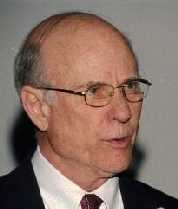
The odious Pat Roberts (R-Kan.) is thinking about broadening the laws against leaks of classified information to reporters.
The chairman of the Senate Select Committee on Intelligence said yesterday that he may add language to the fiscal 2007 intelligence authorization bill to criminalize the leaking of a wider range of classified information than is now covered by law. He indicated the new measure would be similar to legislation vetoed by President Bill Clinton more than five years ago.
The leak of the NSA warrantless wiretap program to the New York Times, and the disclosure of the CIA secret prisons in Eastern Europe to the Washington Post, must really exasperate the old Republican codger.
Recalling the legislation Clinton vetoed, Roberts said, "Whether it's a reporter or just any individual or somebody by the water cooler who's upset or somebody who has just a very strong difference of opinion knowingly reveals classified information, that would be a felony."Since the Clinton veto, he added, "I think times have changed, and we may be introducing that in the intelligence authorization bill."...
Clinton vetoed a measure by Sen. Richard C. Shelby (R-Ala.) that would have broadened the law that criminalizes release of "national defense information."Civil liberties groups and news organizations, which argued that the legislation would chill their ability to get information from officials, lobbied for the veto, which Clinton exercised in 2000.
In 2002, with George W. Bush in the White House, Shelby reintroduced his language, but then-Attorney General John D. Ashcroft said that "rigorous investigation" and enforcement of existing laws -- not new legislation -- were the best way to fight leaks.
The recent AIPAC case appears to be part of the impetus for the new anti-leak push.
A lawyer familiar with the AIPAC case said administration officials "want this case as a precedent so they can have it in their arsenal" and added: "This as a weapon that can be turned against the media."
The media in this country is already subservient to a very large degree to the whims of the government, despite wing-nut claims to the contrary.
Leaks exposing egregious wrongdoing and blatant illegalities are the only way that the few people who still care about the United States can keep an eye upon the malefactors who have hijacked the nation.
The intentional attempts via legislation to dry up of this trickle of information means that the lawmakers who try to do this are co-conspirators in the crimes of the Bush administration.
Gonzales Recusal Asked By Democrats
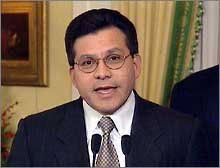
The meddlesome Democrats are requesting that Attorney General Abu Gonzales recuse himself from any involvement in the Jack Abramoff lobbying cases.
Justice says there is no need.
Thirty-one Democratic senators said Gonzales's close ties to the White House could create a conflict of interest as the Justice Department examines lobbyist Jack Abramoff's dealings with government officials.Gonzales previously served as the White House's top lawyer.
"Given the possible ties between Mr. Abramoff and senior government officials with whom you are familiar and to whom you may have provided legal advice, you will avoid the appearance of a conflict if you recuse yourself now," the senators said in a letter.
A Justice Department official said Gonzales does not need to recuse himself because the investigation is being handled by experienced lawyers serving in nonpolitical posts.
Hell, if Gonzales had to recuse himself from every issue in which he provided dodgy legal advice to the administration he would be on a paid vacation 24/7.
NASA Working To End Political Censorship

NASA is continuing to try to clean up it's act and dispense with political minders dictating what scientific data and conclusions get disseminated to the press.
NASA Administrator Michael D. Griffin said yesterday he has convened a team of scientists and public information officials to draft new guidelines to ensure that news of agency research or events will not be tailored or curtailed to reflect political or ideological bias.In his clearest statement yet regarding accusations that NASA public relations officials had manipulated news releases or reports involving climate change and cosmology, Griffin told reporters that "it is not appropriate for scientists to be required to adjust, spin or alter their scientific work to fit any particular political agenda."...
Although (Science Committee Chairman Sherwood L.) Boehlert (R-N.Y.) and other House members mentioned NASA's public information difficulties in opening statements, they asked Griffin no questions about the accusations that arose in January when scientist James E. Hansen charged that the agency's press office was restricting his efforts to publicly discuss climate change.
In response to Hansen's assertions, Griffin earlier this month e-mailed employees vowing to respect scientific openness. On Feb. 10, NASA spokesman George C. Deutsch, a political appointee, resigned after allegations he had edited a scientist's press release on cosmology to conform to administration views.
Griffin told reporters after yesterday's hearing that he has made it a policy that "technical people within NASA are not only allowed to speak their minds . . . we beg them to speak their minds."
Philippine Overthrow Plot Uncovered

Coups d'Etat are one of the most conspicuous types of political skullduggery.
The Philippine government and armed forces said they were containing a plot to overthrow and perhaps even kill President Gloria Macapagal Arroyo by fugitive mutineers backed by retired officers and opposition figures."Everything is under control," Col. Tristan Kison, the armed forces spokesman, said on the radio Friday. He said extra security was in place and the justice department was investigating.
"We discovered that there are some who are recruiting, but I cannot tell you who they are," he said. "Knowing and proving are different things."
Last year, Arroyo survived a political crisis, including an impeachment attempt, over allegations of vote-rigging and corruption. Security concerns are also running high as the country celebrates the 20th anniversary of the Feb. 25 "people power" revolt that ousted dictator Ferdinand Marcos.
A mudslide triggered by two weeks of heavy rain crashed through a village in the central Philippines on Friday, leaving about 1,500 people missing and hundreds feared dead...
Rescue workers were particularly alarmed about the fate of students at the elementary school in Guisahugon village, which was in session when a swath of the nearby mountainside collapsed at about 9 a.m. Officials said they believed about 200 youngsters were inside along with their principal and six teachers.
The landslide leveled most of the surrounding community, burying at least 350 homes and leaving only a few twisted chunks of corrugated metal poking above the mud, which emergency workers said was up to 30 feet deep in some places. Two other nearby villages were also damaged...
When rescue efforts were suspended at nightfall because of darkness and a continuing downpour, emergency teams had retrieved only 23 victims. The Red Cross reported that about 1,500 people were unaccounted for...
The Philippines is frequently buffeted by floods and heavy rain, especially typhoons that pound the archipelago on an average of 20 times a year. A string of storms in 2004 left 1,800 people dead or missing in an area northeast of Manila.
Thursday, February 16, 2006
Cheney Attempts To Put Controversy Behind Him

Vice President Cheney has carefully cultivated a reputation as the "strong, silent type." He may have missed his true calling. Cheney should have been a comedian.
The vice president rejected critics, including Republicans, who said the incident should have been announced promptly by the White House, rather than by the ranch owner calling a friendly local reporter the next day. "I thought that made good sense because you get as accurate a story as possible from somebody who knew and understood hunting," he said, adding: "And I thought that was the right call. . . . I still do."
A master of ironic humor at work.
His (nominal) boss may not be too happy with the recent developments:
In a sign of the extraordinary tension inside the White House -- evidently even between Bush and Cheney -- McClellan noted that when he said at a Monday briefing that he would have handled disclosure of the shooting differently, he was "speaking on behalf of the White House and the president."
Cheney's victim is not your typical gooper:
Whittington's politics, according to friends, have not always conformed with the conservative ideology of many Texas Republicans. One Texas Republican described Whittington's politics as that of a Rockefeller Republican, not a Reagan Republican. Others cited Whittington's opposition to the death penalty as an example of his ideological independence.
It is no secret why Cheney chose the compliant Brit Hume for the exclusive interview, he is an apologist tool for the administration:
Hume has questioned the recent behavior of the White House press corps, telling viewers Tuesday: "It doesn't seem to me, from what I can tell, from what I'm reading from the public, that the public much cares about whether they found out about this on Saturday night or Sunday afternoon or Monday morning."
Cheney was not eager to discuss another big liability, his role in "Plamegate":
Vice President Cheney yesterday praised his former chief of staff, I. Lewis "Scooter" Libby, and said the indicted ex-aide deserves to be considered not guilty until proved otherwise. But the vice president declined to say whether he authorized Libby to disclose classified information...Cheney is juggling so many crises now that his poor ticker must be under a heck of a strain. His cardiologist must be hating life right about now
In the interview, Cheney said he had the power under a presidential executive order to declassify information. "I've certainly advocated declassification and participated in declassification decisions," he said, but he would not say whether he had done so unilaterally.Cheney was referring to an executive order on classification of information first signed by President Bill Clinton in 1995. In March 2003, just days after ordering U.S. troops into Iraq, President Bush amended order to, among other things, give the vice president the same classification power as the president.
DeLay Keeps in Touch With His Constituents

Good lawmakers make a practice of keeping in touch with the folks back home, their constituents.
Rep. Tom DeLay (R-Tex.) has sent an eight-page handwritten letter to constituents, asking for their vote in his upcoming primary election and defending his dealings with former lobbyist Jack Abramoff.The letter, dated Feb. 6, was sent to thousands of potential Republican voters. It asserted that DeLay's indictment by a state grand jury on charges related to campaign funding "was about partisan politics . . . plain and simple" and that the conspiracy alleged "never occurred."
Those nefarious "conspiracy theorists" are always trying to wreck things for the rest of us.
DeLay said trips he took with Abramoff between 1997 and 2000 to Russia, the Northern Mariana Islands and the United Kingdom were proper, and said they had a "common thread" -- they were about "exporting the principles of American free enterprise, religious freedom and democracy."
I'm not entirely sure that Tom DeLay is the best emissary of American values to be sending anywhere, let alone overseas.
Justice Dept. Role in NSA Program Investigated

An investigation being portrayed as "routine" is being conducted by the Justice Department into it's own role in the extra-legal NSA warrantless eavesdropping program.
We again venture into the "fox investigating what happened to the chickens in the henhouse" labyrinth with this action.
The Justice Department's Office of Professional Responsibility has opened an internal investigation into the department's role in approving the Bush administration's warrantless domestic eavesdropping program, officials said yesterday...
In a letter to Rep. Maurice D. Hinchey (D-N.Y.), Office of Professional Responsibility counsel H. Marshall Jarrett said that his office has "initiated an investigation" into the Justice Department's role in the NSA surveillance program. The letter, dated Feb. 2 but not received by Hinchey until yesterday, indicates that the probe will include "whether such activities are permissible under existing law."But Justice Department spokeswoman Tasia Scolinos said the inquiry will be more limited: "They will not be making a determination on the lawfulness of the NSA program but rather will determine whether the department lawyers complied with their professional obligations in connection with that program."
Scolinos also said that "OPR routinely looks into issues of this kind."
In addition, Attorney General Alberto R. Gonzales signaled in an interview with The Washington Post yesterday that the administration will sharply limit the testimony of former attorney general John D. Ashcroft and former deputy attorney general James B. Comey, both of whom have been asked to appear before the Senate Judiciary Committee regarding the program.
"Clearly, there are privilege issues that have to be considered," Gonzales said.
Well, the White House betrayed no concern about "privilege issues" when they sent Gonzales himself to testify last week to the Judiciary Committee.
Maybe they knew that Gonzales would keep to the script.
In response to the comments last night, Senate Judiciary Committee Chairman Arlen Specter (R-Pa.) said he has asked Gonzales for permission to call Ashcroft and Comey to testify but has not received an answer.
Meanwhile, Gonzales continues to prove why he was such a good choice to be this administration's AG:
Attorney General Alberto R. Gonzales unveiled a series of initiatives yesterday aimed at combating child exploitation, housing discrimination and gang violence, saying that the Justice Department's continued focus on preventing terrorism should not detract from other pressing problems.
He's our man, dealing squarely with all the controversial issues.
"Pressing" too.
Insult To Injury

As if life was not hard enough these days for lobbyists, a software snafu is providing new headaches:
Thousands of lobbyists, including the president of a lobbyists' trade association and the co-author of an authoritative lobbying manual, were unable to file their disclosure reports electronically this week as required by a new congressional system...
Unable to use the new filing method, they were forced to print out their reports and mail or fax them with a cover letter explaining that at least they had tried...
The new system was hailed by lawmakers, lobbyists and government watchdog groups as a boon to public disclosure when it was announced last summer. It was initiated by Rep. Robert W. Ney (R-Ohio), then the chairman of the House Administration Committee who has since been implicated in the Jack Abramoff political corruption scandal.
Previously, electronic filing had been voluntary. Ney, who denies he did anything wrong related to Abramoff, made it mandatory in the House starting this year.
There outta be a law.
Preval Declared President After Much Haitian Political Skullduggery

The threat of mass uprisings convinced authorities to back off their plan to rob Preval of his victory.
Rene Preval was declared the winner of Haiti's presidential election Thursday under an agreement between the interim government and electoral council, staving off a crisis over last week's disputed vote in the Western Hemisphere's poorest country.Political developments were worsening there just yesterday:With nearly all the votes counted, Preval had been just shy of the 50.1 percent margin needed to avoid a runoff next month. Under the agreement, some of the 85,000 blank ballots cast in the Feb. 7 election were subtracted from the total number of votes counted, giving Preval a majority, said Michel Brunache, chief of Cabinet for interim President Boniface Alexandre.
Haitians celebrated in the street Thursday as word of Preval's win spread...
Voters almost overwhelmed poll workers by their numbers on election day. When returns were slow in coming, suspicion built that the vote count was being rigged.
U.N. police officers went to a garbage dump near the Haitian capital Wednesday to recover election materials, including numbered bags apparently used to carry results and tally sheets, as charges mounted that last week's presidential election was marred by fraud.Thousands of ballots, including some that were marked, were strewn over about an acre at the dump...
Rene Preval has alleged that the Feb. 7 vote was marred by "massive fraud or gross errors" designed to leave him just short of the majority needed for an outright victory.
Daily life in Haiti remains grim:
Today, most Haitians are unemployed or get by on odd jobs. The majority live in the deforested countryside with no electricity, clean drinking water or health care.
Legalized Bribery Going Strong

What a shocker!
It is February 2006, but the results of the lobbying disclosures for the first six months of 2005 are just in at PoliticalMoneyLine, the online organization that tracks lobbying and campaign money: A record $1,164,586,968 was spent on lobbying Congress and the executive branch during the first six months. That amounts to "$194 million in spending per month, almost $6.5 million a day, or more than $540,000 an hour in a twelve-hour day."
Health care was the big lobbying issue, with more than $173.2 million spent.
No wonder millions of Americans cannot afford health care.
I wonder how big-pharma would react to a socialized medicine plan. Do you think they might make their objections known?
Wednesday, February 15, 2006
Dead-Eye Dick Proving a Liability to Administration, USA, and World

"Dead-Eye" Dick Cheney hasn't been the poster boy for good governance lately. You know it's bad when even the Bush administration becomes embarrassed by the actions of their Vice-President.
Vice President Cheney's slow and unapologetic public response to the accidental shooting of a 78-year-old Texas lawyer is turning the quail-hunting mishap into a political liability for the Bush administration and is prompting senior White House officials to press Cheney to publicly address the issue as early as today, several prominent Republicans said yesterday.
The Republicans said Cheney should have immediately disclosed the shooting Saturday night to avoid even the suggestion of a coverup and should have offered a public apology for his role in accidentally shooting Harry Whittington, a GOP lawyer from Austin...
Some current and former White House officials said Cheney's refusal to address the issue or accept any blame has the potential to become a political problem for Bush because it reinforces the image of a secretive and above-the-law White House.
Some Cheney advisors, however, remain in denial:
Mary Matalin, a Cheney adviser who has helped him deal with the shooting fallout, rejected suggestions that the White House's handling of the incident might result in political damage. "We have a history replete with evidence to the contrary," she said. "Every time we've had predictions of monumental liability, it never occurred."
Mary, luck has been known to run out, especially when someone is facing the karma that our Veep is dealing with.
One person close to (Bush and Cheney) said that Bush is the only person in the White House who could persuade Cheney to change strategy and that even high-level White House aides are reluctant to take on the vice president's office. That left White House press secretary Scott McClellan to be battered by reporters on national television:
White House press secretary Scott McClellan was in fine fettle yesterday morning when he strode smiling into the briefing room and made a joke about Vice President Cheney's hunting accident.President Bush, he announced, would be on the South Lawn to honor the national champion University of Texas Longhorns, whose football jerseys are burnt orange and white. "The orange they're wearing is not because they are concerned that the vice president will be there," the spokesman deadpanned.
The reporters, who had tormented a stone-faced McClellan about the episode on Monday, guffawed at his newfound levity. "Although," McClellan continued, pointing to his orange tie and eyeing the loaded-for-bear reporters, "that's why I'm wearing it."
But the stand-up routine ended abruptly when McClellan returned two hours later for the afternoon briefing. The joking spokesman had been replaced by flack in full scandal mode, informing the questioners that he would indulge the silliness no more and was, instead, pressing on with the people's business...
Why the quick switch in tone? Unbeknownst to the reporters -- but well beknownst to McClellan -- the White House had been informed before the second briefing that the shooting victim, Harry Whittington, had suffered a heart attack and had undergone a cardiac procedure because a pellet from the vice presidential shotgun was in his heart. Suddenly, the White House had more than an embarrassment on its hands...
The vice presidential misfire revived all the old Cheney gossip. In the morning, NBC's Kelly O'Donnell wondered if she should interpret the lack of a phone call between Bush and Cheney on the day of the accident as a sign of a "strain in the relationship."
"No," McClellan said with a forced laugh, "you shouldn't."
Proposed Ken Herman of Cox News: "Why don't they go hunting together?"
Ho Ho Ho.
More details about possible law-enforcement skullduggery at the scene of the shooting are emerging:
The ranch hand, a former county sheriff, called back and described the incident as a hunting accident. Salinas said he decided to send an investigator in the morning because he knew the victim was being hospitalized and he felt assured that it was an accident.
Within minutes, the Secret Service agent who had called him called back and asked him to send an investigator at 8 a.m. Central time Sunday.
Nice.
Update: Cheney has screwed the pooch. He admitted to Brit Hume on Fox News that he had "consumed one beer earlier in the day."
As any patrol officer will tell you, every person stopped for drunk driving admits to having had one or two beers. They think that it is somehow exculpatory. In reality it opens the door to the presumption under the law of being intoxicated.
Ask any cop.
Fuzzy Recollections About Abramoff

The Washington Post features an editorial today about the amnesia among administration officials on the subject of who may or may not have ever dealt with Jack Abramoff.
Some good observations are included:
Mr. Rove's memory is fuzzy, too, as luck would have it. His name, according to the Associated Press, was rather routinely dropped by Mr. Abramoff as his big White House contact. Mr. Abramoff's former assistant, Susan Ralston, went to the White House to work for Mr. Rove, and, the Associated Press reported yesterday, Mr. Rove's office helped set up a 2002 meeting between Mr. Bush and the prime minister of Malaysia, another Abramoff client. One Abramoff business associate reported being in the lobbyist's office when Mr. Rove's office called to confirm the meeting.
All of this recalls the question we've been asking for a few weeks now: Why doesn't the White House just release information about Mr. Abramoff's meetings and other visits there? This is a man who has pleaded guilty to trying to bribe public officials. The White House says he turned up for a "few staff level meetings" and two Hanukkah parties. Whom did he meet? About what?
The Post has pointed to the $64 question.
What level of access did Mr. Abramoff's money buy?
The White House is no doubt hoping that each of the names that contributed to the Bush reelection campaign thru Mr. Abramoff, making him a "Pioneer", belong to real people who actually gave money.
Hackett Withdraws From Ohio Senate Race

Chickenshit Democratic leaders have prevailed upon Iraq war veteran Paul Hackett to abandon his hopes to replace Sen. Mike DeWine as U.S. Senator from Ohio.
Iraq war veteran Paul Hackett withdrew from Ohio's U.S. Senate race yesterday, blaming the national Democratic Party for his inability to gain financial traction in his primary contest against Rep. Sherrod Brown."I made this decision reluctantly, only after repeated requests by party leaders, as well as behind the scenes machinations, that were intended to hurt my campaign," Hackett said in his formal withdrawal statement.
Hackett alleged that several party leaders -- including Democratic Senatorial Campaign Committee Chairman Charles E. Schumer (N.Y.) and Senate Minority Leader Harry M. Reid (Nev.) -- had made calls to donors discouraging them from contributing to his campaign, an allegation that DSCC spokesman Phil Singer denied.
Democrats like Schumer will be singing a sad song when American progressives finally say goodbye to the gutless Democratic party.
NCTC Database Lists 325,000 People

This is a whole hell of a lot of people:
The National Counterterrorism Center (NCTC) maintains a central repository of 325,000 names of international terrorism suspects or people who allegedly aid them, a number that has more than quadrupled since the fall of 2003, according to counterterrorism officials...
U.S. citizens make up "only a very, very small fraction" of that number, said an administration official, who spoke on the condition of anonymity because of his agency's policies. "The vast majority are non-U.S. persons and do not live in the U.S.," he added. An NCTC official refused to say how many on the list -- put together from reports supplied by the CIA, the FBI, the National Security Agency (NSA) and other agencies -- are U.S. citizens.
How are we supposed to know "only a very, very small fraction" of that number are Americans? The administration has been deceptive about the measures taken in the "war on terror" before, we have benefit-of-the-doubt issues here.
Names from the NCTC list are provided to the FBI's Terrorist Screening Center (TSC), which in turn provides names for watch lists maintained by the Transportation Security Administration and other agencies.Civil liberties advocates and privacy experts said they were troubled by the size of the NCTC database, and they said it further heightens their concerns that such government terrorism lists include the names of large numbers of innocent people. Timothy Sparapani, legislative counsel for privacy rights at the American Civil Liberties Union, called the numbers "shocking but, unfortunately, not surprising."...
Sparapani said, "If we have over 300,000 known terrorists who want to do this country harm, we've got a much bigger problem than deciding which names go on which list. But I highly doubt that is the case."
Most national security activities are (believe it or not) at the whim of the offices of legal counsel at each agency. That's why nothing is done without some kind of (occasionally spurious) legal justification, or even better, a Directive.
Terrorism-related names and other data are sent to the NCTC under standards set by Homeland Security Presidential Directive 6, signed by President Bush in September 2003, according to a senior NCTC official. The directive calls upon agencies to supply data only about people who are "known or appropriately suspected to be . . . engaged in conduct constituting, in preparation for, in aid of, or related to terrorism."...
Analysts at the NCTC review all incoming names and can reject them if they do not have an apparent link to international terrorists, officials said. "That is not common, but it does happen," an NCTC official said.
George Orwell would easily recognize the current operational environment for citizens of the USA:
"If being placed on a list means in practice that you will be denied a visa, barred entry, put on the no-fly list, targeted for pretextual prosecutions, etc., then the sweep of the list and the apparent absence of any way to clear oneself certainly raises problems," said David D. Cole, a Georgetown University law professor who has been sharply critical of the Bush administration's anti-terrorism policies.
The names will keep piling up because, unless you are a Senator or other powerful person, no security official will be willing to put his or her career on the line to decide that someone who was considered "suspicious" enough to be placed on a "terrorist" list is not actually dangerous.
Sounds Like A Republican

This guy has got to be a Republican.
A Cook County Jail guard told investigators he helped six inmates escape over the weekend in an attempt to influence the election for sheriff, newspapers reported. The guard said he was trying to embarrass outgoing county Sheriff Michael Sheahan and his chief of staff, Tom Dart, who is running for sheriff, the Chicago Sun-Times and the Chicago Tribune reported, citing unidentified law enforcement sources.
Since outgoing Sheriff Sheahan is a former Democratic alderman and Tom Dart is also a Democrat, the odds are high that the dirty trickster is GOP.
Tuesday, February 14, 2006
It's Not The Crime, It's The Cover-up

The White House is catching some well-deserved flak for delaying the official notification of the public about the poor gun-handling by Vice-President Cheney.
If the dumbshittery had occurred in the opposite direction, with lawyer Whittington accidently peppering Cheney, would the story have been held for 18+ hours?
President Bush and White House Deputy Chief of Staff Karl Rove were told of the shooting Saturday night but deferred to Cheney on providing information to the public, White House aides said. In what one official described as a break with the White House practice of disclosing such high-level mishaps immediately, Cheney waited more than 14 hours after the shooting to disclose it publicly.
Cheney's spokesman said the vice president was more concerned about the health of the accident's victim, Republican lawyer Harry Whittington. But even some White House officials said Cheney mishandled the response and opened the administration to criticism that it was withholding important public information...
The White House typically releases information immediately on incidents involving the president's personal life, such as bike-riding accidents, to avoid the appearance of covering up embarrassments. It is highly unusual, if not unprecedented, for the White House to allow a private citizen serve as its de facto spokesman.
Even the normally deferential editorial page of the Washington Post found fault with the cover-up:
What makes little sense, however, was the White House's decision, according to press secretary Scott McClellan, to defer disclosure of the shooting incident to the vice president's office, and that office's decision to further defer to the owners of the ranch.
Deferring to the ranch owner? No sale.
We may be looking at an impeachable offense. It is always the cover-up, not the crime that gets them.
President Clinton got impeached for the cover up when he blasted Ms. Lewinsky in the chest.
Great Returns On Investment

Big money types know one eternal truth about hiring lobbyists in Washington.
It provides a great return on their investment.
A few years ago, a coalition of 60 corporations -- including Pfizer, Hewlett-Packard and Altria -- made an expensive wager. They spent $1.6 million in lobbying fees -- a hefty amount even by recent K Street standards -- to persuade Congress to create a special low tax rate that they could apply to earnings from their foreign operations for one year.The effort faltered at first, but eventually the bet paid off big. In late 2004, President Bush signed into law a bill that reduced the rate to 5 percent, 30 percentage points below the existing levy. More than $300 billion in foreign earnings has since poured into the United States, saving the companies roughly $100 billion in taxes...
James A. Thurber, a lobbying expert at American University, (says) that "the investment in lobbying is minimal compared to the outcomes."
The Carmen Group Inc., a mid-size lobbying firm, is so proud of its performance that it annually publicizes its clients' costs and compares them with the benefits they receive. In 2004, the latest year available, Carmen said, it collected $11 million in fees and delivered $1.2 billion in assistance to its clients -- a ratio of less than 1 to 100. The payoff is large but fairly typical of modern-day lobbying, said David Carmen, the firm's president.
Take Carmen Group's experience with the General Contractors Association of New York. The association paid Carmen $500,000 to persuade the federal government to cover its members' insurance premiums for cleanup work at Ground Zero after the terrorist attacks of Sept. 11, 2001. After three years of lobbying, the government agreed to pay $1 billion...
Congress is considering several plans to crack down on lobbying. But the growth of lobbying was not slowed by the most recent changes in the law, a decade ago, which increased disclosure and limited what lobbyists could buy for lawmakers.
Annual fees paid to registered lobbyists reached $2.1 billion in 2004 -- the latest full year for which figures are available -- a 40 percent increase from 1999. For 2005, lobbying revenue is on pace to rise by at least $300 million.
I'm getting ready to hang out a shingle.
Get While The Getting Is Good

The Bush administration, sensing that the good times may be coming to an end, is giving away the whole store to some lucky allies.
The federal government is on the verge of one of the biggest giveaways of oil and gas in American history, worth an estimated $7 billion over five years.
New projections, buried in the Interior Department's just-published budget plan, anticipate that the government will let companies pump about $65 billion worth of oil and natural gas from federal territory over the next five years without paying any royalties to the government.
Based on the administration figures, the government will give up more than $7 billion in payments between now and 2011. The companies are expected to get the largess (sic), known as royalty relief, even though the administration assumes that oil prices will remain above $50 a barrel throughout that period...
Short of imposing new taxes on the industry, there may be little Congress can do to reverse its earlier giveaways. The new projections come at a moment when President Bush and Republican leaders are on the defensive about record-high energy prices, soaring profits at major oil companies and big cuts in domestic spending.Indeed, Mr. Bush and House Republicans are trying to kill a one-year, $5 billion windfall profits tax for oil companies that the Senate passed last fall.
"It's one of the greatest train robberies in the history of the world," said Representative George Miller, a California Democrat who has fought royalty concessions on oil and gas for more than a decade. "It's the gift that keeps on giving."
Of course, gooper apologists will point out that it is the congress (under Clinton nonetheless) which enacted the egregious royalty relief.
I don't see Bush or the Republican-controlled congress doing anything to stop this.
ABA Bad Rappin' "Our Leader"

Those fussy legal eagles just don't seem to understand that we need protectin' from the terr'ists.
Why else would they talk bad about our president who is keeping "our families" safe?
The American Bar Association denounced President Bush's warrantless domestic surveillance program yesterday, accusing him of exceeding his powers under the Constitution.The nation's largest organization of lawyers adopted a policy opposing any future government use of electronic surveillance in the United States for foreign intelligence purposes without first obtaining warrants from a special court set up under the 1978 Foreign Intelligence Surveillance Act.
They should go back to doing what they do best.
Contributing to the Democrat (sic) Party.
More on Ohio Skullduggery

The saga of "Coingate" returns to the news today with the not unexpected additional legal difficulties for the principal in the case.
A coin dealer and Republican fundraiser hired to manage an unorthodox state investment in rare coins was charged Monday with embezzling at least $1 million.Tom Noe, 51, pleaded not guilty and was released on $500,000 bail. He was arrested over his handling of a $50 million investment fund set up by the state workers' compensation bureau in an unusual attempt to make money by buying and selling rare coins...
After the scandal broke last year, President Bush and Republicans in Ohio rushed to give back donations from Noe.
Ohio Inspector General Tom Charles said investigators know where the money went, but he would not say where. Investigators were looking into whether any of the stolen money was donated to political candidates.
Noe faces charges of illegally funneling $45,000 to Bush's reelection campaign. The 53 new counts include racketeering, forgery, theft, money laundering and tampering with records, with the most serious charge carrying up to 10 years in prison.
Republican recipients of Noe's largesse are doubtlessly wishing that their boy could have kept his hand out of the till.
Talk about killing the goose that laid the golden egg...
Bush Plans To Cut Health Programs

Mister Danger has decided to make cuts in some relatively unimportant areas--health programs that offer, at the minimum, some hope to people suffering from dreaded maladies.
If enacted, the 2007 budget would eliminate federal programs that support inner-city Indian health clinics, defibrillators in rural areas, an educational campaign about Alzheimer's disease, centers for traumatic brain injuries, and a nationwide registry for Lou Gehrig's disease. It would cut close to $1 billion in health care grants to states and would kill the entire budget of the Christopher and Dana Reeve Paralysis Resource Center...
To meet his twin goals of taming a rising deficit and increasing spending on national security, Bush proposed $2.2 billion in cuts to discretionary programs elsewhere in the budget. The Department of Health and Human Services would absorb $1.5 billion of that total, in part to direct more money to mandatory programs such as Medicare.
"We had to make hard choices, hard choices about very well-intentioned programs," said HHS Secretary Mike Leavitt.
Sen. Edward M. Kennedy (D-Mass.) said the administration chose "tax cuts for the wealthy and giveaways for the drug industry" over services for needier patients.
Senator Kennedy is familiar enough with this vile administration to know full well what would be their natural priorities.
Monday, February 13, 2006
Info-Op News

The info-op designed to inflame and thereby demonize the Muslim hordes on the eve of possible war between the U.S. and Iran has received a boost by a perfectly timed release yesterday of a video showing British soldiers abusing Iraqis who were attending an anti-"coalition" demonstration in 2004.
The footage, described by the News of the World in its Sunday edition and linked to the paper's Web site, was shot from the observation tower of a compound in southern Iraq during a series of street demonstrations in early 2004, the newspaper reported.
Eight soldiers in riot gear and army uniforms can be seen dragging four boys or young men into the courtyard of a walled compound, wrestling them to the ground and battering them with more than 40 blows over a two-minute period. The teenagers offer little resistance and occasionally cry out, "No, please!"
As the beatings escalate, a man with a British accent can be heard urging the soldiers on, yelling, "Oh, yes! Oh, yes! You're gonna get it. Yes! Naughty little boys," then laughing and uttering expletives.
The video is getting good play on satellite news programs watched in the Middle-East.
A riposte in the propaganda war features the Iranian Foreign Ministry spokesman denying U.S. allegations of fomenting the protests over the "cartoon controversy."
Foreign Ministry spokesman Hamid Reza Asefi singled out comments by Secretary of State Condoleezza Rice and said Denmark should apologize to help calm the furor that has erupted over the images, which first appeared in a Danish newspaper more than four months ago...
Rice said Wednesday that "Iran and Syria have gone out of their way to inflame sentiments and have used this for their own purposes. And the world ought to call them on it."
Bush's personal favorite (and least effective) propaganda warrior is going back on the road.
Never let it be said that Bush administration officials don't learn from experience. In September, Undersecretary of State for Public Diplomacy Karen Hughes -- who's adopted a somewhat low profile amid the furor over those Danish cartoons -- took 16 reporters on her first trip to the Mideast. We all know how well that trip turned out. So this time, Hughes, heading later this week for Qatar, the United Arab Emirates and Germany, has reduced the media contingent a bit. To zero.
Some of the best coverage of the covert information operation has been in the Sweden-based blog Swedish Meatballs Confidential.
Would You Trust This Guy To Cut You Open?

This is an extremely hypothetical scenario.
Nobody would want to go on a camping trip with Frist to begin with.
During an interview earlier this month in Hampstead, N.H., where he was courting GOP activists, Senate Majority Leader Bill Frist (R-Tenn.) was asked which member of his caucus he would most want to join him on a three-day camping trip:Frist: "Pete Domenici," referring to the senator from New Mexico.
Why?
Frist: "He's got experience."
As a camper?
Frist: "Well, he can shoot a shotgun pretty well. But mostly because he gets the big picture. Has lots of budget experience. He understands entitlements, the heart of the issue, which most politicians are chicken to address."
So you'd want someone who understands entitlements with you on a camping trip?
Frist: "Oh, I thought you meant, oh. I thought we were gonna be talking on this camping trip around the fire. Uh. Uh. Let's see, [New Hampshire's] Judd Gregg, no."
He turns to an aide and asks, "Who are our outdoorsmen?"
Frist continues: "Let's see. [South Dakota's John] Thune would be good -- he hunts. Let me think. Leadership team . . . nope. Chairman's meeting . . . uh, no. Let's see. I'd say Thune, he's a man who's comfortable out there."
Sheesh.
Sunday, February 12, 2006
Boehner and Luntz, Not BFF

House majority leader John Boehner has a good memory when it comes to remembering past slights.
After the 1998 midterms, House Speaker Newt Gingrich (R-Ga.) resigned -- in part because Republicans failed to gain seats in a year when President Bill Clinton was battling impeachment. Days before the GOP caucus met to hold leadership elections, Boehner appeared on several Sunday talk shows making clear that he and Gingrich had often parted ways on strategy.Luntz said at the time that Boehner made a "big mistake" by criticizing Gingrich, and he heaped praise on Rep. J.C. Watts (Okla.), who was challenging Boehner for the conference chairmanship. Watts beat Boehner -- throwing the Ohioan unceremoniously out of leadership.
Luntz found himself bumped from a previously scheduled gig at the House Republicans' annual retreat on Maryland's Eastern Shore, reportedly on Boehner's instructions.
Payback can be a b*tch.
More Abramovian Skullduggery

Little by little the facts surrounding Jack Abramoff's political skullduggery are coming to light.
Cases in federal court produce a Chinese water torture of revelations in a steady (but often painfully slow) cascade-- drip, drip, drip.
Convicted lobbyist Jack Abramoff had more extensive discussions than previously disclosed with a top General Services Administration official regarding federal property the lobbyist sought to acquire around the time the two men went on a $130,000 golf trip to Scotland in 2002, according to papers filed by prosecutors in federal court yesterday...
In their filing, prosecutors produced e-mails showing that Abramoff engaged in an aggressive campaign to secure for himself and clients the use of GSA-controlled property, including the Old Post Office in downtown Washington. Among his efforts, Abramoff considered trying to get a provision backing the land acquisition added to a bill being managed by House Administration Committee Chairman Robert W. Ney (R-Ohio), who also went with Abramoff on the golf trip, which prosecutors have called "lavish."...
The e-mails show how Abramoff and members of his team were strategizing among themselves and with Safavian about how to acquire or lease part of 600 acres of the Naval Surface Warfare Center-White Oak in Montgomery County. Abramoff wanted the property for a Jewish school he operated. He also wanted to gain use of the Old Post Office for a tribal client. A key strategy involved getting members of Congress, at Safavian's suggestion, to press the GSA on the issue.
Here's a political career that seems to have recently hit the wall:
Former Christian Coalition leader Ralph Reed was also on the trip with Abramoff, Ney, and Ney's chief of staff, William Heaton. Ney, who reported to the House that the trip was paid for by a think tank, is under investigation for allegedly promising to add a provision to the same bill for an Indian tribe attempting to reopen a shuttered Texas casino.
Speaking of politicians taking their turn in the barrel, several more names are becoming known from these court filings as having associated with our favorite lobbyist.
Two of the elected officials referred to in Friday's filings have been identified in published reports as Reps. Steven LaTourette, R-Ohio, and Don Young, R-Alaska. According to Roll Call, a Capitol Hill newspaper, the two representatives wrote to the GSA in September 2002, urging the agency to give preferential treatment to groups such as Indian tribes when evaluating development proposals for the Old Post Office.LaTourette maintains he did nothing improper by advocating special opportunities for certain small businesses in areas known as HUBzones, or Historically Underutilized Business zones. His spokeswoman, Deborah Setliff, said that the letter was reviewed by Young's chief of staff and counsel and that it did not advocate any particular business over another.
A spokesman for Young did not return telephone calls.
I think I would be reluctant to talk to reporters if I were in a similar position myself.
It shows Bush greeting the leader of an Indian tribe with adviser Karl Rove watching on Bush's right and Abramoff in the background over Bush's left shoulder. The meeting took place May 9, 2001, at the Old Executive Office building next to the White House, Time said.
Ohio Corruption Scandal Widens

Coingate, the Ohio political corruption scandal, is back in the news with more (now former) assistants to the governor being called to account for improper dealings with a man who made questionable state investments in rare coins.
Ohio's corruption scandal widened Friday as two former aides to Gov. Bob Taft were charged with failing to report loans and other favors from a coin dealer at the center of the case.Douglas Talbott and Doug Moormann became the third and fourth former Taft aides charged with ethics violations over their relationship with Tom Noe.
Noe is a coin dealer and top Republican fundraiser who is under investigation over his handling of an ill-fated $50 million state investment in rare coins. Up to $13 million of the money is unaccounted for.A grand jury has been investigating the coin investment since last summer, and Franklin County Prosecutor Ron O'Brien said he expects to see "the conclusion of that phase" within a week. He would not comment on whether charges will be filed.
Last year, Taft pleaded no contest to accepting golf games and other gifts he did not report.
I'm sure that the coin scheme sounded like a good idea at the time.
Saturday, February 11, 2006
Mehlman and Frist on the Stump

Ken "Bullshit Cannon" Mehlman, renowned for his rapid fire delivery of debatable facts, is stumping as part of the administration's propaganda effort to defend their extra-legal NSA warrantless eavesdropping program.
Republican National Committee Chairman Ken Mehlman yesterday accused Democratic leaders of wanting to deny law enforcement officials the tools they need to defend against terrorism and criticized them for challenging President Bush's program of warrantless surveillance of potential terrorists...
Citing national security, the federal judiciary and the economy, Mehlman said Americans will have clear choices in the 2006 election. He urged his audience of conservative activists to take the GOP message directly to friends and neighbors, rather than trusting major news organizations that he said have failed to understand the appeal of conservative ideas and leaders.
On the same dais, Sen. Bill "I am a heart surgeon" Frist, reminded listeners of his previous career and pandered to his "values" oriented constituency:
Senate Majority Leader Bill Frist (R-Tenn.) spoke after Mehlman, and he promised that on June 5 he will bring to the floor a constitutional amendment to bar same-sex marriage, and pledged a May vote on eliminating the estate tax, items high on the conservative agenda.Frist said the amendment is needed to protect the majority of Americans, whom he said oppose same-sex marriage, from "the whims of a few activist judges" who seek to "override the commonsense of the American people." He added, "When America's values are under attack, we need to act."
An amendment to the constitution would probably be necessary if these "activist judges" were forcing people who were not interested to marry someone of the same sex.
As is stands, though, Frist and other "culture war" types are distracting people from the real problems that face the United States.
Global Warming Issue Still Politicized at NOAA

As efforts are being initiated to shed the political pressure upon the climate scientists at NASA, their colleagues at another agency are revealed to be similarly under the gun.
James E. Hansen, the NASA climate scientist who sparked an uproar last month by accusing the Bush administration of keeping scientific information from reaching the public, said Friday that officials at the National Oceanic and Atmospheric Administration are also muzzling researchers who study global warming.Hansen, speaking in a panel discussion about science and the environment before a packed audience at the New School university, said that while he hopes his own agency will soon adopt a more open policy, NOAA insists on having "a minder" monitor its scientists when they discuss their findings with journalists...
New School President Bob Kerrey, a former Democratic senator from Nebraska, said he invited Hansen to speak because he was "very concerned" about what he called the administration's efforts to steer the debate over global warming: "It's not only inappropriate; it stifles the very debate we're trying to have today, and that we need to have on this issue."
Religious fundamentalists can ignore inconvenient truths if they so desire, but they should not be given carte blanche to impose their narrow viewpoints upon the handling of scientific data.
A Worse Danger Than the Freedom Hatin' Muslims

In the "disaster waiting to happen" department, an entry today deals with a clear and present danger worse than the freedom hatin' Muslim terrorists.
The growing trade deficit between the value of U.S. imports of goods from other countries and exports of U.S. goods to other countries is leaving our nation vulnerable to pressure from the foreign owners of our debt.
The U.S. trade deficit soared to a record in 2005 for the fourth year in a row, according to a government report released yesterday that provided a reminder of the dangers hovering over a generally robust economy.The United States imported $725.8 billion more in goods and services than it exported last year, the Commerce Department said. That is up 17.5 percent from last year, and it is an all-time high not only in dollar terms but as a proportion of the economy; the figure is equal to 5.8 percent of gross domestic product.
Here's the kicker:
But the gap worries many economists because it means the United States must borrow heavily from overseas. The dollars that Americans spend on imports are often invested by foreigners in the bonds of the U.S. Treasury and mortgage agencies such as Fannie Mae and Freddie Mac, so the more the trade deficit widens and the longer it persists, the greater U.S. indebtedness becomes. That is why some analysts fret about a scenario in which foreigners would sell off U.S. securities en masse, causing interest rates to soar and the global economy to fall into recession.
The next time you hear one of the administration jerkoffs spooking the citizenry over the "terrorist" threat, keep in mind another danger that could actually bring the country to ruin.
The terrorists don't have that kind of power.
Friday, February 10, 2006
He's a Magic (Bullet) Man

Does anyone else get a creepy feeling when they see Senate Judiciary Committee Chairman Arlen Specter sitting next to the senior Democratic member of the committee, Teddy Kennedy?
Every time I see them together it reminds me of Specter's invention of the "magic bullet" theory while a staff attorney on the Warren Commission investigating the assassination of JFK.
The postulated existence of a miraculous "magic bullet" is the only way that the events of November 22, 1963 would not have had to have been caused by more than one gunman.
It is the artifact upon which all conspiracy foes have long hung their hats.
Having the "moderate" Specter in charge of the Senate Judiciary Committee investigation of the extra-legal NSA warrantless eavesdropping gives me a similar uneasy feeling.
This doesn't help:
"During my stewardship here, I'm going to put everybody under oath when we have testimony, as we do on confirmation hearings."
Judiciary Committee Chairman Arlen Specter, April 5, 2005
And from this Monday,
"It is my judgment that it is unnecessary to swear the witness."
Specter, declining to put Attorney General Alberto R. Gonzales under oath, Feb. 6, 2006
Tree-effing-mendous
"Big Time" Wants Extra-Legal Spying to be Election Issue

In the "when you got it, flaunt it" department Vice President Dick "Big Time" Cheney is thinking that the dictatorial power issue will be a winner at the polls in November.
Vice President Cheney suggested last night that the debate over spying on overseas communications to or from terrorism suspects should be a political issue in this year's congressional elections.Speaking to Republicans gathered for the annual CPAC convention, Cheney said the debate over the National Security Agency surveillance program "has clarified where all stand" on an issue that has drawn criticism from congressional Democrats and some Republicans...
His comments reflected the emerging GOP plan to make national security and terrorism the centerpiece of House and Senate elections. White House Deputy Chief of Staff Karl Rove telegraphed the strategy last month when he told a Republican audience that "we are dealing with two parties that have fundamentally different views on national security."
Cheney's comments were the closest a top White House official has come to calling for the NSA program to be a political matter.
Democrats have criticized the White House for politicizing national security issues such as the USA Patriot Act and NSA surveillance.
Its unclear whether the GOP strategy will work, however...
In recent weeks, Bush has shifted his public focus away from Iraq and trained it on winning public support for the program.
Bush and Cheney are in full "gotta save our asses" mode. They need to get voters to believe that the warrantless spying is necessary for "security" and to apply pressure on their elected officials to get the heat off the administration over this issue. Elsewise, fearsome legal difficulties could be on the horizon for all involved with the program.
Stenographer Tool

An acquaintance sent me a link to the most thorough ball-licking defense of the extra-legal NSA warrantless eavesdropping program that I have yet seen. (Not being a reader of wing-nut blogs has it's advantages.)
The piece is from a mainstream source, the online edition of Newsweek magazine, and purports to be a technical examination of the NSA's capabilities. The stenographer, Michael Hirsh, carries a small lake of water for his contacts in the intelligence community.
I would usually relish demolishing this tool's arguments, but it is not worth spending that much time on. Some snippets can't be left unremarked upon, however:
It all sounds frighteningly Orwellian. But the truth is that, for all the hue and cry over American civil liberties, we are a long way from Big Brother today. In fact, we could probably use a little more Big Brother about now.
Yes, he actually had the nerve to emerge from the barrel long enough to commit this line to posterity.
On Sept. 10, 2001, (according to former NSA senior director Philip Bobbitt), the NSA intercepted two messages: ''The match begins tomorrow'' and ''Tomorrow is zero hour.'' They were picked up from random monitoring of pay phones in areas of Afghanistan where Al Qaeda was active. No one knew what to make of them, and in any case they were not translated or disseminated until Sept. 12.
The utter impossibility of this long-known story being true is lost on our stenographer. As outrageous as it seems, the NSA may have been "randomly" monitoring pay phones in "areas of Afghanistan where Al Qaeda was active." What did not occur is that by Sept 12, the very limited number of Arabic speakers at NSA and those available to be attached to NSA on an emergency basis could not have possibly extracted, translated, and connected those two innocuous phrases to the hijacking plot without already having specifically targeted the speakers for intercepts.
The dropping of the ball on Al-Qaeda is not a secret, and argues against accepting Hirsh's hypothesis that more data-mining and expanded eavesdropping authority is needed.
The tool is still not finished (Hirsh, either ;-):
Ironically, one of the most hopeful new intelligence surveillance programs is one that is still demonized in the media and on Capitol Hill. This is the Pentagon's Total Information Awareness (TIA) project, which was canceled after the last big civil-liberties scandal in late 2002.
Those fussy civil-libertarians always make trouble for our heroes.
What'Â’s needed is a fundamental rethinking that would put some of those billions of dollars that go into NSA's global surveillance into more human intelligence and Internet surveillance instead. But that'Â’s not happening.
In a non-sequitur, Hirsh spends the dividend of an NSA agenda-dominated article by calling for NSA money to be transferred to CIA, and to a lesser extent DIA (HUMINT).
And what makes him think that NSA and other DOD agencies are not all over the internet already? He must mean that more money should be devoted to this effort.
Nice.
Abramoff Team, Reid's Office No Strangers

The Republicans may not have been as off the mark as previously thought when they tried to tie Jack Abramoff's lobbying excesses to Democrats, including Sen. Harry Reid.
Senate Minority Leader Harry M. Reid wrote at least four letters helpful to Indian tribes represented by Jack Abramoff, and Reid's staff had frequent contact with the disgraced lobbyist's team about legislation.The activities -- detailed in previously unreported billing records and correspondence -- occurred over three years as Reid (D-Nev.) collected nearly $68,000 in political donations from Abramoff's firm, lobbying partners and clients.
Reid's office yesterday acknowledged having "routine contacts" with Abramoff's lobbying partners. Reid intervened on government matters in ways that Abramoff's tribal clients might have deemed helpful, once opposing legislation on the Senate floor and four times sending letters pressing the Bush administration on tribal issues. Reid collected donations around the time of each action.
Abramoff's firm also hired one of Reid's top legislative aides as a lobbyist. The aide later helped throw a fundraiser for Reid at Abramoff's firm that raised money from several of Abramoff's lobbying partners.
A Reid spokesman said none of the senator's actions were affected by donations or done for Abramoff. "All the actions that Senator Reid took were consistent with his long-held beliefs, such as not letting tribal casinos expand beyond reservations, and were taken to defend the interests of Nevada constituents," spokesman Jim Manley said...
As for the timing of donations, Manley said, "There is no connection. This is just a typical part of lawful fundraising."
President Bush met lobbyist Jack Abramoff almost a dozen times over the past five years and invited him to Crawford, Tex., in the summer of 2003, according to an e-mail Abramoff wrote to a reporter last month.
Bush "has one of the best memories of any politicians I have ever met," Abramoff wrote to Kim Eisler of Washingtonian magazine. "The guys saw me in almost a dozen settings, and joked with me about a bunch of things, including details of my kids."...
In the e-mail, Abramoff scoffs at Bush's public statements that he does not recall ever meeting the disgraced lobbyist and former top Bush fundraiser. "Of course he can't recall that he has a great memory!" Abramoff wrote. Eisler, an editor for Washingtonian, said in the interview that the lobbyist was the source of his exclusive report last month that at least five photographs of Bush with Abramoff exist. Abramoff showed him the pictures, Eisler said. Abramoff has told others he will not release them publicly.
Bush has said he does not recall ever meeting Abramoff or posing for pictures with the Republican lobbyist at official events or parties.
That settles it then. With a photographic memory, Bush wouldn't likely be wrong about something like that.
Thursday, February 09, 2006
Unrealistic Goals For Deficit Reduction

President Bush is looking at big budget cuts in the next few years to reach his stated goals for deficit reduction.
To meet the goal of halving the federal budget deficit by 2009, White House documents say that significant cuts would be needed throughout the decade in even some of President Bush's favored domestic programs.
Some accounting skullduggery seems to be involved:
Historically, presidential budgets have detailed financing for every federal program -- including entitlement programs and programs funded at Congress's discretion -- for each of the years in the budget's five- or 10-year window. Bush's budget specifies funding levels for mandatory programs, the cost to the Treasury of his tax proposals, overall spending and the projected deficits for each of the next five years. But it does not give details for discretionary programs beyond the 2007 budget.
As usual, "security" programs are not on the cutting block:
The budget document does not show the same pattern for every program. Most homeland security programs are in for steady increases through 2011, as are defense programs. Many domestic programs face steep declines throughout the decade, even in 2007."These numbers confirm our warning about the deep cuts the president's budget will mandate in key services, like veterans care, education and environmental protection," said Rep. John M. Spratt Jr. (S.C.), the ranking Democrat on the House Budget Committee, who is familiar with some of the numbers but has not seen the document. "Even if the administration tries to disavow these cuts as formula-driven, they still illustrate the painful consequences of deep cuts in domestic discretionary spending."
One would hope that Bush could recognize the fact that having an educated workforce in future years holds our best chance to support the large baby-boomer generation in their retirement. Apparently not.
Under the Bush figures, student financial assistance would plunge, to $13.7 billion in 2010 from $19.2 billion this year. By the end of the decade, higher-education assistance would be cut nearly in half, to $1.1 billion from $2 billion.
Priorities will be priorities, I guess.
Promising to "bring fiscal sanity" to Washington, Bush argued that the nation must curtail programs such as Medicare and Medicaid to control a budget deficit that has soared to records on his watch. But he maintained that his "rational reforms" targeted fraud and abuse while sparing recipients much pain.
The legislation, which Republicans called the "Deficit Reduction Act of 2005," pares spending for Medicaid, the health program for the indigent, and Medicare, the health program for the elderly...
Bush found himself under attack for his fiscal policies. He was greeted by an editorial in the conservative Manchester Union Leader asserting he had "squandered the opportunity" to make more meaningful changes to entitlements.
"Mr. President, you are not fooling anyone," the editorial said. "Stop these short-term political games and give us a budget that brings federal spending down to a sustainable level. Don't let the American people down by passing this problem on to our children."
This shows that even the venerable Manchester Union Leader, like the proverbial stopped clock, can be right once in a while.
Jose Bove Detained and Deported

A Berkeley-educated French activist best known for vandalizing a McDonald's restaurant in Paris has fallen afoul of U.S. authorities on a lecture visit to the United States.
Immigration officials said Wednesday that they detained and later deported Jose Bove, the firebrand leader of Europe's movement against genetically modified food, back to France."He was not eligible to enter the U.S. under the visa waiver program," said Janet Rapaport, spokeswoman for U.S. customs and border protection in New York. "Based on personal background, he needed a visa and a waiver."
He needed a visa and a waiver? Say what?
Bove, a French citizen, came to the United States at the invitation of the National Family Farm Coalition to speak at an agriculture conference at Cornell University.
American officials probably consider Bove a "terrorist."
Hill Staffers' Wikipedia/Wikinews Editing Draws Unwanted Attention

Staffers for some Senators have been moonlighting as volunteers of the reader-edited websites Wikipedia and Wikinews.
This is perfectly fine, lots of people do this.
This is making news because Wikipedia is complaining that staffers for at least five Senators have been using the keyboard version of the editor's red pen to delete factual information and to insert flattering details about their bosses.
Recent reports about editorial antics taking place on the site -- selective erasures of past faux pas, outright insults and dozens of other politically motivated revisions -- prompted Wikipedia to block temporarily some addresses on Capitol Hill from being able to edit entries.
At the same time, Wikinews, the affiliated news site about Wikipedia, launched an investigation into changes from Senate offices. Wayne Saewyc, a volunteer Wikinews editor, designed a computer program to match up more than 65,000 possible Internet addresses to offending changes, and it traced them back to various lawmakers' offices. (A similar gumshoe tactic could not be used on House offices, because those computers share an Internet address, according to Wikipedia and Wikinews).
This crime-scene-style investigation points to staff members of at least five offices: Sen. Norm Coleman (R-Minn.), Sen. Dianne Feinstein (D-Calif.), Sen. Joseph R. Biden Jr. (D-Del.), Sen. Conrad Burns (R-Mont.) and Sen. Tom Harkin (D-Iowa).In all cases the edits removed factually accurate but unflattering descriptions of the lawmakers, and in many cases they added some beautifying language describing awards or glorifying legislative records.
The article is correct about all House IPs being identical. This blog gets many hits from House.gov, and Senate.gov. I welcome their readership, and they are free to post any comments partisan or otherwise here if they so desire.
Wednesday, February 08, 2006
Boehner Rents D.C. Apt. From Lobbyist

In the "it's a small world after all" category we discover via the Washington Post that new House Majority Leader John Boehner is renting his Washington D.C. digs from a lobbyist who specializes in the type of industries that Boehner oversees.
There is no obvious skullduggery involved:
Boehner's primary residence is in West Chester, Ohio, but for $1,600 a month, he rents a two-bedroom basement apartment near the House office buildings on Capitol Hill owned by (John D.) Milne, Boehner spokesman Don Seymour said yesterday. Boehner's monthly rent appears to be similar to other rentals of two-bedroom English basement apartments close to the House side of the Capitol in Southeast, based on a review of apartment listings.
Milne's clients -- including restaurant chains and health insurance companies -- hired him to lobby on issues at the heart of Boehner's work, including minimum-wage increases, small-business tax breaks and tax-free savings accounts to help cover insurance costs, congressional lobbying records show...
House members may not accept anything from lobbyists worth more than $50. If Boehner is paying market-rate rent, it would appear he is not violating that rule.
(Two restaurant chains) hired Milne to lobby on the minimum wage and tax credits for tips, issues directly under the Education and the Workforce Committee's purview.The restaurant industry has long fought minimum-wage increases, seeking instead to augment restaurant wages with tips that become more valuable if they can avoid taxation. Despite numerous attempts by Democrats and some pro-labor Republicans, the minimum wage has not been raised since 1997, when it was lifted from $4.75 to $5.15. Since then, inflation has eroded its value to near-record lows.
Nice.
Cronyism At World Bank Criticized

World Bank President Paul D. Wolfowitz has brought in allies from the Bush administration to help oversee the multi-national staff at headquarters on H Street.
Wolfowitz' circle is drawing an increasing chorus of political criticism from the worldly employees who can detect the whiff of cronyism that Washington foreign policy types have long complained about when it occurs in distant lands.
But after months of seeming tranquility, the bank is stewing with discontent over Wolfowitz's choice of several confidants with administration or Republican connections to serve in key bank posts. The most influential is Robin Cleveland, who worked closely with Wolfowitz when she was a senior official at the Office of Management and Budget and is now his top adviser. Two others are Kevin S. Kellems, a former spokesman for Vice President Cheney who last month became the bank's chief communications strategist; and Suzanne Rich Folsom, a former Republican activist named last month to head the Department of Institutional Integrity, the bank's internal watchdog unit. Kellems also holds the title of senior adviser to the president, and Folsom has the title of counselor to the president...
Top bank officials, who spoke on the condition of anonymity for fear of offending the new team, said a sense of powerlessness prevails in the bank's upper echelon because of the requirements for important matters to go through the Wolfowitz coterie. Several high-ranking officials have left -- notably Shengman Zhang, the bank's former No. 2, and Roberto Danino, the general counsel, both of whom told colleagues that they felt cut out of decision-making.Further fueling the disquiet was the disclosure last week that Ana Palacio, who was foreign minister of Spain when that nation sent troops to Iraq, has received a short-term contract as a bank consultant -- perhaps positioning her for a permanent job...
Although the World Bank president is by tradition a U.S. citizen, no previous president has filled his office with Americans, much less a group of politically kindred spirits, according to bank staffers who have worked there since it was run in the 1970s by former defense secretary Robert S. McNamara. Common as such a staffing approach may be at, say, a U.S. Cabinet agency, it goes down poorly among the bank's international civil servants.
Part of the problem, bank staffers acknowledged, is that many of them don't care for Republican policies.
You can't really blame them for that. Heck, many Americans "don't care for Republican policies."
The difference is that many World Bank staffers have homes in more reasonable countries.
Most American critics are stuck here.
Upper Mississippi River Project Questioned

As if the Army Corp of Engineers doesn't have enough on it's plate with any levee rebuild project for New Orleans, there are questions about the feasibility of a massive lock-building project on the upper Mississippi.
A senior Pentagon official has urged the administration to put the brakes on the costliest water navigation and restoration project in history, suggesting the $3.1 billion plan for the upper Mississippi and Illinois rivers may not be economically justified.In a Jan. 17 letter to the Office of Management and Budget, John Paul Woodley Jr., the Army's assistant secretary for civil works, recommended the government proceed with the project's design but hold off on construction until the Army Corps of Engineers revises its economic projections. Woodley wrote that there are "flaws serious enough to limit the credibility and value of the study within the policymaking process . . . especially in the economic analysis."
The project -- which aims to speed the shipment of grain and other products down the Mississippi River by adding locks that can raise or lower vessels to meet the river's level -- has come under fire from environmental and taxpayer groups as well as some congressional Republicans and Democrats.
Although shipping on the upper Mississippi has been declining in recent years, the Corps has predicted it could increase by as much as 45 percent over the next 20 years.
The problem here is that there is only so much money to go around. With the ruinously expensive war in Iraq, many projects that actually have merit are being forced to be scrapped.
Tuesday, February 07, 2006
Defense Spending to Bring Nation to Ruin

The administration will apparently not be satisfied until the rampant spending on "defense" brings this country to complete ruin. With the record budget deficits, we passed bankruptcy long ago.
Lining the pockets of the well-connected government contractors has been the major military priority of our elected politicians since World War II ended. In recent years the budget train has completely jumped the tracks. The increases demanded by the Bush administration have given a sinister new definition to the term "shameless greed-intoxicated rapacious morally-deviant ethically-depraved psychopathic power-hungry abusers of authority."
The Pentagon yesterday announced a $439.3 billion budget request that adds billions for new initiatives to fight terrorism and other "irregular" conflicts without cutting major conventional weapons systems -- effectively postponing what defense budget analysts predict will be tough decisions down the road.The defense budget includes $5.1 billion to increase Special Operations Forces by 4,000 in 2007, with plans to add a total of 14,000 troops at a cost of nearly $28 billion through 2011. The elite troops -- now numbering about 52,000 -- are skilled in combating terrorism and insurgents, and in working with foreign militaries, but they have been stretched thin by the wars in Iraq and Afghanistan.
Now we get to the really egregious parts:
Much bigger sums go toward continuing conventional weapons systems, with $15 billion for new helicopters and fighter jets such as the Joint Strike Fighter and Air Force F-22, and $11.2 billion for two new Navy DD(X) destroyers, one Virginia-class submarine and two Littoral Combat Ships aimed at expanding the Navy's ability to operate in coastal areas.
The Army, the branch that won the biggest increase, is allocated $6.6 billion to expand and modernize its brigades to deploy more rapidly, and $3.7 billion for research on the Future Combat System, a network of lighter ground vehicles, aerial drones and sensors.
Defense Secretary Donald H. Rumsfeld said the Pentagon's budget increase -- 6.9 percent more than Congress enacted for 2006, and 4.8 percent more than requested for 2006 -- is needed because as the military counters new threats, it cannot afford to lose superiority over other military powers.
What he means is that our military contractors must receive entitlements to keep them afloat while poor American citizens are left to flounder without a lifeboat.
As budget pressures mount, defense analysts see a growing problem with the Pentagon's reluctance to cut more traditional weapons systems. They say this could eventually crowd out initiatives to transform the military to meet future threats. "Not only did they not address the funding mismatch, but their plan calls into question whether these [new initiatives] will be doable in coming years," said Steven M. Kosiak, a defense budget expert at the Center for Strategic and Budgetary Assessments, a think tank.
The defense buildup has seen Pentagon spending on weapons procurement double in current dollars from $42 billion in 1996 to $84 billion in 2007, and that is unlikely to last, analysts say. The cost of research and development has also grown, reaching $73.2 billion in the 2007 budget.
Not enough largesse for the big boys? Apparently not. The new budget steals from the (albeit misguided) members of the all-volunteer military:
Exacerbating the cost crunch are expanding personnel expenditures such as pay, health benefits and recruiting costs. "People costs for the U.S. military have grown tremendously," up 35 percent in real terms since 1999, Kosiak said.
The 2007 budget reflects some efforts to rein in personnel costs. For example, the military pay raise is only 2.2 percent, and the budget includes a plan to increase the cost sharing for health benefits paid by military retirees younger than 65 from 12 percent to as much as 26 percent, Pentagon comptroller Jonas said. Otherwise, she said, health care benefits would rise from the 2007 budgeted amount of $39 billion to more than $50 billion in 2011.
The assholes in power in the United States claim to "support the troops". Nearly every vehicle except the most swanky in Washington is adorned with magnetic stickers that make that spurious claim.
Like the lapel-pin flags on their suits, it is all for show. These people care nothing for the Americans who are being sent in great danger to kill and be killed in their name.
They care even less for the people who call bullshit on their theft of this country.
What Other Illegalities Are They Hiding?

Attorney General Alberto R. Gonzales was not very forthcoming in yesterday's testimony before the Senate Judiciary Committee. I wouldn't be either if I was attempting to protect myself and my boss from allegations of illegality.
A curious aspect of his reticence was the way he danced around the question of whether there are any other "extra-legal" spying programs being conducted by the administration that haven't leaked yet.
Has President Bush, invoking his "inherent powers" under the Constitution, also authorized warrantless eavesdropping on domestic calls, opening of Americans' mail and e-mail, and searches of their homes and offices?"I am not comfortable going down the road of saying yes or no as to what the president has or has not authorized," Gonzales, shifting frequently in his chair, informed the senators.
Nice.
I have a feeling that Gonzales was, as his boss calls it, "disassembling."
Gonzales chose his words carefully, frequently limiting his answers to "this program" or to "the program the president has confirmed." At one point he said senior Justice Department officials, whose concerns about the program contributed to a temporary halt in surveillance in 2004, did not raise objections to the program he was discussing.
A department official said after the testimony that Gonzales was not implying that any other program existed.
When Gonzales argues that the Constitution gives the president undisputable powers to conduct warrantless surveillance despite a statute aimed at requiring him to seek court approval, such an interpretation "is not sound," Specter said in the interview. ". . . He's smoking Dutch Cleanser."
That is simply wrong.
Arlen knows full well that at the pay grade of the Attorney General, Gonzales could surely afford good bud.
Tennessee Trying To Clean Up It's Act

The great state of Tennessee, which has had a well-deserved reputation for political skullduggery over the years, is taking concrete steps in the direction of good government.
The Tennessee Legislature passed a sweeping ethics reform bill Monday less than one year after four state lawmakers were arrested on bribery charges.The bill, which passed overwhelmingly in both chambers, would create an independent ethics commission, restrict lobbyists and cap cash political contributions at $50. It now goes to Gov. Phil Bredesen, who said he expects to sign it next week.
Bredesen called the special legislative session in response to a sting operation last year that led to the arrest of four sitting lawmakers, one former lawmaker and others on bribery charges...
Several other states, including Florida and Georgia, have passed ethics bills recently, and advocates are calling on the federal government to adopt similar reforms _ particularly after Washington lobbyist Jack Abramoff pleaded guilty last month to corruption charges.
But some lawmakers said the bill does not go far enough to stamp out the culture of corruption in Nashville.
State Rep. Michael Kernell, a Memphis Democrat who voted against the bill, said it allows big-money contributions but puts restrictions on smaller political donors...
Dick Williams, chairman of the watchdog group Common Cause Tennessee, said the bill isn't perfect, but goes further than he expected.
"This is clearly not business-as-usual," he said. "It's not business-as-it-should-be, but I don't think we will ever have that."
Maybe we are going to see true political reform across the nation.
Stranger things have happened.
Do not hold your breath, however.
Warrantless Eavesdropping Illegal, Says Carter

Former President Jimmy Carter, who has been thoroughly demonized by wing-nuts since leaving the White House, is rendering his professional judgment on the Bush administration's extra-legal NSA eavesdropping program.
It is illegal, he says.
Former President Jimmy Carter criticized the Bush administration's domestic eavesdropping program Monday and said he believes the president has broken the law. "Under the Bush administration, there's been a disgraceful and illegal decision -- we're not going to the let the judges or the Congress or anyone else know that we're spying on the American people," Carter told reporters. "And no one knows how many innocent Americans have had their privacy violated under this secret act."
The former president also rebuked Attorney General Alberto Gonzales for telling Congress that the spying program is authorized under Article 2 of the Constitution and does not violate the 1978 Foreign Intelligence Surveillance Act passed during Carter's administration. Gonzales made the assertions in testimony before the Senate Judiciary Committee, which began investigating the eavesdropping program Monday. "It's a ridiculous argument, not only bad, it's ridiculous. Obviously, the attorney general who said it's all right to torture prisoners and so forth is going to support the person who put him in office. But he's a very partisan attorney general and there's no doubt that he would say that," Carter said. "I hope that eventually the case will go to the Supreme Court. I have no doubt that when it's over, the Supreme Court will rule that Bush has violated the law."
He would be in a position to know. Carter, after all, was the president who had to come in and clean up Dodge City after the Nixon and Ford administrations.
He signed FISA into law and actually made a "signing statement" indicating that FISA was the sole controlling legislation for surveillance.
So much for the gooper's claim that it is a constitutional power.
The former president said he would testify before the Judiciary Committee if asked."If my voice is important to point of the intent of the law that was passed when I was president, I know all about that because it was one of the most important decisions I had to make."
I somehow doubt that Chairman Specter, the non-AG swearing, "magic bullet" inventing, "open-minded" Republican will have the skills (or desire) to get the Judiciary Committee to call this ex-president.
Monday, February 06, 2006
Prospects Improving For Democrats in Fall Elections

With a multitude of disasters reaching near biblical levels, the Republicans are facing challenges in the fall congressional races in many parts of the country.
Not since 1994 has the party in power -- in this case the Republicans -- faced such a discouraging landscape in a midterm election. President Bush is weaker than he was just a year ago, a majority of voters in recent polls have signaled their desire for a change in direction, and Democrats outpoll Republicans on which party voters think is more capable of handling the country's biggest problems.
The result is a midterm already headed toward what appears to be an inevitable conclusion: Democrats are poised to gain seats in the House and in the Senate for the first time since 2000. The difference between modest gains (a few seats in the Senate and fewer than 10 in the House) and significant gains (half a dozen in the Senate and well more than a dozen in the House) is where the battle for control of Congress will be fought.
The contest begins with Republicans holding 231 House seats and Democrats holding 201, with one Democrat-leaning independent and two vacancies, split between the parties. Democrats need to gain 15 seats to dethrone the GOP majority. In the Senate, Republicans hold 55 seats to the Democrats' 44, with one Democrat-leaning independent. Democrats need six more seats to take power...
There is still time for things to improve for the Republicans:
History dictates a certain modesty about predictions. Early in 1994, few foresaw the size of the Republican landslide-in-the-making. By November, the anti-incumbent mood overwhelmed even well-prepared candidates. If the public mood deteriorates further this year, Republicans could be swamped; if not, the GOP could be adequately equipped to wage trench warfare state by state and district by district and leave Washington's current balance of power intact.
We discussed the money picture on this blog a few days ago, but here's a recap:
If the American public remains oblivious to the malfeasant majority party and leaves them in command of congress, the country will get exactly what they deserve (to paraphrase the wise Frenchman, Alexis de Tocqueville.)The DSCC ended last year with about $15 million more in the bank than the NRSC. On the House side, the NRCC raised $22 million more than its Democratic counterpart, but ended the year with just $4 million more in its campaign coffers. Looming over all of these financial calculations is the sizable $28.5 million cash edge the Republican National Committee has over the Democratic National Committee, which could wipe out other Democratic fundraising successes in 2005.
If there is a wave that carries Democrats to power in the Senate, it must begin in Democratic strongholds of the East, Pennsylvania and Rhode Island, before sweeping west through such traditionally GOP-leaning states as Montana, Ohio, Missouri and Arizona. Democrats are most optimistic about defeating Republican incumbents in the first four of these half-dozen states. Beating the incumbents in the other two looks more difficult...
At this point estimates of the number of genuinely competitive House races ranges from a low of 25 or 30 to as high as 40 in the most optimistic Democratic scenarios. Democrats' best opportunities will come in Republican-held open seats, with the three best prospects, according to both parties, in Arizona's 8th District, Colorado's 7th District and Iowa's 1st District.
But Republicans say they have opportunities to pick up seats in Ohio's 6th and 13th districts, both of which are being vacated by Democratic members seeking statewide office.
Given recent trends, in which reelection rates have hovered around 95 percent in the House, it is no easy task to beat a sitting member of Congress. Because of the Abramoff scandal, however, Democrats have two golden opportunities to oust embattled incumbents in Ohio and Texas.
Former House majority leader Tom DeLay (R-Tex.), who, in addition to his connections to Abramoff, is under indictment by an Austin grand jury, finds himself in what promises to be a close race against former representative Nick Lampson (D). Former Republican representative Steve Stockman's independent candidacy is another complicating factor for DeLay.
Ohio Rep. Robert W. Ney (R) appears to be at the center of the pay-to-play schemes of Abramoff and has been informed by federal investigators that he may be indicted. Ney has pledged to run regardless but is trailing his two little-known Democratic opponents in internal GOP surveys.
Democrats Portray Boehner As No Reformer

New House Majority Leader John A. Boehner (R-Ohio), despite being a foe of earmarks, is an enduring symbol of the old corrupt Republican regime, according to Democrats on Capitol Hill.
As mentioned in this blog previously, Boehner is watering down the Hastert/Dreier plan to entirely ban gift-giving. He is talking about substituting a "disclosure" policy, rather than an outright ban.
Democrats pounced on Boehner's remarks as evidence that Republicans were not serious about anti-corruption efforts. "Increasing lobbyist disclosure to an ethics committee in the House that hasn't functioned for years is hardly the way to restore integrity to Washington and end the culture of corruption," Sen. Barak Obama (D-Ill.) said in a statement responding to Boehner. "It shows that some in Congress simply aren't serious about reducing the influence of lobbyists and ending the culture of corruption that has plagued Washington."Boehner had said that "we need to reduce the number" of spending earmarks, but "I don't know that it's appropriate to eliminate all of them." As for banning privately funded travel, an idea floated by Hastert, Boehner said on "Meet the Press," "I've got my doubts about that." He said it would be sufficient for the House ethics committee to pre-approve such trips, and he defended his own privately funded travel. "I've got a very open relationship of lobbyists in town, with my colleagues, with the press and with my constituents," he said. "And as a result, people invite me to go give speeches, and I go give them."
Boehner said he would not return political contributions given to his political action committee by Abramoff clients because "the money that I raised from those tribes had nothing to do with him."
Allegedly, Boehner never received any contributions from the Indian tribes before Abramoff began representing them.
Medicare Drug Plan Harming The Most Vulnerable

The Republican Medicare Prescription Drug Plan is proving to harm not only the poor and the elderly, but also the mentally ill.
Since the prescription program made its debut Jan. 1, some of the estimated 2 million mentally ill Americans covered because they receive both Medicare and Medicaid have gone without the drugs that keep their delusions, paranoia, anxieties or stress in check. Mental health service providers and advocacy organizations nationwide say they worry that scores are at high risk of relapse. Numerous people have been hospitalized."The continuation of medications is absolutely critical to keep them in community living," said Steven S. Sharfstein, chief executive of the Shepherd-Pratt Health System in Baltimore and president of the American Psychiatric Association. Last week, the association joined other mental health groups in a lengthy talk with Medicare officials about the myriad problems.
"I really don't know what the future will bring. . . . I have a very deep concern that psychiatric patients will suffer disproportionately," Sharfstein said. "If by the end of February or March, if [federal officials] haven't figured this out, we could have an epidemic on our hands."
With each new outrage, I am finding it hard to believe that the entire Medicare Prescription Drug Plan isn't a scheme to intentionally abuse our most vulnerable citizens for profit.
Sunday, February 05, 2006
The Self-Importance of Bill Frist

Senate Majority Leader Bill Frist knows how well the power of repetition works upon the less intellectually inclined.
He learned this from his buddy George W. Bush who has mastered the art of speaking in front of backdrops festooned with the insipid slogan of the day repeated scores of times for emphasis.
Bill Frist never shies away from mentioning his previous career as a heart surgeon, in fact he is known to bring it up on nearly every public occasion.
Frist, in New Hampshire yesterday for what he insisted was not a campaign appearance, took the bragging about the old career to levels that would shame any ordinary person.
After mentioning his medical credentials several times during a speech:
Before jetting out, Frist repairs to a backroom for an interview, in which he will remind you again that he's a heart transplant surgeon -- seven times in 20 minutes.I have heard that Dr. Frist makes his previous employment known in private staff-only meetings in his office on Capitol Hill.
Political Pressure on NASA Resisted

The Bush administration has been interfering with NASA for the last few years. Their meddling first became public when the bible-beaters prevailed upon President Bush to jettison the Hubble Space Telescope . The "God Squad" objected to the photos from Hubble which showed distant galaxies as they appeared billions of years ago. The religious fundamentalists believe that the universe is only 6,000 years old. In the dogma vs. science debate, science had to lose.
Recently NASA has tried to mute their own scientists on another issue that the Republicans desire to cover up--global warming.
The new NASA administrator finally appears to be speaking up for his troops:
NASA Administrator Michael D. Griffin, facing complaints from agency scientists that political appointees were stifling discussion of global warming, acknowledged problems late Friday and pledged his commitment to "scientific openness."...
Griffin's statement came four days after House Science Committee Chairman Sherwood L. Boehlert (R-N.Y.) asked NASA to respond to charges by its most senior climate scientist that the agency had tried to keep him from speaking out about global warming.James E. Hansen, director of NASA's Goddard Institute for Space Studies, told The Washington Post and other news organizations last month that senior political appointees were "trying to control what's getting out to the public."
For instance, when Hansen posted data on the Internet last fall suggesting that 2005 could be the warmest year on record, NASA officials ordered him to withdraw the information because it had not been screened in advance. More recently, NASA officials tried to discourage a Washington Post reporter from interviewing Hansen for an article about global warming and later insisted he could speak on the record only if an agency spokeswoman listened in.
Several other scientists provided the Times with e-mails last week detailing incidents in which political appointees sought to control the dissemination of scientific information, including research on subjects other than climate change.
We shall give the final word on the matter to Hansen, the man who brought NASA's politically inspired skullduggery to light:
"Neither science nor democracy can function well with the kind of pressure and filtering that have been occurring," he said.
Saturday, February 04, 2006
Boehner's Lobbying Plan Weaker Than Hastert/Dreier Proposal

New House Majority Leader has a lobbying reform plan that doesn't have the teeth of the Hastert-Dreier proposal that would have banned the rampant gifting coming from the direction of K Street.
That was never too practical, Washington insiders say.
The reformers' plan is apparently off the table for now. Boehner's proposal is for "disclosure" within 24 hours of gifts from lobbyists to lawmakers.
(Boehner) was quick to say the proposals that Hastert and House Rules Committee Chairman David Dreier (R-Calif.) put forward are not the Republican Conference's plan.
"We don't have a package," he said. "There are some ideas that the speaker and Mr. Dreier have put out. They are very good ideas. I know Mr. Dreier is working in a bipartisan way to refine those proposals, and until then it's a work in progress."The lobbying plan is probably the first hurdle Boehner faces as he seeks to bring together a fractured Republican Conference and cope with a growing congressional corruption scandal. As a sign of the abrupt shift in leadership since Boehner was elected Thursday to succeed indicted Rep. Tom DeLay (R-Tex.) as majority leader, House leadership aides who helped draft Hastert's initial response said it will have to be pulled back...
Where (the Hastert/Dreier plan) sought to separate lawmakers from lobbyists, Boehner will emphasize the immediate disclosure of contacts between lobbyists and lawmakers, allowing the voting public to decide whether those contacts are proper. And he will tackle what many Republicans see as the root of the lobbying problem -- the ease with which lawmakers can dole out millions of dollars in favors through pet provisions in spending bills...
Hastert's proposal to end all privately funded trips, even those funded by well-known nonprofit organizations such as the Aspen Institute, would be counterproductive, Boehner said...
He added, "members need to understand what's happening in the world. They need to understand what's happening with industry. That won't happen if they're locked up in a cubbyhole here in the Capitol.
What an Effwit. Why can't lawmakers "understand what's happening in the world" and "understand what's happening with industry" in the same way that ordinary Americans and even scholars do--by reading about it? Admittedly, it isn't as much fun that way. That must be the problem.
Boehner called for the disclosure of any meal or gift from a lobbyist within 24 hours, both by the lawmaker and the lobbyist."If you can't go out and justify a $60 meal and see it in the press, then maybe you shouldn't go," he said. "But if you can, go ahead and do it, and let the world see what that relationship was. I think that's a far smarter way to go about this."
I'm betting that the "I forget to file the disclosure" excuse will become the new Washington catchphrase if Boehner's proposal goes through. Teamed with the"accepting gifts is legal" defense, we should see lobbying back to normal in no time.
You see, under the Hastert-Dreier plan, such excuse-making would not fly. That's why the real reforms had to be killed. Getting caught accepting bribes gifts when the practice is banned altogether would look really bad. Explaining that a staffer forgot to file the disclosure of perfectly legal bribes gifts would not constitute a career-ending scandal.
Senate Intelligence Committee is "In The Bag"

President Bush apparently has any Senate Intelligence Committee investigation into the extra-legal NSA warrantless eavesdropping program "in the bag."
The chairman of the committee, Sen. Pat Roberts (R-Kan.) has declared, before any hearings on the matter, that no law was broken. It looks like the fix is in.
Roberts said Friday the Bush administration's domestic spying is within the president's inherent power under the Constitution, and he rejected criticism that Congress was kept in the dark about it. The program is "legal, necessary and reasonable," the Kansas Republican wrote in a 19-page letter, taking a particularly expansive view of the president's authority for the warrantless surveillance.
"Congress, by statute, cannot extinguish a core constitutional authority of the president," Roberts wrote.Presidents from George Washington to George W. Bush have intercepted communications to ascertain enemy threats to national security, Roberts told the chairman and ranking Democrat on the Senate Judiciary Committee. Roberts' letter came just three days before that panel was to question Attorney General Alberto Gonzales about the surveillance.
Pointing to others who have broken laws and then claiming that this means that there is no law on the books is the current gooper talking point on the issue. It's like a speeding motorist telling the cop that has just stopped him "those 42 cars in front of me were speeding too, that makes the law invalid."
The officer would say to the motorist the same thing that Americans will soon be telling "Mister Danger" and the rest of his administration.
It is hopefulness bordering on the Pollyanna-ish to think that the Senate Judiciary Committee will be much harder on the crooked administration when they begin hearings on Monday.
That is because the average motorist does not have the judiciary up to and including the Supreme Court in his or her pocket.
Friday, February 03, 2006
No Robin Hoods in the Senate

In an obscene reversal of the Robin Hood principle, the Republican-led Senate is making headways towards the next installment of the program of stealing from the rest of us to line the coffers of the rich.
One day after Congress gave final approval to a contentious measure to reduce the deficit by nearly $40 billion through 2010, the Senate last night easily approved a $70 billion tax-cutting measure that would more than wipe out all those savings.The five-year measure, passed on a bipartisan 66 to 31 vote, would extend a variety of popular tax breaks, such as business tax credits for research and development, while blunting the growing impact of the alternative minimum tax, a parallel tax system established to hit the rich but increasingly pinching the middle class. Senators loaded up the measure yesterday with new tax breaks for coal-mining safety equipment and new spending on military equipment and veterans' health care.
A final package must still be negotiated with the House.
Is It Getting Warm In Here?

In the "is it getting warm in here?" department, we find the relationship between the executive branch and one prominent Republican under scrutiny.
Yesterday, Democratic Sens. Barbara Boxer (Calif.), John F. Kerry (Mass.) and Frank Lautenberg (N.J.) said they would seek a "sense of the Senate" resolution that the White House should "provide the public with a thorough account of the meetings the president, his staff, and senior executive branch officials had" with disgraced lobbyist Jack Abramoff.
Maybe these Democratic Senators haven't heard the news.
The Bush administration is especially tight-fisted when it comes to providing information on their monocratic imperative.
Mad Cow Testing Under Scrutiny

The beef industry wields a whole lot of influence in this country (just ask Oprah). Our foreign trading partners have long complained about the tiny percentage of cows that are tested for mad cow disease in the United States.
Short answer why: the industry's desires are taken seriously by the Agriculture Department.
It appears now that skullduggery may be involved in propagandizing the citizenry that all testing is up to cutting-edge scientific standards.
Agriculture Department officials overruled field scientists' recommendation to retest an animal that was suspected of harboring mad cow disease last year because they feared a positive finding would undermine confidence in the agency's testing procedures, the department's inspector general said yesterday.
After protests from the inspector general, the specimen was sent to England for retesting and produced the nation's second confirmed case of bovine spongiform encephalopathy (BSE), also known as mad cow disease.
The (Agriculture's IG) report details why scientists at the National Veterinary Services Laboratories concluded that a sample from a Texas animal should be tested with other techniques following initial inconclusive findings. It adds that top officials at the USDA's Animal and Plant Health Inspection Service (APHIS) told them not to do the additional tests.
When officials from the inspector general's office met with the head of APHIS, they were told that the protocol followed by the agency was the international "gold standard" and nothing more was needed, the report adds. Nonetheless, the sample was later sent to England for a different set of tests and was found to have the mad cow infection.
This reminds me of a related issue.
Why is it that when our largest customers of imported U.S. beef (Japan, et al) stopped accepting any of our product, the price of beef at the grocery store did not fall, but indeed increased?
Behind The Scenes of Majority Leader Race

Over the past few months, the Washington Post managed to get a number of uncharacteristically publicity-shy lawmakers to give accounts of the behind the scenes jockeying leading up to yesterday's election of John Boehner for House majority leader. The lawmakers' stories were provided on the condition that not a word of it would be published until after yesterday's vote, for fear of retribution from aggrieved parties.
Some excerpts:
A little over two weeks ago, Roy Blunt (R-Mo.) declared the race for majority leader over. He released a statement announcing that a majority of Republicans had pledged support to him. It was a publicity stunt, of course, an effort to turn an early lead into an invincible stampede...
John A. Boehner (R-Ohio), on the other hand, thought the claim was bogus. Camped out in a smoky office in the basement of the Longworth House Office Building, Boehner was hearing from dozens of disgruntled members of the House Republican Conference who were fed up with the current direction of the GOP and rumors that Blunt was trading favors such as better committee assignments for votes.
Boehner called Speaker J. Dennis Hastert (R-Ill.) to privately complain about Blunt's tactics, but he spent the bulk of his time pleading with Republicans to back him on the first or second ballot come election day...
Boehner, a perpetually tanned conservative, had spent much of the past year meeting secretly with Republicans who complained about the current leadership team, especially Blunt and his mentor, DeLay, and encouraged Boehner to launch a political comeback. More than a year ago, Blunt and Boehner discussed how they may soon be pitted against each other in a face-off over DeLay's successor.In Florida, when news that DeLay was relinquishing the majority leader's position broke in early January, Boehner started calling colleagues from his vacation spot. He penned a 37-page manifesto calling for a new Republican direction and highlighted his career-long opposition to special-interest pork projects in the federal budget.
He struck a more cautious note in private, assuring Republicans that he would not overreact to the Jack Abramoff lobbying scandal and eviscerate the lax travel and spending rules they had come to enjoy. As the candidate himself realized, Boehner as the reform candidate was not an easy sell. His beach parties for rich donors were notorious, as were the stories of how he handed out checks from tobacco executives on the House floor a decade ago...
(Blunt's) aggressive tactics were starting to backfire. Across the street in Longworth, Boehner was getting flooded with complaints about Blunt's tactics. Judiciary Chairman F. James Sensenbrenner Jr. (R-Wis.) was fuming about a rumored deal to provide Barton some of his committee's control over telecommunications policies. "Where there is smoke, there is fire," Sensenbrenner thundered.
Rep. Richard W. Pombo (R-Calif.) was telling Republicans that Blunt offered him the chairmanship of the Agriculture Committee in exchange for his vote. Blunt denied both charges...
If Republicans really wanted change, Shadegg offered it. He was a reliable advocate of cutting taxes and spending and bucked the president and party leaders by opposing the No Child Left Behind education law and the new Medicare prescription drug benefit, two big government programs that economic conservatives deplore. Boehner and Blunt voted for both. The Wall Street Journal, National Review and several conservative talk radio hosts heartily endorsed him...
Yet Shadegg committed a cardinal sin of leadership races -- he hesitated. He gave Blunt and Boehner a week's head start and his campaign never gained traction. Boehner, knowing he needed his votes plus Shadegg's, did everything but publicly embrace the Arizonan. If Shadegg issued a statement, Boehner endorsed it. If lawmakers pledged their support to Shadegg, Boehner praised them for opting for change.
Boehner's strategy ended up being the wise course.
We will see how effective he turns out to be. DeLay will be a tough act to follow.
Thursday, February 02, 2006
Boehner Wins

Rep. John Boehner (R-Ohio) came from behind to beat Rep. Roy Blunt (R-Mo.) in the balloting to replace disgraced Rep. Tom DeLay (R-Tex.) as House majority leader.
Boehner's victory over the presumed front-runner Blunt, stunned even him, according to House members attending the closed-door election. It sent a clear signal that most House Republicans were eager for a fresh face to lead the party when the GOP's decade-long control of the House is under threat.
Blunt, who as majority whip will still be the third-ranking Republican in the House, came within seven votes of victory, picking up 110 supporters in the first round of voting, compared to Boehner's 79. Another 40 went to Rep. John Shadegg (R-Ariz.), while two wrote in Rep. Jim R. Ryun (R-Kan.). With just a handful needed in a second round of voting, members began sending e-mails that Blunt appeared to have won.
But in a second, head-to-head tally pitting the first- and second-place finishers, Boehner scored a decisive 122-109 win. Freed from their promises, some Blunt supporters switched their support to Boehner, the chairman of the House Education and the Workforce Committee.
We discussed the probability that a second ballot would go to the second or third seed on this blog several days ago. That just goes to show that a stopped watch is right twice a day.
White House Adds Two Cents to Supreme Court Debate Over Texas Gerrymandering

Gerrymandering has a bad name for a reason. It is cheating. That makes the practice, when applied for the benefit of Republicans all the more appealing to the Bush administration, which sees nothing wrong with bending a few rules here and there.
The Bush administration has come to the defense of Texas in a legal battle with political overtones, telling the Supreme Court in a brief filed yesterday that the state's 2003 congressional redistricting plan, drafted by Republicans, is fully consistent with the 1965 Voting Rights Act.
The redistricting plan, drawn up at the request of Rep. Tom DeLay (R-Tex.), who was House majority leader at the time, was designed to give Texas's House delegation a Republican majority to match the state's overall voting preference...
But opponents have challenged the plan in court on a variety of grounds, saying that it is so partisan that it violates the constitutional guarantee of equal protection, and that it violates the Voting Rights Act by diluting the voting strength of black and Hispanic voters in some areas. A three-judge U.S. District Court panel upheld the plan last year; the Supreme Court will hear arguments in the case during a special two-hour hearing March 1.DeLay's efforts on behalf of the plan resulted in his being admonished by the House Ethics Committee and indicted on charges of illegally diverting money to the campaigns of state legislators who drew the new map.
Justice Department lawyers initially recommended rejecting Texas's plan, saying it would harm black and Hispanic voters, but were overruled by senior Justice officials.
Blunt Successful in Getting Budget Cuts Through in Close Vote

Rep. Roy Blunt passed the election-eve test of his powers of persuasion that we discussed yesterday. But only barely. The closeness of the secret ballot is not the best omen for Blunt's hopes in today's similarly secret balloting for majority leader.
The House yesterday narrowly approved a contentious budget-cutting package that would save nearly $40 billion over five years by imposing substantial changes on programs including Medicaid, welfare, child support and student lending.With its presidential signature all but assured, the bill represents the first effort in nearly a decade to try to slow the growth of entitlement programs, one that will be felt by millions of Americans. Women on welfare are likely to face longer hours of work, education or community service to qualify for their checks. Recipients of Medicaid can expect to face higher co-payments and deductibles, especially on expensive prescription drugs and emergency room visits for non-emergency care. More affluent seniors will find it far more difficult to qualify for Medicaid-covered nursing care...
Yesterday's 216 to 214 vote, largely along party lines, gave a much-needed boost to President Bush, who is trying to reassert his control over domestic policy despite a series of legislative setbacks and near-record-low approval ratings.
Some Republicans Dragging Feet on Lobbying Reform

The much bally-hooed cleaning up of Washington is not being embraced by all lawmakers.
In a tense, 3 1/2 -hour closed-door session, many Republicans challenged virtually every element of the leadership's proposal, from a blanket ban on privately funded travel to stricter limits on gifts to an end to gym privileges for lawmakers-turned-lobbyists. Rep. John Shadegg (R-Ariz.), a veteran conservative who is seeking a top leadership post, scoffed that Congress knows how to do just two things well -- nothing and overreact, according to witnesses.
I'd vote for Shadegg based only on the great awareness of the political process that is evidenced by that quote.
GOP leaders did withstand a motion to force every leader but Hastert to stand for reelection today. Yet the motion was backed by 85 of the roughly 200 Republicans at the meeting, after leaders predicted that it would attract little support...
House Rules Committee Chairman David Dreier (R-Calif.), who was to unveil a draft of the full lobbying reform package yesterday, instead announced it was not ready. Dreier did press forward with a change in House rules that bans former members who have become lobbyists from the House floor and the House gym. It also strips lobbyist spouses of current lawmakers of floor and gym privileges...
Among those voting no were some of the House's most powerful and connected members, including Ways and Means Committee Chairman Bill Thomas (R-Calif.), Financial Services Committee Chairman Michael G. Oxley (R-Ohio), Energy and Commerce Committee Chairman Joe Barton (R-Tex.), and former majority leader Tom DeLay (R-Tex.).Taken together, yesterday's events suggested that House Republicans are badly divided over how to respond to a scandal that includes the guilty plea of Rep. Randy "Duke" Cunningham (R-Calif.), the loss of a committee chairmanship by Rep. Robert W. Ney (R-Ohio), and the cooperation with prosecutors by Abramoff, a once-prominent GOP lobbyist, who pleaded guilty to fraud, tax evasion and conspiracy to bribe public officials.
Clearly, if the Republicans were catching much grief from their constituents back home, they would be more eager for reform.
That is not gonna happen.
Justice Refuses To Provide Legal Rationale for Warrantless Spying To Senate

The Justice Department is refusing to provide classified documents drawn up by their crackerjack legal minds justifying the extra-legal NSA warrantless eavesdropping program, reports the New York Times.
The Senate begins hearings on Feb 6 over the spying program. The first (and perhaps only) witness will be Attorney General Alberto (Abu) Gonzales.
The Senate should subpoena the documents from Justice. At least then Justice will have to call attention to it's intransigence.
The legality of the program is known to have produced serious concerns within the Justice Department in 2004, at a time when one of the legal opinions was drafted. Democrats say they want to review the internal opinions to assess how legal thinking on the program evolved and whether lawyers in the department saw any concrete limits to the president's powers in fighting terrorism...
Several Democrats and at least one Republican have pressed the Justice Department in recent days to give them access, even in a closed setting, to the internal documents that formed the legal foundation of the surveillance program. But when asked whether the classified legal opinions would be made available to Congress, a senior Justice Department official said Wednesday, "I don't think they're coming out."
They are clearly hiding the internal debate within Justice that must have had some career lawyers stating the obvious--that the program is illegal.
While the administration has laid out its legal defense repeatedly in the last two weeks, the formal legal opinions developed at the Justice Department to justify the program remain classified. The administration has refused even to publicly acknowledge the existence of the memorandums, but The New York Times has reported that two sets of legal opinions by the Justice Department's Office of Legal Counsel asserted the president's broad power to order wiretaps without warrants in protecting national security...
Members of the Judiciary Committee have sought access to the memorandums, officials said. Some Democrats speculate that the classified memos may contain far-reaching and potentially explosive legal theories similar to those advocated by Mr. Yoo and others, and later disavowed by the Justice Department, regarding policies on torture.
Any other defendant who hires a crackpot lawyer gets what he pays for in court. Why not the administration?
But Senator Charles E. Schumer, a New York Democrat who also serves on the Judiciary Committee, said the panel should consider issuing subpoenas if the administration is not more forthcoming in providing documents and witnesses.
"Without the Justice Department memos and without more witnesses, it's hard to see how anything other than a rehashing of the administration line is going to happen," Mr. Schumer said Wednesday. "I am worried that these hearings could end up telling us very little when the American people are thirsty to find out what happened here."
The "rehashing of the administration line" is all they can do. Bush must convince the sheeple that he is "protecting" them with his assumption of dictatorial powers.
Then the brainwashed masses (if they technically possess brains) must go to work on their elected officials to detour any official accountability for the gross transgressions conducted by the administration.
The plan has a good chance to work.
Unless government employees with inside knowledge of the crimes listen to their consciences and provide incriminating evidence to lawmakers and the press. Like the people who leaked the program to the N.Y. Times in the first place.
Some of these people may already be spilling their guts to congressional investigators as we speak.
Earle Extends DeLay Probe

Poor Tom DeLay just can't get a break these days. First, he gets indicted, then he loses his plum majority leader position. Now his legal difficulties are expanding.
A European trip that former House majority leader Tom DeLay (R-Tex.) took six years ago with disgraced lobbyist Jack Abramoff is the new focus of a money-laundering investigation in Texas, court documents filed in Austin show.Travis County District Attorney Ronnie Earle wants DeLay's wife and several associates who joined DeLay on the trip to turn over travel itineraries, expense reimbursement requests and other documents.
Earle is seeking the records on the trip -- taken in the spring of 2000 -- as part of his campaign funding investigation, which has led to money laundering charges against DeLay.
DeLay is awaiting trial on those charges. He denies any wrongdoing.
Wednesday, February 01, 2006
Bush Uses SOTU to Evade Responsibility for Abuses of Power

A cynical pundit or two were predicting that President Bush would use his State of the Union address to propagandize the citizenry into buying his claim that he was not breaking the law with the extra-legal warrantless NSA eavesdropping program.
The freedom hatin' cynics turned out to be right in their estimates as to how low Bush would sink to try to save his hide.
For instance, Bush strongly suggested that the Sept. 11, 2001, attacks could have been prevented if the phone calls of two hijackers had been monitored under the program. This echoes an assertion made earlier this year by Vice President Cheney.
But the Sept. 11 commission and congressional investigators said the government had compiled significant information on the two suspects before the attacks and that bureaucratic problems -- not a lack of information -- were the main reasons for the security breakdown. The FBI did not even know where the two suspects lived and missed numerous opportunities to track them down in the 20 months before the attacks.
Bush also asserted that "previous presidents have used the same constitutional authority I have." But the most recent example cited by the administration -- involving actions by President Bill Clinton -- is hotly disputed by Democrats who say the current and past situations are not comparable.The Foreign Intelligence Surveillance Act (FISA), which required the executive branch to get approval from a secret court before conducting wiretaps within the United States, was silent on warrantless physical searches of suspected spies or terrorists. So the Clinton administration asserted that it had the authority to conduct such "black bag" jobs, including searches of CIA turncoat Aldrich Ames's house, which turned up evidence of his spying for Russia.
Clinton later sought amendments to FISA that brought physical searches, as well as wiretaps, under the FISA framework. Bush has never sought such amendments, and he did not publicly acknowledge the program until it was revealed in news reports.
Bush's rampant stretching of the credulity of the American people extended into other spheres as well:
He repeatedly warned against the dangers of "isolationism," but the Democratic leadership has not called for isolationist policies, and polls show that the American public has little interest in them.
Bush ended his address with a stirring image that "every great movement of history comes to a point of choosing." But then he said, "The United States could have accepted the permanent division of Europe, and been complicit in the oppression of others."
This is historically misleading. At the end of World War II, the United States allowed the division of Europe between Soviet and Western spheres, though it drew the line at giving up West Berlin. And the United States permitted the Soviet Union's grabbing of large parts of other countries -- or even whole countries, such as the Baltic states.
Bush should know this. In May, he flew to Latvia and declared that the United States bore some blame for "the division of Europe into armed camps" -- what he called "one of the greatest wrongs of history."
What a jackass.
Blunt Faces Big Test

Everyone in politics in Washington is awaiting Thursday's election of a new House majority leader to replace Tom DeLay.
Perhaps no one has more at stake than House majority whip Rep. Roy Blunt of Missouri.
Blunt must first sheperd through a major Republican budget-cutting bill. His success or failure in this endeavor will be a good reflection of his power in the House, as well as if his colleagues will be willing to trust him with the big job.
Supporters and opponents of Blunt say passage of the budget bill may not ensure his victory in the leadership vote on Thursday, but its failure could be a serious blow to his bid to succeed DeLay (R-Tex.), who is under indictment in his home state. As Republican whip, Blunt is supposed to win votes, and he took considerable heat last year for the GOP's difficulties passing high-profile legislation.
On the lobbying reform front:
The House will also vote today on the Republican leadership's proposal to ban former House members who become lobbyists from the House floor and House gym, venues that have made retired lawmakers valuable commodities for lobbying firms. The lobbyist spouses of current and former lawmakers would also be banned. Speaker of the House J. Dennis Hastert (R-Ill.) said last month the measure would be the first step in a much broader effort to change rules on congressional lobbying over the coming weeks.
In another development, Republican representitives are trying to make the selection of leadership positions more democratic:
House Republicans will meet this morning to quiz Blunt and his two opponents, Reps. John A. Boehner (R-Ohio) and John Shadegg (R-Ariz.), in what will be the first conference-wide meeting since DeLay relinquished his claim to the majority leader's post.
At that meeting, Reps. Daniel E. Lungren (R-Calif.) and John E. Sweeney (R-N.Y.) will move to force all of the Republican leadership posts other than Hastert's to be opened to challenge. That way, all GOP leaders will have to face the questions of a rank and file increasingly worried about the growing corruption scandal that has forced one member to plead guilty to bribery charges and another to relinquish his committee chairmanship. If the resolution can garner a majority of the Republican members, Thursday's election could lead to considerably more turmoil -- and a fresh slate of new GOP leaders...
Already, four candidates -- Reps. Eric I. Cantor (R-Va.), Mike Rogers (R-Mich.), Todd Tiahrt (R-Kan.) and Zach Wamp (R-Tenn.) -- have declared they want to run for majority whip, a post that would open only if Blunt wins the majority leader's race or if the Lungren-Sweeney resolution succeeds. In recent days, Reps. Jack Kingston (R-Ga.) and Marsha Blackburn (R-Tenn.) have said they would challenge Rep. Deborah Pryce (R-Ohio) for the post of Republican Conference chairman.
Senate Democrats Raking In the Cash

Will wonders never cease?
Senate Democrats are raising more cash than the usually flush Republicans of that august body.
The major Senate Democratic fundraising committee has pulled millions of dollars ahead of its Republican counterpart despite the solid GOP Senate majority and the fundraising advantages of incumbency.The Democratic Senatorial Campaign Committee, chaired by Sen. Charles E. Schumer (N.Y.), reported collecting $44 million in 2005, nearly $10 million more than the $35.5 million raised by the National Republican Senatorial Committee, chaired by Sen. Elizabeth Dole (N.C.).
More important, the Democratic committee ended the year with a cash balance of $25 million available for use in the 2006 elections, compared with the Senate Republicans' $10.5 million cash on hand.
Unfortunately for the Democrats, the lead in fundraising ends on the other side of the capitol dome.
In the fight for control of the House, the Democratic Congressional Campaign Committee raised $42.7 million, with $15.7 million in the bank at the start of the year and $1.9 million in debts. The National Republican Congressional Committee raised $65 million, had $19 million in the bank and had no debts.
The RNC reported raising $105.4 million and ending 2005 with $34 million in the bank. The DNC raised $51.5 million and had $5.9 million in the bank.
The "She Wasn't Covert" Meme Resurfaces

I never begrudge any defense attorney the use of any tactic that may get his or her client off.
But that doesn't mean I can't point to flaws in any application of legal whiz-bangery.
Attorneys for Vice President Cheney's former chief of staff urged a court yesterday to force a prosecutor to turn over CIA records indicating whether former CIA operative Valerie Plame's employment was classified, saying the answer is not yet clear.
The CIA would not have referred the matter to Justice if she had not been an Operations Officer, i.e., a covert operative.
The defense team for I. Lewis "Scooter" Libby also asked that the court require Special Counsel Patrick J. Fitzgerald to turn over any informal assessments conducted by the CIA to determine whether the leak of Plame's identity in July 2003 damaged national security or agency operations.
Maybe they are looking for the (presumably fictitious) assessments that Bob Woodward claimed to have seen. The CIA denies that any "formal" assessment has been made.
Defense lawyers argued in court papers that it is crucial to determine whether Plame was not an undercover operative at the time Libby was discussing her with members of the media, and whether little or no damage was done to national security when her identity was publicly disclosed.
If either is true, the defense argued, it will "challenge the prosecution's contention that Mr. Libby has reason to lie to the FBI and the grand jury about his conversations with reporters in July 2003."
This goes to the question of motive. The answer is simple, he must have thought that she was undercover, hence the lies to cover his ass.
The defense said it also is seeking records of daily briefings from the Office of the Vice President to show that Libby was immersed in national security matters from dawn to dusk every day.
"These documents are material to establishing that any misstatements he may have made were the result of confusion, mistake and faulty memory . . . rather than deliberate lies," according to the papers.
No sale. Libby's lies involved spinning an entirely fictional scenario in which he had been told of Plame's CIA employment by Tim Russert. This was not a matter of a busy person's faulty recollection.
There is a big difference.


